

A referral lands after an employee has been absent for several weeks. The manager wants a clear answer, the clinician wants to protect the worker, and the employee wants to know whether the assessment is a test that can be passed or failed. If the evaluator uses vague instructions, an unsuitable task battery or inconsistent stopping rules, the resulting report may create more uncertainty than it resolves.
A properly conducted functional capacity evaluation test gives occupational health teams a structured way to compare current performance with real job demands. It doesn't provide a binary verdict on a person's future. Its strongest use is to support safer task matching, reasonable adjustments and graded return-to-work planning.
Table of Contents
- What a Functional Capacity Evaluation Test Is and When to Use It
- Preparing for a Defensible Functional Capacity Evaluation
- Running the Standardised Test Battery Step by Step
- Scoring Interpreting and Understanding the Limits
- Reporting Results and Planning Return to Work
- Quality Control Tips and Equipment That Improves Repeatability
What a Functional Capacity Evaluation Test Is and When to Use It
A warehouse employee returning after back pain may lift a light object from waist height yet struggle with repeated floor-to-waist handling. A firefighter may tolerate a sub-maximal aerobic test but show a different restriction during loaded movement. A desk-based worker may have adequate strength but limited postural tolerance or hand endurance. These are work-capability questions, not judgments about whether someone is “fit”.
The Society of Occupational Medicine description of functional capacity evaluations defines an FCE as an assessment process examining work capability alongside the physical and cognitive demands of work. It belongs within occupational health. It is not a general fitness check, diagnostic consultation or prediction that a person will remain injury-free.
When an FCE is appropriate
An FCE is useful when a referral needs practical evidence about:
- Return to work: Whether current abilities match the previous role's essential duties.
- Work capability: Which activities can be completed safely and which need modification.
- Rehabilitation planning: How a graded return can progress through tasks, tolerance and exposure.
- Reasonable adjustments: Whether changes to lifting, posture, pacing, equipment or task rotation could support continued work.
The assessment may examine lifting, carrying, standing tolerance, mobility, dexterity, postural tolerance and, where relevant, cognitive demands. UK occupational-health guidance from the Chartered Society of Physiotherapy supports standardised test batteries rather than relying only on subjective discussion.
Results still require a decision limit. An observed capacity is not a guarantee of safe performance across every shift, site or workload. The evaluator must relate findings to actual job demands, note examiner and equipment variability, and state where the evidence supports task matching, restrictions or adjustments rather than a pass-or-fail conclusion.
Resource the assessment realistically
An FCE is specialist work. A UK occupational-health provider describes a typical face-to-face assessment as taking 2–4 hours, depending on the tasks involved. A detailed estimate packages the work into 13 hours of professional input at £1,300 before travel. These figures appear in the Society of Occupational Medicine resource, showing why an FCE should not be booked as a brief screening appointment.
The same resource describes 25 years of experience, providing historical context for the assessment's established role in UK workplace health. For clinicians explaining the process to employees or managers, practical medical evaluation illustrations can clarify the difference between a clinical examination and a structured work-capability assessment.
Practical rule: Let the referral question determine the test battery. A longer assessment is not automatically better if its tasks do not represent the job.
Preparing for a Defensible Functional Capacity Evaluation
The quality of an FCE is largely determined before the first lift. A controlled test environment can't repair a vague referral, an incomplete job description or unclear termination criteria.
Start with the referral and job demands
The evaluator should identify the essential tasks, typical loads, frequency, work heights, floor surfaces, walking requirements, postures, hand demands and environmental constraints. “Manual work” isn't specific enough. The assessment needs to distinguish occasional lifting from repetitive handling, low-level work from waist-height work and isolated grip from sustained tool use.
The evaluator should then define what the result needs to answer. A return-to-work referral may require task restrictions and a graded exposure plan. A work-capability referral may need a clear description of maximum safe capacity and the conditions under which that capacity was observed.
Complete safety and consent checks
Before testing starts, the practitioner should review the relevant medical history, current symptoms, medication, pain behaviour, recent changes in health and any contraindications to exertion or loading. The person needs a clear explanation of the purpose, procedures, foreseeable discomforts, monitoring and right to stop. The provider's consent process should be documented using a consistent approach, such as the informed consent procedures.
A useful pre-test record includes:
- Identity and referral: Confirm the person, referral question and job description.
- Health screening: Record relevant diagnoses, symptoms, medication and current restrictions.
- Consent: Document understanding, questions and agreement to proceed.
- Baseline measures: Record relevant observations before loading or exertion.
- Equipment checks: Confirm that scales, dynamometers, heart-rate devices, steps and timing systems are ready.
- Stopping rules: Agree the clinical and safety criteria before the battery begins.
The same evaluator should use the same instructions, demonstration style, rest periods and encouragement language across comparable assessments. Another examiner should be able to understand exactly what happened from the record without relying on memory.
Standardise the station
Set the room out so the sequence is repeatable. Mark lifting zones, walking distances and working heights. Check that loads are labelled and that the dynamometer, heart-rate monitor and timing equipment are functioning. Where software is used, confirm the correct client record and test settings before data collection.
Examiner roles also need definition. One practitioner may lead instructions and safety decisions, while another records observations, heart-rate responses and termination reasons. If a single evaluator performs every role, the reporting system should still separate measured results from interpretation.
Running the Standardised Test Battery Step by Step
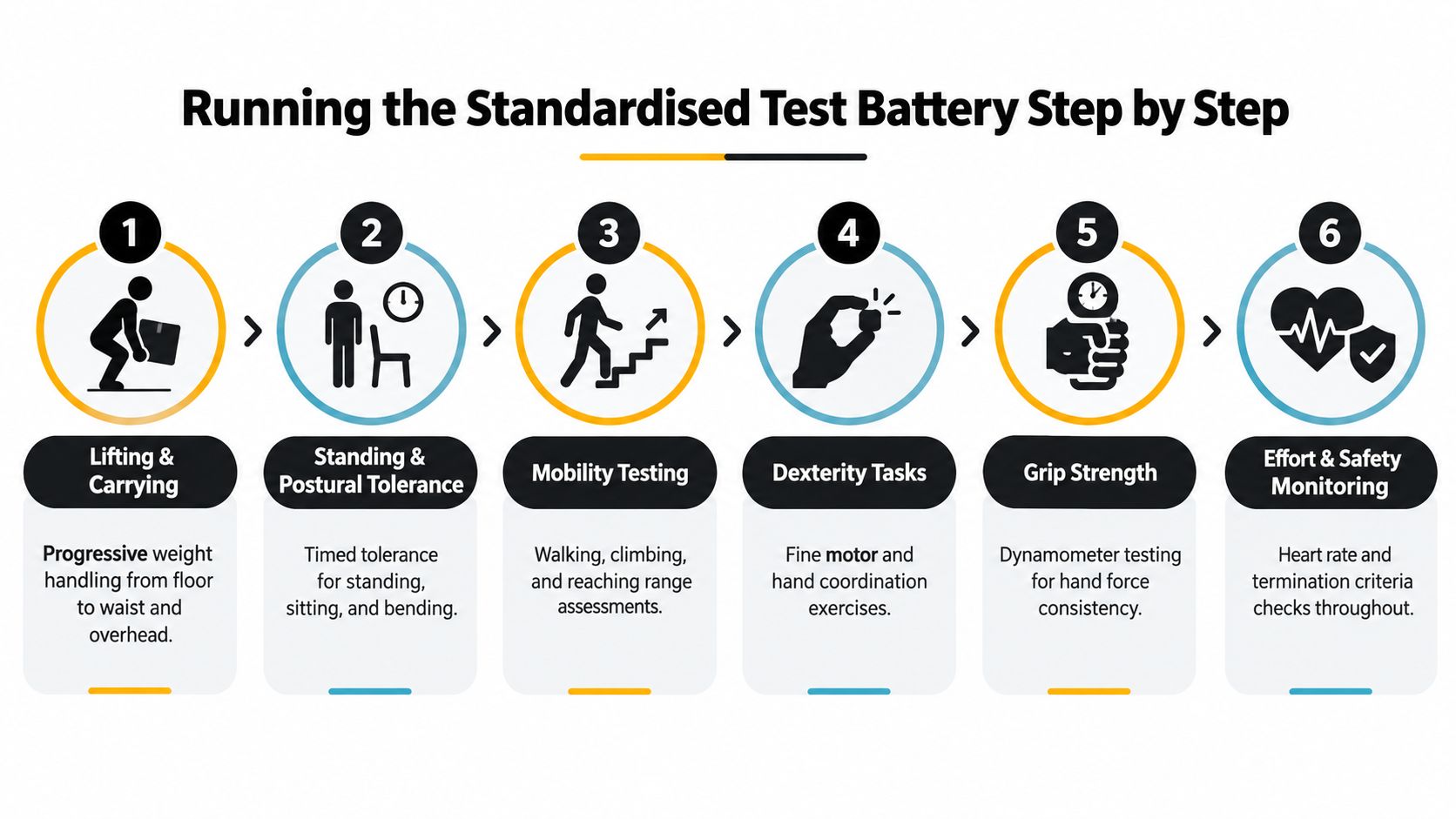
A defensible battery resembles the referral role and applies one clearly defined protocol to each participant. It is a task-matching assessment, not a pass or fail fitness test. Sequence tasks to manage fatigue, limit carryover between stations and preserve the evaluator's view of technique. The findings should show what work the person can perform safely, under which conditions, and where reasonable adjustments may be needed.
Begin with movement and postural tasks
Start with mobility, walking tolerance, reaching and positional control before heavier loading. Record movement quality as well as completion. Trunk substitution, asymmetry, balance, pace, recovery and changes after repeated exposure may identify limits that a simple completion score misses.
Link standing, sitting, bending and kneeling to the work description. Prolonged standing has a different occupational meaning from alternating between a workstation and brief walking periods. Document the position, duration, symptoms, observed adaptations and reason for stopping. That detail supports a practical recommendation rather than a generic statement about tolerance.
Progress through lifting and carrying
Reproduce the relevant work heights and directions. Floor-to-waist lifting may expose a different restriction from waist-to-overhead handling. Carrying adds distance, grip, gait and trunk-control demands. Increase the load only after the preceding level is completed safely, without unacceptable substitution or a change in the agreed technique.
Record the load, height, repetitions or duration, technique, symptoms and termination reason. “Could lift” does not define a work capacity. “Completed the task with a neutral load path and stopped after symptoms increased” is more useful, provided it matches the observation. The report should distinguish measured performance from the examiner's interpretation.
Measure grip with a defined technique
Grip strength varies with handle position, posture, instruction, familiarisation, hand dominance, pain and rest. A UK NHS Southampton procedure using a JAMAR dynamometer specifies that three measurements are recorded for each hand, with sides alternated between trials. Alternating sides reduces the risk of systematically fatiguing one hand before its final trials.
Record the device, posture, handle setting, side, trial sequence and any pain or inconsistent effort. Interpret grip alongside the job demands. Repetitive tools, sustained pinch, wrist deviation and whole-arm loading may remain limiting even when a single grip result appears acceptable.
Add aerobic assessment when the role requires it
Include aerobic testing when cardiovascular endurance relates directly to the role, such as emergency response, sustained walking, stair work or physically demanding shifts. The Chester Step Test is a progressive, sub-maximal test originally designed for workplace medico-fitness screening. The protocol starts at 15 steps per minute, increases by 5 steps per minute every 2 minutes, records heart rate and Borg RPE at each stage, and typically stops at 80% of age-predicted maximum heart rate or an RPE of 14, with a maximum duration of 10 minutes. The Chester Step Test protocol sets out these requirements.
Use a low step with a metronome or audio track. Heart-rate responses estimate VO₂max rather than measure it through direct gas analysis, as described in the Chester Step Test method. A Chester Step Test Kit consists of a step at the desired height and calculation software. A separate heart-rate device, including a Polar H10 Heart Rate Strap, can also be purchased. Test credits expire one year after purchase, and each calculated test uses one credit, according to the linked product information.
Stop for the pre-agreed clinical or safety criteria, not because the participant has reached a planned stage. Record the stage completed, heart-rate response, perceived exertion, symptoms, recovery and termination reason. The output informs task matching and possible adjustments. It does not, by itself, establish whether someone will sustain every aspect of a shift.
Include psychosocial context without over-interpreting it
Physical performance does not explain every work barrier. Where psychosocial factors are relevant, validated psychological screening may sit alongside objective measures, observation and clinical judgement. Screening should guide assessment and rehabilitation discussions, not serve as a shortcut for judging credibility.
| FCE Component | What It Measures | Example Job Demand Link |
|---|---|---|
| Lifting and carrying | Safe handling capacity, technique and tolerance | Stock movement, equipment handling |
| Postural tolerance | Ability to sustain or change position | Standing work, low-level tasks |
| Mobility | Walking, reaching, climbing and movement control | Site access, stairs, field duties |
| Dexterity | Fine motor control and coordination | Tool use, keyboard or component handling |
| Grip strength | Hand force consistency across trials | Handles, tools and load control |
| Aerobic capacity | Sub-maximal cardiovascular response | Sustained movement or emergency work |
Scoring Interpreting and Understanding the Limits
Scoring starts with accurate description. The evaluator should record the maximum safe capacity, the task conditions, the observed technique and the reason the task ended. A result isn't meaningful if the report omits whether the person stopped because of pain, fatigue, balance, cardiovascular response, unsafe mechanics or a pre-agreed limit.
Separate the result from the conclusion
A useful record distinguishes four elements:
- Maximum safe capacity: The highest load or duration completed safely without unacceptable substitution.
- Termination reason: The specific reason the task stopped, rather than a generic “unable”.
- Effort indicators: Consistency across trials, movement behaviour, heart-rate response and recovery.
- Decision limit: The extent to which the result answers the referral question, without extending it into future prediction.
The Valpar Joule FCE reliability study found intraclass correlation coefficients above 0.90 for determining the last safe weight lifted in forceful tasks. It also found 97.2%–100% agreement for test-termination reasons and 97.2%–98.6% agreement for identifying maximum safe capacity. Those findings are reported in the Valpar Joule FCE reliability study, but the same study found only 8.3%–50% full agreement when raters identified the last weight safely lifted in forceful tasks.
That contrast is operationally important. A protocol can be well defined while examiner judgement remains variable, especially when assessing poor body mechanics. Raters with different training and experience may reach different conclusions about whether a movement is unsafe.
Reliability isn't predictive validity
A repeatable result isn't the same as a forecast. The broader evidence base contains methods with stronger reliability than predictive validity, so a “pass” shouldn't be treated as a guarantee of sustained work ability. The test describes performance under defined conditions on the assessment day. It doesn't establish that the person will tolerate every shift, every variation in workload or every future exposure.
Interpretation boundary: An FCE should answer what the person demonstrated safely, under which conditions, and how that compares with the job. It shouldn't claim more than the protocol can support.
Age, sex, health status, work history and job exposure may provide context, but they shouldn't be used as substitutes for job-specific analysis. Reassessment is appropriate when health status, duties, rehabilitation progress or workplace demands change materially. It may also be appropriate when the original assessment had poor standardisation or didn't include an essential task.
Reporting Results and Planning Return to Work
A report earns its value by answering the referral question in language that managers, clinicians and employees can act on. It should begin with the purpose of the assessment, the job information supplied, the tests completed and any relevant limitations on interpretation.
Translate performance into tasks
The report should state what the person demonstrated, what they couldn't safely demonstrate and what conditions affected the result. Recommendations should connect directly to job demands:
- Task matching: Identify duties that fit the observed capacity and duties requiring modification.
- Reasonable adjustments: Consider changes to load, height, pacing, equipment, posture, breaks or task rotation.
- Graded return: Specify a staged increase in exposure, with review points linked to function rather than an arbitrary label.
- Employer liaison: Confirm which essential tasks remain unchanged and which can be temporarily adapted.
A report shouldn't say only “fit” or “unfit”. A more defensible conclusion describes the task, the observed limit, the evidence supporting it and the assumptions made about frequency, work rate and recovery. If the job description is incomplete, that limitation belongs in the report.
Make review conditions explicit
A graded return plan needs practical controls. The report may recommend starting with selected duties, monitoring symptom response and reviewing performance after an agreed period of work exposure. It should also identify what would trigger earlier review, such as a material change in symptoms, duties or workplace setup.
FCE findings can support a wider medical or legal process, but they shouldn't be confused with a final medical conclusion. For readers working across rehabilitation, claims or medico-legal contexts, an MMI guide for personal injury provides useful context for distinguishing functional findings from broader questions about recovery status.
The employee should receive an explanation of the findings in accessible language, while the employer receives task-focused recommendations that respect confidentiality. The strongest report supports a conversation about safer work design, not a judgement about personal worth or future employability.
Quality Control Tips and Equipment That Improves Repeatability
Repeatability depends more on disciplined practice than on buying a larger equipment list. The service needs written standard operating procedures, defined examiner training, consistent demonstrations and a clear method for recording deviations.
Calibration and maintenance should be scheduled for every instrument that affects interpretation. Dynamometers need consistent posture and trial order. The NHS Southampton JAMAR procedure's alternating-side approach provides a useful model for documenting repeated hand-grip measurements rather than relying on a single reading.
Heart-rate monitoring is equally important when a sub-maximal aerobic test is included. The practitioner should verify signal quality, stage timing and recorded RPE, then use calculation software to reduce transcription errors. A calculation tool doesn't remove clinical responsibility, but it can protect the arithmetic and make the audit trail easier to follow.
Common failures to remove
- Inconsistent stopping rules: Agree pain, fatigue, cardiovascular and safety limits before testing.
- Unclear mechanics judgement: Train assessors with shared examples and documented decision criteria.
- Poor task simulation: Match load height, distance, posture and repetition pattern to the actual role.
- Incomplete records: Capture conditions, observations, symptoms, rest periods and termination reasons.
- Overconfident conclusions: Keep current demonstrated capacity separate from predictions about future work tolerance.
Professional services can review functional capacity evaluation equipment alongside their protocol, software and training needs. Cartwright Fitness supplies assessment equipment and software for aerobic fitness, VO₂ assessment, dynamometry, body composition, metabolic testing, functional fitness and occupational fitness, while its Cartwright Assess platform is being developed to support standardised testing, result calculation, assessment histories and professional reports.
Cartwright Fitness can help occupational health and performance teams source professional equipment, Chester Step Test resources, dynamometry and assessment software for a more repeatable FCE service. Visit Cartwright Fitness to review the relevant measurement solutions and build a testing setup aligned with real workplace demands.


