

You've got the quote request open, three tabs full of product pages, and a procurement team asking which test kit belongs in the clinic, lab, or wellness van. That's where most buyers get stuck, because fitness assessment tools look similar on paper and behave very differently in the field. A step test, a body composition analyser, and a metabolic cart can all be “professional,” but they solve different problems, for different users, under different levels of standardisation.
The smart move is to stop asking which device sounds most advanced and start asking best for what, for whom, and validated against what. That's the lens here, and it matters whether you're outfitting an occupational health clinic, a university lab, or a corporate screening programme. If you're also trying to balance in-person and digital workflows, the discussion around hybrid tech-driven training insights is a useful companion because it shows how buyers are already mixing software, mobility work, and assessment data in one stack.
Table of Contents
- Why Choosing the Right Fitness Assessment Tool Is Harder Than It Looks
- The Five Measurement Domains Every Buyer Should Know
- Cardiorespiratory, Body Composition, and Strength Tools Compared
- What Validation Really Means for Fitness Assessment Tools
- Matching Tools to Clinicians, Trainers, and Researchers
- When a Simpler Tool Beats the Most Instrumented Option
- A Procurement Checklist Buyers Usually Forget
- Building a Validated Workflow That Survives Contact With Reality
Why Choosing the Right Fitness Assessment Tool Is Harder Than It Looks
A clinic manager can walk into a catalogue thinking the decision is simple, then end up staring at a wall of step tests, analyzers, dynamometers, and software platforms that all claim to be “professional-grade.” That's usually the moment the wrong purchase gets made. The product looks capable, the brochure looks polished, and the sales pitch skips the part where the tool has to fit a real workflow.
The real problem is fit, not feature count
A grip dynamometer makes sense for a workplace screen. A metabolic cart makes sense in a lab where you care about precise energy expenditure. A body composition analyser might be ideal for a clinic that needs repeatable trend data, but useless if you can't cleanly move patients through it or export the results.
That's why the historical spread of school-based testing matters. A 2022 review found that 16 states mandate school-based physical fitness testing, 10 states make the data public, and 62% of states report results to students, parents, or principals at the school level, while 6.3% do not share results at all, which shows that these tools aren't niche gadgets, they're part of public-health infrastructure used at scale (U.S. school-based physical fitness testing review). The same review found that 92% to 100% of states used the pacer/mile, curl-up, and push-up tests, which tells you something blunt, standardisation wins when the goal is broad comparison.
Practical rule: buy for the population and the protocol first, then the device.
One buyer, three different answers
A university lab, an OH provider, and a personal training studio can all buy the same product category and still need different specifications. The lab wants raw data and criterion alignment. The clinic wants repeatability, cleaning, and support. The trainer wants fast setup and client-facing reporting.
Mayo Clinic's framework is a good reminder that fitness assessment isn't one thing, it spans aerobic fitness, muscle strength and endurance, flexibility, and body composition (Mayo Clinic fitness assessment overview). Once you accept that, the procurement question gets much clearer. You're not buying “a fitness test.” You're buying a measurement decision with a workflow attached.
The Five Measurement Domains Every Buyer Should Know
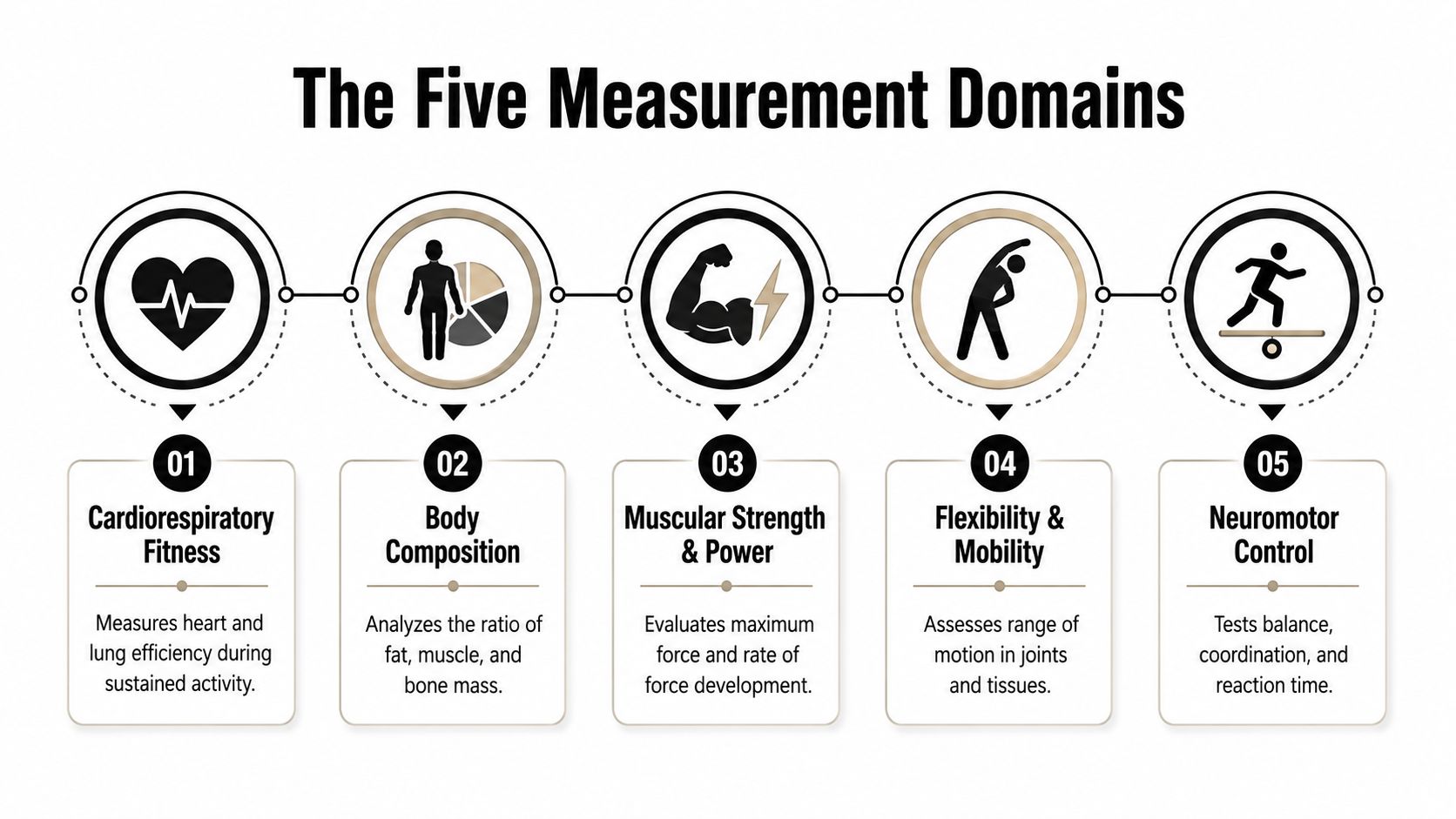
If a product does not fit a measurement domain, it does not belong on your shortlist. Buyers get into trouble when they confuse the instrument with the question. A field test, a scanner, and a lab device can all produce numbers, but they answer different questions and serve different users.
The core issue is fit, not feature count
Cardiorespiratory fitness forms the foundation of assessment capability. If this domain is weak, the rest of the profile is harder to interpret. Tools here include step tests, walk tests, heart-rate monitors, and metabolic systems, and the main question is how well the heart and lungs sustain activity.
Mayo Clinic gives age- and sex-specific push-up and 1.5-mile run benchmarks, such as 25-year-old women performing 20 push-ups and men 28 push-ups, or 35-year-old women performing 19 push-ups and men 21 push-ups (Mayo Clinic fitness assessment overview). A healthy adult resting heart rate is typically 60 to 100 beats per minute. That matters because this domain is built around standards, not guesswork.
Body composition provides the structural framework for interpretation
Body composition gives you the structural framework that sits under the rest of the system. If you are wrong here, every other reading gets harder to interpret. This domain includes BIA scales, skinfold calipers, ultrasound systems, and DEXA, and buyers need to decide whether they want a trend tool or a criterion tool.
For gym use, repeatable trend data may be enough. For research or high-stakes clinical decisions, you need stronger alignment with criterion methods. A practical primer is the internal how to measure body composition guide, and a more detailed body composition guide for lifters is also useful if you are comparing methods for a training population.
Muscular strength and power drive the output
This domain covers the tools that show how much force someone can produce and how quickly they can produce it. Grip dynamometers, vertical jump platforms, and pull-up protocols all belong here. The question is whether you need maximum force, rate of force development, or a quick proxy for general strength.
Flexibility and mobility determine usable range
Flexibility and mobility tell you how far the body can move without compensation. Sit-and-reach, goniometry, and task-based mobility screens belong here. These tools are most useful when movement quality matters more than maximal output.
Neuromotor control governs balance and coordination
Neuromotor control covers balance, coordination, and reaction time. If the athlete cannot control direction, the rest of the data can mislead you. The infographic above labels this domain clearly, and that is useful because balance and coordination should be treated as their own category, not folded into a vague general fitness label.
Cardiorespiratory, Body Composition, and Strength Tools Compared
The worst buying errors show up in these three domains because they look familiar. A step test, a body composition device, and a strength tool can all perform well, but only if the protocol fits the setting and the user can run it the same way every time.
Cardiorespiratory tools need the right use case
A step test is the right call when you need repeatable, low-cost field screening. The Chester Step Test was built for that kind of setup, and Cartwright Fitness sells the related Chester tools, including the calculator and platform components, for a practical test workflow. For a broader field protocol, the 6-minute walk test fits clinical and rehab settings where walking capacity says more than maximal exertion.
At the lab end, indirect calorimetry with a metabolic analyser is the precision choice. The National Collaborative on Childhood Obesity Research lists direct observation, doubly labeled water, and indirect calorimetry as criterion methods, while monitors such as heart-rate devices and accelerometers give objective field data that still sit below criterion measurement (NCCOR overview of physical activity assessment tools). That trade-off is the whole purchase decision, stronger signal usually brings more cost and more workflow.
Body composition is where buyers overspend on the wrong promise
A BIA scale is convenient, but convenience is not criterion precision. Skinfold calipers can work well in trained hands. Ultrasound adds another layer of information, and DEXA sits at the criterion end of the category. The right purchase depends on whether your team needs fast tracking, coaching feedback, or defensible clinical and research numbers.
If you are buying for a lifter population, the body composition guide for lifters is useful because it forces the question of what change matters from one retest to the next. That is the procurement mindset buyers skip too often. For a practical internal starting point, the how to measure body composition guide lays out the method choices without dressing them up.
Strength and power tools should match the population
A handgrip dynamometer is a workhorse. It suits workplace screening, frailty screening, and quick clinical trend checks. A vertical jump platform fits better when power matters, and pull-up or jump protocols belong in athletic settings where you need more dynamic output.
The point is not that one tool is superior. It is that each tool works only when the measurement question is tight.
| Common fitness assessment tools by domain and intended setting | |||
|---|---|---|---|
| Tool Category | Domain | Validation Level | Best Suited For |
| Chester Step Test and walk tests | Cardiorespiratory fitness | Field validated | Occupational health screening, group monitoring |
| Metabolic analyser | Cardiorespiratory fitness | Criterion | University labs, exercise physiology, clinical testing |
| BIA scale | Body composition | Field based | Coaching, trend tracking, low-burden screening |
| DEXA | Body composition | Criterion | Research, clinical decisions, high-precision baseline work |
| Handgrip dynamometer | Strength | Field validated | Workplace screening, rehab trend data |
| Jump platform | Strength and power | Field and performance oriented | Sport settings, athletic profiling |
Cartwright Fitness also lists validated brands such as Omron, Seca, Roche, Takei, and Cosmed. That is a factual signal about the supplier's inventory, not a guarantee of fit for every buyer. The decision still depends on calibration, software, support, and whether the device matches the setting.
What Validation Really Means for Fitness Assessment Tools
The word validated gets used so loosely that buyers stop asking what kind of validation they are paying for. That is a bad habit. A tool can be useful without matching a gold standard, and it can also be consistent without being accurate.
Criterion validity is the real benchmark
Criterion validity means a tool is compared against a stronger reference method. In practice, that means the reference is the standard you trust more, not just another field test with similar output. The buyer needs to know whether the device is being judged against direct observation, doubly labeled water, indirect calorimetry, or another accepted reference, because a match with a different test is not the same thing as agreement with a criterion. The distinction matters, and the criterion validity guide from Cartwright Fitness is a clear starting point for the term.
A common mistake is treating correlation as proof. Two tests can rise and fall together and still disagree on the actual value you need for a decision. That matters when you are buying for screening, baseline assessment, or outcome tracking.
Reliability is about consistency, not truth
A tool can repeat itself neatly and still be wrong. That is why test-retest reliability matters, along with standard error of measurement and limits of agreement. The practical question is simple, repeated use must give you enough stability to trust a change score.
A peer-reviewed study of real-world sport and occupational tests found that the modified Harvard step test, handgrip test, vertical jump, pull-ups, and 60-second jump test were reliable across time, while the dynamic balance test was not. The same study also reported learning effects for the Harvard step and 60-second jump tests, and limits of agreement that made small individual changes hard to detect (real-world fitness test reliability study). That is the part buyers ignore at their peril. A test can rank groups well and still be weak for detecting small improvements in one person.
Vendor question to ask: “Show me the criterion reference, the test-retest data, and the limits of agreement for the exact protocol I will use.”
If the question is whether a protocol has been studied against a meaningful reference, the answer should be direct and specific. If the seller cannot explain how the cited method matches your population, your staff, and your decision threshold, do not sign the purchase order yet.
The same caution applies to specialist screening tools. A clinic looking at posture or spinal screening should examine the method behind the claim, not just the marketing around it. The PosturaZen Adams test analysis is useful here because it shows why protocol, interpretation, and the limits of automation all matter more than the label on the device.
Validation claims need population and protocol context
The same device can be solid in one setting and shaky in another. Protocol changes, unfamiliar testers, and weak familiarisation all distort the result. Buyers should ask whether the validation study matches their own population, their own workflow, and their own decision threshold.
A machine tested in trained adults under controlled conditions does not automatically earn the same confidence in an occupational clinic, a university lab, or a busy coaching floor. Ask who was tested, how the test was run, and what decision the study was meant to support. That is the true test of whether the validation claim means anything for your purchase.
Matching Tools to Clinicians, Trainers, and Researchers
A single device category can serve three buyers and still need three different specs. That's why generic “best tools” lists fail. A body composition analyser in a rehabilitation clinic is not the same purchase as one in a sports science department.
Clinicians and occupational health teams need repeatability and integration
Clinicians care about hygiene, repeatability, and whether the result can land cleanly in the record. They also care about consumables, service response, and whether the software exports in a usable format. If the device doesn't fit the clinic's data flow, it creates more work than it saves.
For this buyer, a 6-minute walk test setup, grip dynamometer, or BIA device can be perfectly sensible if the protocol is stable and the outputs are easy to store. In older or medically complex populations, more targeted tools often beat a broad battery because they reduce burden and confusion.
Trainers need portability and speed
A trainer doesn't usually need the most instrumented device. They need something they can set up fast, explain in plain language, and repeat with minimal friction. A step test, jump test, or portable body composition device often works because it's easy to deploy and easy to sell to clients.
That's also where software matters. Cartwright Fitness's fitness assessment software is relevant because it's built to help professionals gather, analyse, and track movement quality and body composition data for planning. In a coaching setting, the buying question is simple, does the tool improve the conversation with the client, or just add another screen to stare at?
Researchers need protocol fidelity and raw data
University labs don't get to hide behind convenience. They need criterion validity, raw data export, and the ability to run established protocols without improvising the test on the fly. If the product can't support a Chester Step Test, a submax protocol, or a lab-standard assessment flow, it doesn't belong in a research purchase.
Lab rule: if the software hides the raw signal, the lab has bought a reporting layer, not a measurement tool.
Buying gets serious. The same analyser can be a good coaching device and a bad research device, or a perfect research device and an awkward clinic fit. The right answer depends on who is going to touch it every day.
When a Simpler Tool Beats the Most Instrumented Option
The most instrumented option is not always the right one. In fact, it often isn't. In occupational health, corporate wellness, and large-cohort monitoring, the best tool is usually the one staff will use the same way every time.
Digital tools are useful when they stay within their lane
A major underserved area is remote delivery, and the current evidence points in a useful direction. A review of fitness apps found that SA-6MWTapp had the best validity against a criterion measure at r = 0.88, while InterWalk showed the highest test-retest reliability with an ICC of 0.85 to 0.86 (systematic review of digital fitness assessment apps). Those are strong signals, but they don't mean every app is reliable or valid. They mean some apps are getting close enough to deserve a place in a mixed workflow.
Smartphone computer vision has a real role
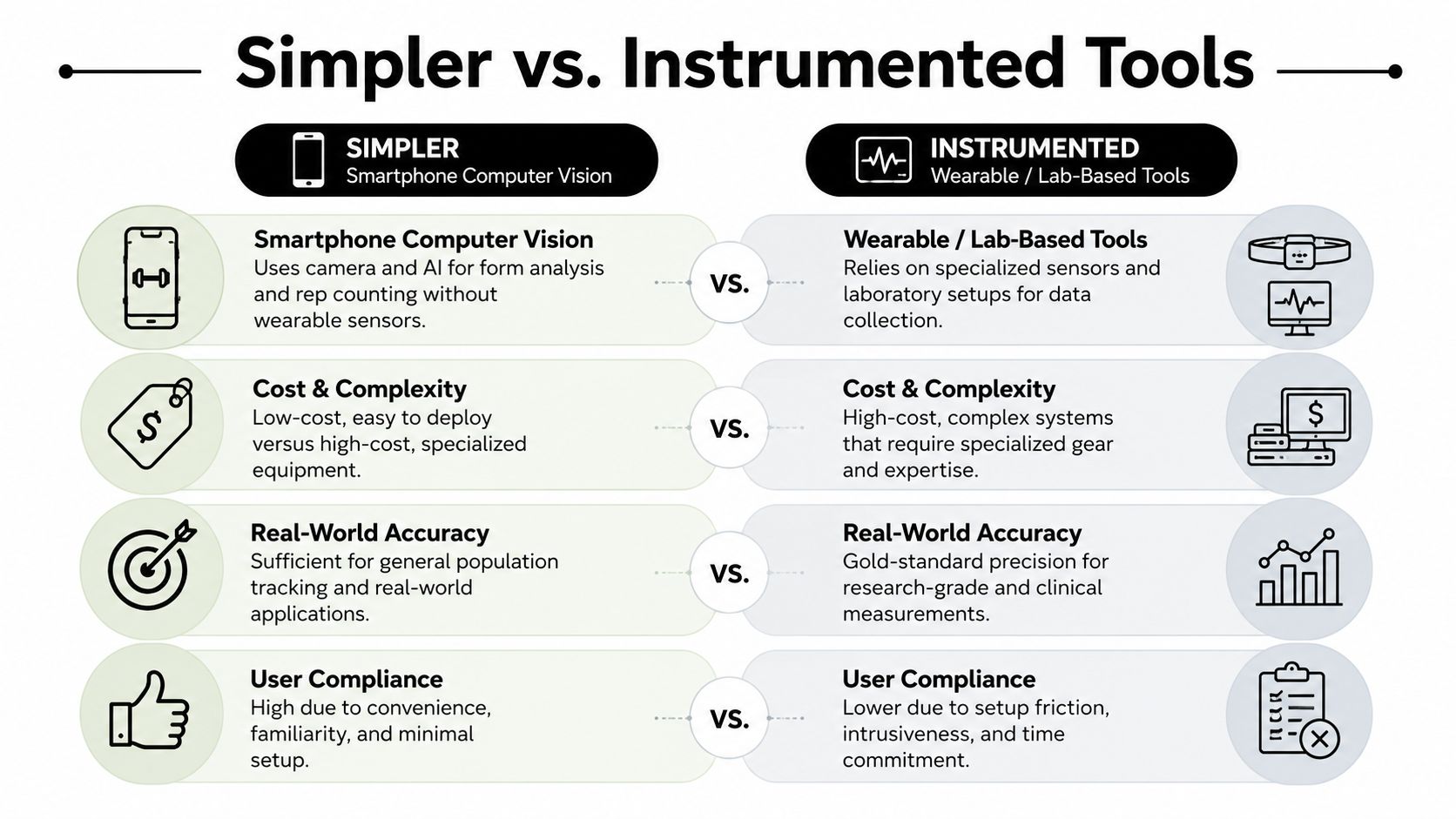
Recent evidence also shows that smartphone-based computer vision can produce excellent validity for static balance assessment and strong agreement for repetition counting. That's useful because it opens low-cost monitoring for rehab, occupational screening, and distributed wellness programmes without forcing every site into lab-grade hardware. The advantage is not novelty, it's access.
The right call is often to use a simpler tool for the first pass, then reserve criterion equipment for the cases that need deeper scrutiny. More sensors do not automatically produce better data. If the protocol is sloppy, the expensive device just gives you expensive slop.
Where simple wins
- Large groups: a standardised field test is easier to repeat than a lab device that needs special setup.
- Remote sites: smartphone-based assessment can outperform a rarely used instrument because people will use it.
- Budget-limited programmes: low-friction tools keep the workflow alive instead of sitting in storage.
The point isn't to downgrade precision. It's to stop pretending that the fanciest device is always the smartest purchase.
A Procurement Checklist Buyers Usually Forget
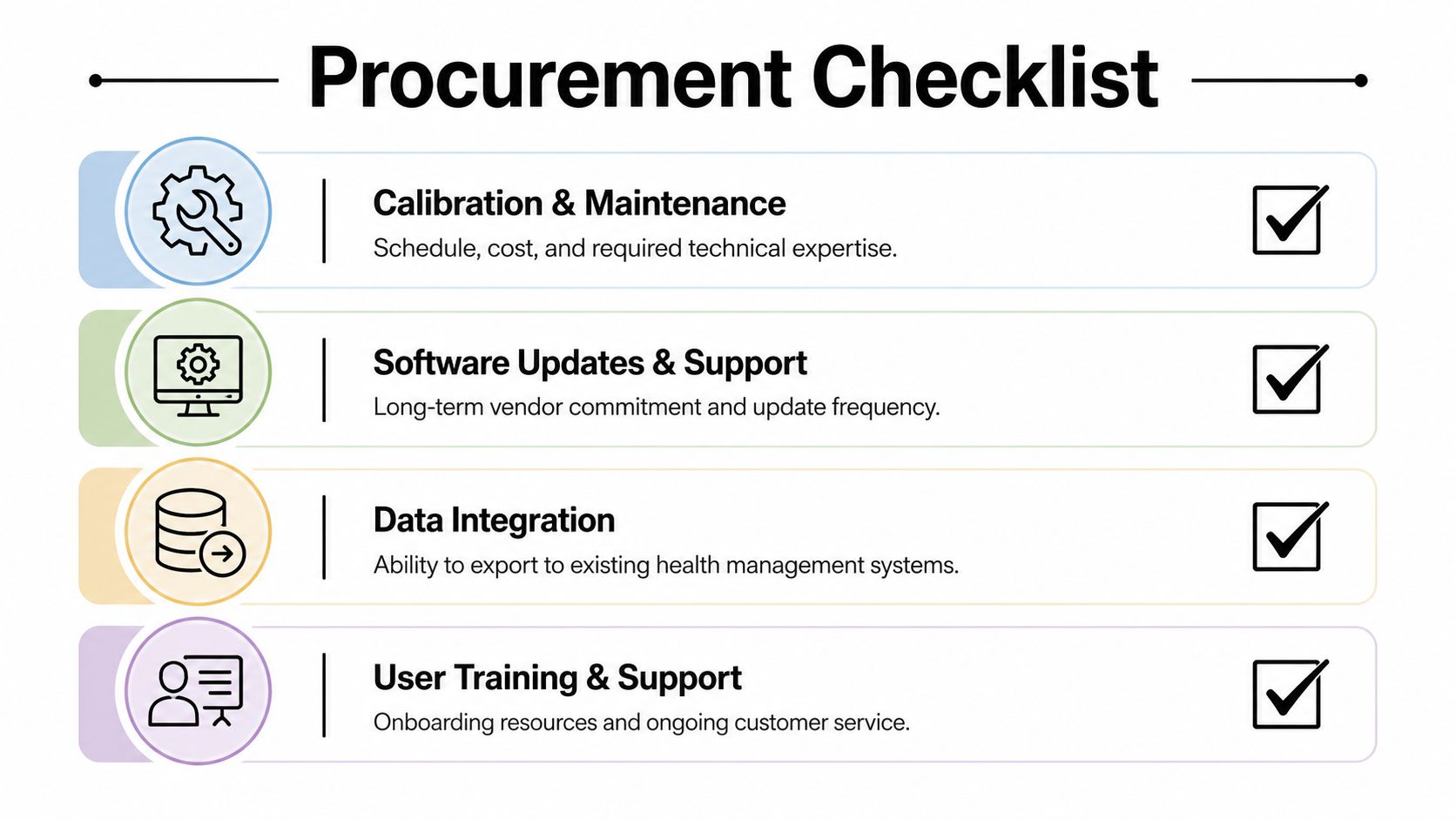
Accuracy gets the attention because it's easy to talk about. The ugly parts of ownership are what decide whether the device is still useful in year two. Calibration, software, consumables, and support determine whether your team keeps trusting the tool.
Check the hidden ownership costs
Ask whether calibration is handled locally or by shipment. Ask what consumables you'll be buying, because mouthpieces, electrodes, printer paper, gel, and gas cylinders can become ongoing friction. Ask whether software updates are included or sold separately.
Demand data compatibility
A device that won't export cleanly is a future headache. Ask about CSV, HL7, and FHIR support if you need to move data into existing systems. If the system only works inside the vendor's closed dashboard, you're renting convenience and losing control.
Make support part of the purchase
Training matters. Warranty terms matter. In-house product support matters. A specialised supplier should be able to explain setup, upkeep, and protocol usage, not just ship a box and disappear.
Cartwright Fitness's model is useful here because it's built around calibrated tools, consumables, and product expertise rather than generic ecommerce. Their catalogue sits closer to a service-led equipment partner than a commodity reseller, which is what serious buyers usually need.
If you want the commercial side of this relationship to be cleaner, the internal note on vendor relationship management is worth keeping nearby during procurement. The right vendor doesn't just sell the device, they help you keep the measurement system alive.
Procurement filter: if the vendor can't explain calibration, service intervals, software licensing, and consumable supply in one conversation, keep shopping.
Building a Validated Workflow That Survives Contact With Reality
A solid workflow beats a flashy purchase. Start by defining the use case, then shortlist two or three validated tools per domain, not ten. Pilot them with familiarisation sessions, because learning effects can distort early results, especially on physical tests.
After the pilot, lock the protocol. Keep the tester, warm-up, order, and reporting template consistent. Mix criterion methods like indirect calorimetry or ultrasound with field tools like the Chester Step Test or grip dynamometry only when the battery makes sense for the population and the decision you're trying to support.
The rule is simple. The right fitness assessment tools match the population, the protocol, the validation question, and the support infrastructure. Brand name matters less than whether the data can survive real use.
If you're comparing options for an occupational clinic, university lab, or performance programme, Cartwright Fitness can help you source validated assessment equipment, software, and consumables that fit a real testing workflow. Visit Cartwright Fitness to review the catalogue, check the protocols you need, and talk through the setup before you buy.


