

You've probably been in this spot already. A new clinic room is finally ready, a performance corner in the gym has been approved, or an existing rehab service wants to add testing. Then the equipment decisions start. One supplier pushes a metabolic cart. Another insists body composition is the best first investment. A third wants to sell an all-in-one system that sounds efficient until you ask how it's calibrated.
That's where most buyers get stuck. Not because they can't compare specifications, but because specifications alone don't answer the practical questions. Which tools will improve decision-making? Which ones fit your workflow? Which purchases will earn their keep in a private clinic, rehab setting, or performance centre rather than sit underused in a corner?
The timing makes the question more urgent. The global fitness equipment market was valued at USD 36.37 billion in 2025 and is projected to reach USD 50.27 billion by 2031, with a CAGR of 5.53% from 2026 to 2031. More products are entering the market, not fewer. That creates more choice, but it also creates more noise.
Good exercise science equipment solves a measurement problem. Great exercise science equipment solves it reliably, fits the population in front of you, and produces data your staff can explain with confidence.
Table of Contents
- Your Guide to Navigating the World of Exercise Science Equipment
- The Foundations of Measurement Validity and Reliability
- A Guided Tour of Key Equipment Categories
- How to Select the Right Equipment for Your Setting
- Beyond the Purchase Calibration and Quality Assurance
- Bringing Data to Life With Protocol Examples
- The Business of Equipment ROI Training and Implementation
Your Guide to Navigating the World of Exercise Science Equipment
A new colleague once asked me what the “best” exercise science equipment package looks like for a small facility. The honest answer was frustrating but useful. There isn't one package. There's only the package that matches your clients, your staff skill, your testing goals, and your tolerance for maintenance.
A private physiotherapy clinic doesn't need to buy like a university laboratory. A sports performance centre shouldn't buy like a cardiac rehab unit. A strength coach who needs fast repeat testing between training blocks values different features than a clinician tracking gradual recovery after surgery.
That's why broad buying guides often miss the mark. They read like product catalogues. Real facilities don't run on product categories alone. They run on appointment lengths, staffing levels, cleaning routines, calibration habits, software compatibility, and whether the data changes what you prescribe that same day.
Start with the question, not the device
The right starting point is simple: what decision are you trying to improve?
If the answer is exercise prescription, a metabolic system or a validated submaximal testing setup may matter most. If the answer is rehabilitation progress, body composition or force asymmetry data may have more day-to-day value. If the answer is screening large groups efficiently, speed and repeatability usually matter more than owning the most advanced hardware in the room.
A practical shortlist usually comes from four filters:
- Population fit: Athletes, older adults, post-operative patients, and general fitness clients don't tolerate the same testing burden.
- Operator fit: Some systems need experienced hands every session. Others are much harder to misuse.
- Workflow fit: If setup takes too long, staff will skip it.
- Business fit: If the data doesn't support a billable service, better retention, or better programme design, the investment is harder to defend.
Buy the tool that answers your most common question well. Don't buy the tool that only shines in your rarest scenario.
The Foundations of Measurement Validity and Reliability
Before you compare brands, compare measurement quality. Most mistakes in exercise science equipment buying happen because people confuse validity with reliability.
What those terms mean in plain language
Think about a kitchen scale. If it shows the same wrong weight every morning, it's reliable but not valid. If it gives a different reading every time you step on it, it may occasionally land near the truth, but it isn't reliable enough to guide action.
That same distinction applies in a lab, clinic, or performance setting.
- Validity asks whether the device measures what it claims to measure.
- Reliability asks whether it gives consistent results under the same conditions.
You need both. A consistent bad measure is still bad. An accurate tool that can't repeat itself is just as problematic.
For body composition, professionals distinguish professional instruments from consumer gadgets. Multi-frequency BIA systems such as the Bodystat Quadscan 4000 operate at multiple frequencies and report a coefficient of variation under 1.5% for lean mass, which is a strong marker of reliability according to HAB Direct's physiology lab equipment overview.
Why practitioners should care
If you're tracking rehab progress, the value isn't just the reading itself. The value is knowing whether a change over time is likely to be real. That depends on reliable measurement conditions, repeatable setup, and operator discipline.
This matters in simple tools too. Anyone who's worked with skinfolds or anthropometry knows that technique changes the outcome. That's why practical resources on mastering accurate dial caliper measurements are useful even outside pure caliper work. They reinforce a wider point. Instrument handling is part of the measurement, not separate from it.
A good reliability mindset usually includes:
- Standardised preparation: Hydration, recent exercise, meal timing, and clothing all affect some measures.
- Consistent operator technique: Landmarking, electrode placement, and body position must be repeatable.
- Repeatable environment: Room temperature, time of day, and testing order can alter results.
- Documented procedures: If staff can't follow the same script, your data quality drifts.
For a concise practitioner-focused explanation of repeatable testing processes, assessment reliability in fitness testing is a useful reference point.
Practical rule: If two trained staff members can't produce similar results from the same protocol, the issue may be the process, not the client.
A Guided Tour of Key Equipment Categories
Most exercise science equipment falls into a few core families. Once you organise the options that way, procurement gets easier because you can see which devices answer which questions.
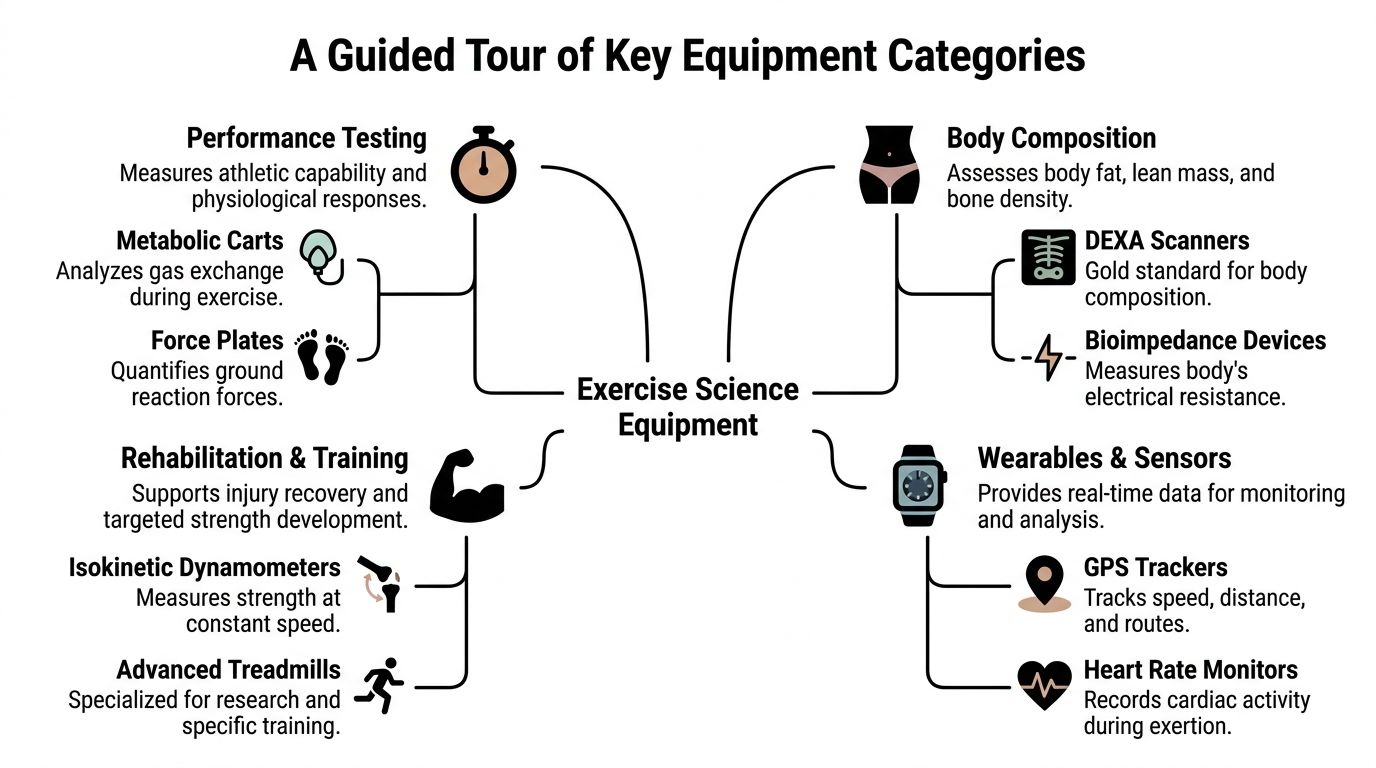
A broad catalogue of health assessment equipment for professional settings gives a useful sense of how these categories sit together in practice, from respiratory testing to body composition and field assessment tools.
Metabolic analysis systems
This is the category people picture first when they think of a sports science lab. Systems such as the Cosmed Quark CPET use breath-by-breath gas analysis to measure oxygen consumption. The device reports VO₂ accuracy of ±2%, supporting precise estimation of peak aerobic capacity according to the University of Virginia Exercise Physiology Core Laboratory equipment page.
In practice, metabolic systems are strongest when you need more than a generic fitness score. They help with:
- Aerobic profiling: Useful for identifying VO₂max and key training thresholds.
- Clinical exercise testing: Valuable where symptom-limited testing and close monitoring matter.
- Programme precision: Better zone setting than heart rate alone when the environment supports proper testing.
What doesn't work is buying a metabolic cart because it sounds advanced, then using it rarely because mask fitting, gas calibration, and protocol delivery exceed staff confidence.
Body composition tools
Body composition tools answer a different question. Not “how fit is this person right now?” but “what's changing in the tissues that matter?”
That's especially important in rehab, weight-management support, and athlete monitoring. Weight alone hides too much. A client can improve function, hydration status, or lean mass while scale weight barely moves.
Common tools include:
- Multi-frequency BIA systems for practical clinic use.
- Ultrasound-based body composition systems when you want more targeted tissue analysis.
- DEXA scanners in settings where gold-standard composition data justifies the operational demands.
The trade-off is straightforward. The more complex the system, the more important standardisation becomes. Hydration and testing conditions matter with BIA. Operator training matters with ultrasound. Throughput and access matter with DEXA.
Strength and force testing tools
Strength diagnostics often begin with something basic and progress toward something far more detailed.
Handgrip dynamometers, isometric rigs, force plates, and isokinetic dynamometers all sit in this family, but they don't serve the same purpose. A handgrip test is fast and practical. A force plate offers richer data on force production and movement strategy. An isokinetic dynamometer can isolate joint actions in controlled conditions, which is useful in return-to-play or targeted rehabilitation.
A short comparison helps:
| Equipment type | Best use | Main trade-off |
|---|---|---|
| Handgrip dynamometer | Fast screening | Narrow measure |
| Force plate | Detailed force profiling | Requires interpretation skill |
| Isokinetic dynamometer | Controlled joint testing | Cost, space, time |
The mistake here is assuming more detail is always better. If your staff can't explain the metric to the athlete or patient, the data won't change behaviour.
Field testing and monitoring tools
Not every useful measure needs a large machine. Some of the best exercise science equipment for real-world service delivery is portable.
This category includes step test kits, heart rate monitors, wearable sensors, timing gates, and practical blood pressure or physiological monitoring tools. These systems often deliver the strongest operational value because they're fast, repeatable, and easy to integrate into regular sessions.
That makes them particularly useful when you need:
- High testing volume
- Minimal setup
- Quick client feedback
- Low disruption to normal training or rehab flow
A portable tool that gets used well every week often delivers more value than a premium system that only comes out for demonstrations.
How to Select the Right Equipment for Your Setting
The same device can be an excellent investment in one setting and a poor one in another. That's why equipment selection should start with context, not aspiration.
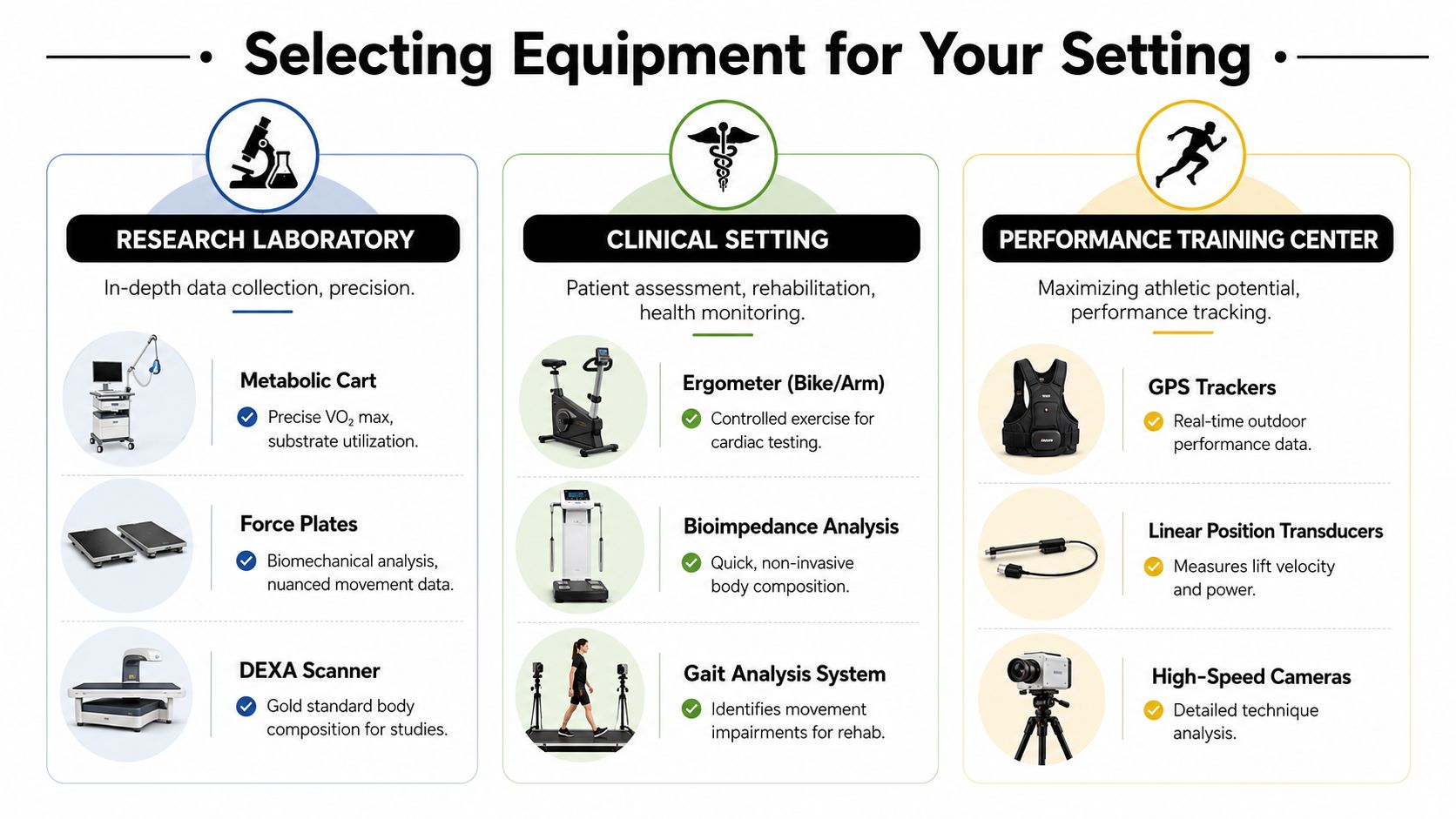
The workforce is also moving beyond traditional university or hospital models. Employment of exercise physiologists is projected to grow 9 percent from 2024 to 2034, which means more professionals will be making equipment decisions in mixed-use clinics, private studios, and performance facilities.
Clinical and rehabilitation settings
Clinical environments need reliability, patient tolerance, and low-friction operation. A test that's technically excellent but difficult for patients to complete isn't useful for routine care.
Good choices in this setting usually share three qualities:
- Low burden: Non-invasive tools with short setup times work better.
- Repeat tracking: The device must detect meaningful change over repeated appointments.
- Clear outputs: Clinicians need to translate the result into treatment decisions quickly.
Body composition tools, ergometers, blood pressure systems, and practical functional testing equipment often perform well here. Wearable comfort also matters more than many buyers expect. If you're using wrist-based monitoring with patients or mixed populations, even details like strap material affect compliance. That's one reason practical options such as Nothing But Bands' silicone collection can matter in day-to-day monitoring setups where devices are worn repeatedly and need to clean easily.
Academic and research environments
Research settings can justify complexity because the measurement question is narrower and the tolerance for setup time is higher. Validity, protocol flexibility, and clean data export matter more than testing speed.
Researchers usually need equipment that supports:
- exact protocol control
- stable calibration routines
- reproducible data collection
- integration with analysis workflows
Gold-standard or near gold-standard systems often make sense. Not because they're prestigious, but because the study question demands tighter control.
Performance centres and commercial gyms
Performance settings are different again. Coaches need data they can act on today. A test that takes too long, needs too many disposables, or creates bottlenecks won't survive a busy schedule.
In these environments, the strongest buying criteria are usually:
| Priority | Why it matters |
|---|---|
| Speed | Athletes and coaches need minimal downtime |
| Durability | Equipment gets frequent use |
| Actionable output | Results must change training decisions |
| Staff usability | Multiple team members may operate the system |
When managers compare options for a wider floor setup, a professional range of exercise equipment for commercial use helps show how testing tools need to sit alongside daily training hardware rather than disrupt it.
In performance work, the best system is often the one that gives a coach a clear answer before the warm-down starts.
Beyond the Purchase Calibration and Quality Assurance
Buying exercise science equipment is the easy part. Protecting the quality of the data is where professional standards show up.
A poorly maintained metabolic cart is like a piano that hasn't been tuned. It may still produce sound, but you can't trust the output. The same applies to body composition devices, blood pressure monitors, force systems, and any tool used to guide exercise prescription or clinical decision-making.
What daily quality assurance looks like
Quality assurance doesn't need to be elaborate, but it does need to be disciplined. In most facilities, it should include some version of the following:
- Pre-use checks: Confirm cables, sensors, consumables, and software connections before the first client arrives.
- Calibration routines: Follow manufacturer guidance for gas calibration, flow calibration, zeroing, or verification procedures.
- Operator logs: Record who performed checks, when they were performed, and whether anything drifted.
- Service scheduling: Book formal servicing before a problem forces downtime.
The important point is consistency. If you calibrate only when a result looks odd, you're already behind.
What usually goes wrong
In smaller facilities, quality failures tend to come from ordinary workflow shortcuts rather than dramatic breakdowns.
Common issues include:
- Skipping setup steps on busy days.
- Using different staff techniques without retraining.
- Running protocols that have slowly drifted from the original standard.
- Ignoring software updates or sensor wear until the device behaves unpredictably.
These errors rarely look serious in the moment. They just make your data less trustworthy over time.
If a reading influences treatment, training intensity, or return-to-play decisions, calibration is not admin. It's part of the intervention.
A good rule is simple. Any device important enough to advertise is important enough to quality-check.
Bringing Data to Life With Protocol Examples
The full value of exercise science equipment shows up when raw numbers become a practical decision. That's where many facilities either win trust quickly or lose it. An advanced tool means little if the person being tested leaves without understanding what happens next.
A practical VO₂max workflow
Take a standard ramp or staged exercise test with a metabolic system. The client is fitted with the mask, baseline checks are completed, and the protocol begins at an easy workload. From there, intensity rises gradually while you monitor gas exchange, heart rate, perceived exertion, symptoms, and movement quality.
The equipment provides the data stream, but the test only becomes useful when the operator interprets it in context. You're not just looking for peak effort. You're identifying how the person responds as work increases, where intensity becomes less sustainable, and whether the result supports a specific training or rehab prescription.
In clinical populations, cardiovascular rhythm and symptom monitoring can shape whether the test continues and how the output is interpreted. For readers who want a plain-language refresher on that side of monitoring, learn EKG interpretation with ProMed Certifications is a practical companion resource.
A strong test report usually answers three immediate questions:
- What did we measure? Peak capacity, threshold behaviour, exercise tolerance.
- What does it mean? Where the client currently sits physiologically.
- What should change? Training zones, progression pace, supervision level, or referral decisions.
A body composition review that changes coaching
Body composition is where communication matters most. If you hand someone a printout and circle body fat, you've wasted the assessment.
A better review looks at the result in relation to the goal. In a rehab case, lean mass preservation may matter more than total weight. In a weight-management case, stable scale weight with improved tissue profile can be a positive outcome. In athletic settings, the question is often whether the current composition supports the demands of the sport rather than whether it matches a generic ideal.
This is why a baseline and trend approach works better than one-off testing. Repeated measures under controlled conditions tell a story. One isolated result only starts the conversation.
Good testing doesn't just describe the body. It helps the client understand why the next phase of training or rehab should look different.
Later in the process, demonstration can help staff and clients see how structured assessment fits into a wider service model.
When a submaximal test is the better option
Not everyone needs maximal testing. In fact, many people don't.
Submaximal protocols are often the better clinical and operational choice for deconditioned clients, larger screening groups, or settings where risk, staffing, and time all need tighter control. A step test is a good example. It can provide a structured estimate of aerobic fitness, standardise effort across participants, and produce useful baseline information without requiring the burden of maximal gas analysis.
What matters is choosing the protocol that answers the referral question safely and clearly. In daily practice, the best test often isn't the most complex one. It's the one you can administer well, repeat consistently, and explain without confusion.
The Business of Equipment ROI Training and Implementation
The hardest part of buying exercise science equipment in a non-academic setting usually isn't technical. It's financial confidence. Owners and managers don't just ask whether a tool works. They ask whether it will justify the spend in the reality of a private clinic or performance service.
That hesitation is common. Recent 2024 to 2025 industry reports indicate that 68% of outpatient physiotherapy practices delay purchasing validated body composition tools because ROI projections are unclear, even though precision equipment improves patient adherence and outcomes by 22%. Those two facts tell you a lot. People often believe in the measurement. They just don't know how to model the business case.
What ROI really means in practice
In smaller settings, ROI usually comes from one or more of four places:
- New services: The equipment lets you offer assessments you couldn't provide before.
- Better retention: Clients stay engaged when progress is visible and credible.
- Stronger referrals: Clear reports give other professionals more reason to refer.
- Better decisions: Staff prescribe more precisely, which improves the client experience.
Not every tool needs to be a direct profit centre. Some earn their value by improving the quality and clarity of your core service.
Costs that buyers overlook
A lot of purchasing mistakes come from focusing on the hardware price alone.
The true investment often includes:
| Cost area | Why it matters |
|---|---|
| Consumables | Ongoing masks, electrodes, paper, or disposables affect margins |
| Training time | Staff need supervised practice before data is reliable |
| Software | Reporting, updates, licences, and compatibility shape long-term usability |
| Floor space | Large equipment can displace other revenue-producing activity |
Training is the most neglected of the lot. A precise device in untrained hands doesn't create premium service. It creates premium confusion.
What tends to work in smaller settings
The best equipment strategy for non-university environments is usually staged, not maximal. Start with tools that answer frequent questions, support repeat testing, and fit your staffing model. Add more complex systems when you already have demand, protocols, and operator competence in place.
That approach works particularly well for clinics and performance centres because it lowers implementation risk. Staff build confidence. Clients learn to value data-driven assessment. Reports become part of the service rather than an isolated add-on.
One pattern shows up repeatedly in good implementations. Facilities that get strong value from precision tools don't treat testing as a one-off event. They build it into the client journey. Baseline, review, progression, and retest are all planned from the start.
That's the commercial lesson many spec sheets never mention. Equipment pays back when it becomes part of a repeatable system of care or coaching, not when it only looks impressive on day one.
If you're comparing professional testing tools and want a supplier that understands both measurement quality and day-to-day implementation, Cartwright Fitness is worth a close look. Their range covers validated health and fitness assessment systems, from metabolic analysers to body composition and step test equipment, with practical support that suits clinics, performance facilities, and academic environments alike.