

Most advice on exercise equipment to lose belly fat starts with the wrong question. Clients ask which machine targets the abdomen. Marketers answer with ab benches, twist boards, vibration platforms, and core gadgets. The physiology doesn't.
No single machine reliably strips fat from one region on demand. Abdominal fat comes down when a client creates and sustains an energy deficit, trains consistently enough to keep total workload high, and preserves lean mass while body weight changes. That's the practical frame clinicians, coaches, and facility managers need. The machine matters, but only insofar as it helps the client accumulate useful work, tolerate progression, and keep showing up.
That distinction changes equipment selection. It also changes how outcomes should be judged. If a programme is built around slogans like “burn belly fat fast,” it usually ends up overvaluing novelty and undervaluing measurable training volume. If it's built around physiology, adherence, and valid assessment, equipment choice becomes much clearer.
That's also why broad consumer advice often feels unsatisfying in practice. Professionals don't just need a machine ranking. They need a decision model. They need to know which tools support sustained energy expenditure, where resistance and interval tools fit, and how to validate whether abdominal change is occurring. For a useful consumer-facing complement to this evidence-first approach, Lila's guide on strategies for belly fat reduction is a good example of how exercise and broader lifestyle habits need to work together rather than as isolated fixes.
Table of Contents
- Introduction The Truth About Abdominal Fat Loss
- The Physiology of Abdominal Fat Reduction
- Evaluating Cardio Equipment for Maximum Energy Expenditure
- The Strategic Role of Resistance and HIIT Equipment
- Designing Client Programs for Abdominal Fat Reduction
- Validating Progress with Professional Assessment Tools
- Conclusion A Synthesized Strategy for Professionals
Introduction The Truth About Abdominal Fat Loss
The most popular advice in this category still implies that belly fat is a machine-selection problem. It isn't. It's a programming and measurement problem.
Professionals see the mismatch every day. A client buys equipment that “targets the core,” uses it regularly, feels the muscles working, and assumes abdominal fat should fall in parallel. When it doesn't, they think the problem is effort. More often, the issue is that the equipment didn't generate enough total workload to meaningfully influence body fat over time.
That's why the better question isn't “Which machine burns belly fat?” It's “Which equipment allows this client to perform enough work, at enough intensity, often enough, to support fat loss while maintaining joint tolerance and adherence?” That question immediately filters out a lot of poor buying and programming decisions.
Clinical reality: clients rarely fail because they lacked abdominal exercises. They fail because the plan didn't create enough repeatable energy expenditure and didn't track the right outcomes.
For practitioners, the job is to separate what feels abdominal from what changes abdominal composition. Those are not the same thing. Core-specific equipment may build strength or endurance in trunk musculature. Cardio equipment may produce the larger energy cost. Resistance training may preserve lean mass and improve body composition quality during weight loss. Assessment tools then tell you whether the programme is changing the abdomen, not just tiring it.
That's the lens the rest of this article uses. Not “best machine” as a slogan, but best equipment choice inside a system that's evidence-based, measurable, and usable in real facilities.
The Physiology of Abdominal Fat Reduction
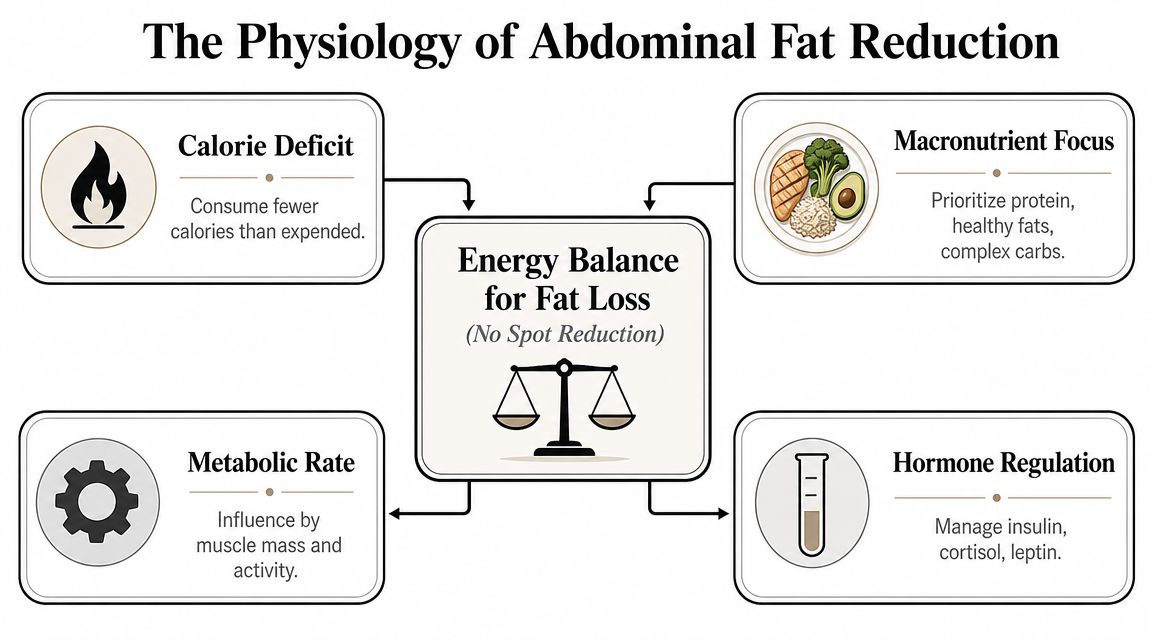
Fat loss is governed primarily by energy balance. Exercise equipment contributes by increasing total energy expenditure, not by magically draining fat from one body part because that area is moving.
Energy balance still decides the outcome
A simple analogy works well with clients. Think of body fat as water in a pool. You can't lower the water level from one corner only. If the system is losing more than it's receiving, the level drops across the pool. The body works similarly. The abdomen may be where the client wants change most, but the driver is still a sustained deficit.
That's why mainstream categories such as treadmills, rowers, bikes, stair climbers, and ellipticals matter. They let people accumulate enough work to shift weekly energy expenditure upward. The machine's usefulness comes from workload, not from a promise printed on the frame.
TRUE Fitness also notes that rowing machines engage approximately 86% of the body's muscles, which helps explain their strong energy-demand profile, while stationary bikes can support longer higher-intensity efforts because they reduce upper-body fatigue in many users, both of which improve session calorie burn over time through different mechanisms in practice (TRUE Fitness on fat-burning cardio equipment).
Subcutaneous and visceral fat aren't the same problem
From a clinical and performance perspective, abdominal fat isn't one uniform entity. Practitioners need to think about subcutaneous fat and visceral fat differently because the risk profile isn't identical. That's one reason many clients benefit from education that goes beyond appearance goals. For a patient-friendly explanation of why internal abdominal fat deserves attention, this guide on reducing dangerous visceral fat is useful.
There is also some nuance worth acknowledging. A 2023 study reported that abdominal aerobic endurance exercise produced a greater decrease in trunk fat mass in adult males, with 1,170 g or 7% reduction in one abdominal exercise group and 697 g or 3% reduction in another comparison, while the control group showed no detectable change. The authors concluded that exercise of the abdominal segment increased release and utilisation of adipose tissue stored adjacent to working muscles (PubMed Central study on abdominal segment exercise).
That finding adds nuance. It doesn't give marketers permission to revive old spot-reduction claims.
In practice, the takeaway is measured restraint. Local effects may exist under specific conditions, but they are modest relative to the bigger determinants of body-fat change. Professionals should still build programmes around total workload, nutritional alignment, and long-term adherence.
Evaluating Cardio Equipment for Maximum Energy Expenditure
If the goal is abdominal fat reduction, cardio equipment should be evaluated by one primary question. How much useful work can the client repeat consistently?
What to prioritise in machine selection
High energy expenditure options usually have two things in common. They recruit large muscle groups, and they make it feasible to sustain moderate-to-vigorous effort without a technical bottleneck.
That's why treadmills, rowers, bikes, ellipticals, and stair climbers remain the core categories. According to Welltech, high-intensity treadmill use can burn roughly 600 to 1,000 kcal/hour, rowing about 500 to 800 kcal/hour, stair climbing about 400 to 600 kcal/hour, and elliptical training about 500 to 700 kcal/hour, which makes these modalities useful when the objective is to raise weekly expenditure enough to support fat loss (Welltech on machines for belly fat loss).
For professionals, those figures aren't a reason to prescribe the highest number blindly. They're a reminder to match the machine to the client's limiting factor.
- Treadmill: often the easiest machine to prescribe because walking and running require little learning. It works well when the client tolerates impact and can use incline or speed progression sensibly.
- Rower: excellent when the client has enough technical skill to produce force efficiently. Poor rowing mechanics can lower output and shorten sessions.
- Stationary bike: often the best compromise for deconditioned, heavier, or orthopaedic-sensitive clients who still need hard intervals.
- Elliptical: useful for those who need lower impact but want a whole-body rhythm that feels more continuous than cycling.
- Stair climber: effective for clients who tolerate local leg fatigue and can maintain posture without hanging on the rails.
Selection rule: choose the machine that allows the highest sustainable workload, not the machine with the loudest fat-loss claim.
A useful supporting reference when estimating activity cost across different tasks is this metabolic equivalent chart. It's not a substitute for direct testing, but it helps practitioners frame comparative demand.
Estimated caloric expenditure by cardio machine
| Machine Type | Estimated Kcal/Hour | Primary Muscle Groups Engaged |
|---|---|---|
| Treadmill | 600–1,000 | Lower body, trunk stabilisers |
| Rowing machine | 500–800 | Legs, back, trunk, arms |
| Stair climber | 400–600 | Glutes, quadriceps, calves, trunk stabilisers |
| Elliptical | 500–700 | Lower body, upper body if moving handles, trunk stabilisers |
The numbers help, but adherence decides whether they matter. A rower may look superior on paper for one client, yet a bike may outperform it over twelve weeks because the client completes the sessions, pushes intensity, and returns without dread.
Equipment purchasing should reflect that reality. A facility doesn't need every machine to be “best.” It needs enough options to cover different biomechanical tolerances, confidence levels, and progression paths.
The Strategic Role of Resistance and HIIT Equipment
Cardio machines drive much of the energy expenditure discussion, but abdominal fat reduction programmes shouldn't be cardio-only. That's where professionals often outperform generic advice.
Resistance equipment protects body composition
Resistance training doesn't need to win the calorie-per-hour contest to matter. Its strategic role is to preserve, and in some cases improve, lean mass during weight loss so that the client doesn't become smaller but weaker.
That changes how we should discuss trunk-focused equipment. Cable stations, dumbbells, barbells, racks, and medicine balls are not “belly fat machines.” They are tools for force production, structural balance, trunk stiffness, and movement competence. Crunch benches and ab machines may strengthen local musculature, but they shouldn't be mistaken for primary drivers of abdominal fat loss.
The strongest programming model combines modalities. Guidance summarised by Tousains recommends 4 to 5 weekly sessions of 20 to 30 minutes of moderate-to-vigorous aerobic work on machines such as the treadmill, rower, or bike, complemented by 2 to 3 weekly resistance training sessions to preserve lean mass and metabolic rate (Tousains guidance on equipment and fat-loss programming).
HIIT tools raise density and effort
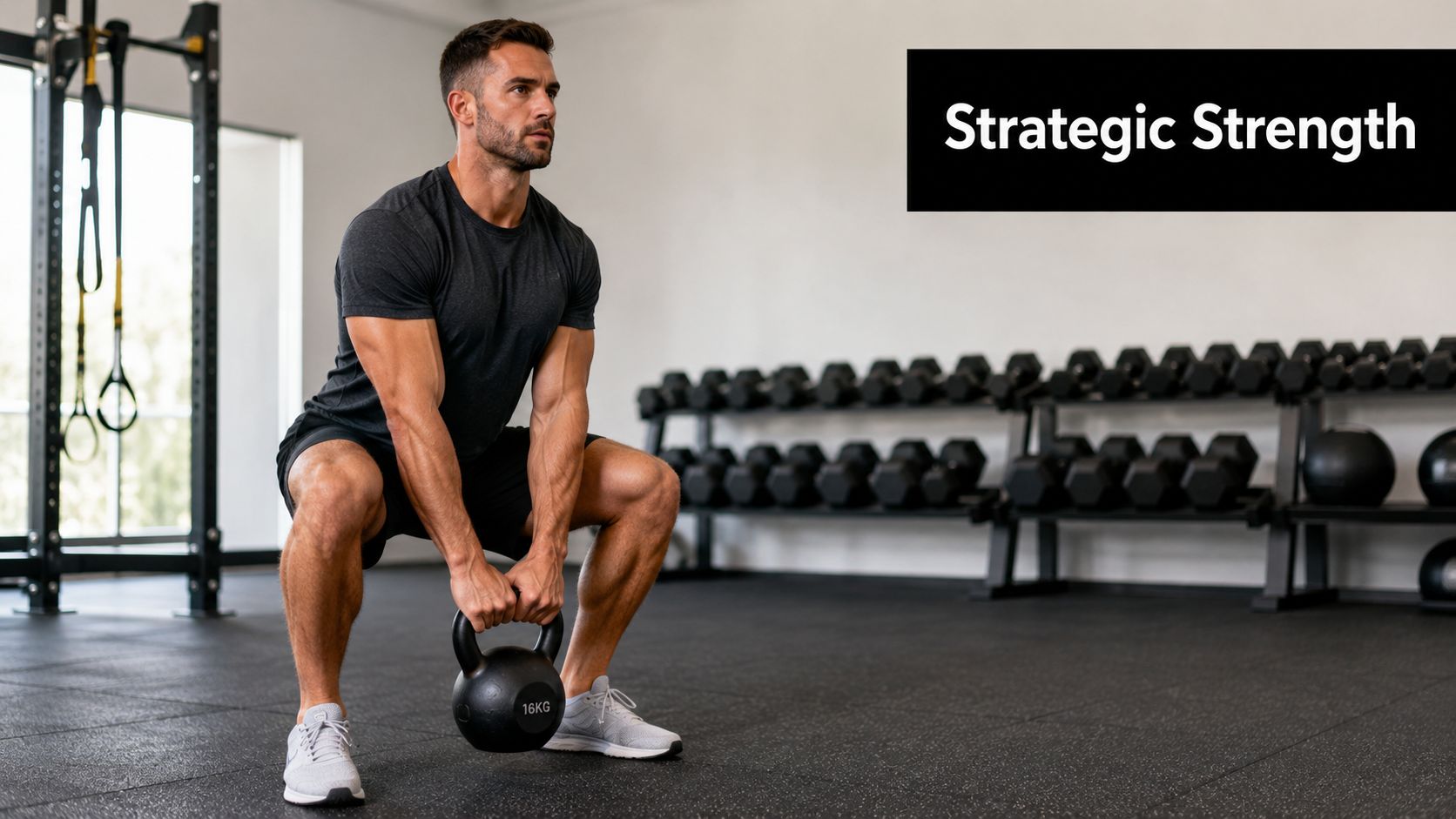
HIIT-oriented equipment sits in a different category from conventional core tools. Air bikes, kettlebells, sleds, battle ropes, and loaded carries are valuable because they let a coach compress substantial effort into short working blocks. They're especially useful when clients need intensity variety or when traditional steady-state work has plateaued psychologically.
A practical way to use them is as metabolic conditioning, not as gimmicks. Kettlebell squat patterns, swings, bike sprints, and rope intervals can raise session density, but only if movement quality stays high enough for repeated efforts. For lower-body explosive exercise progressions and related coaching ideas, this resource on plyometric leg exercise is a useful reference point.
Home and hybrid settings also require some scepticism. Hypervibe's own category discussion reflects a real market issue: vibration plates are often marketed for belly fat loss, but the evidence base is much thinner than it is for traditional cardio, so practitioners should guide clients toward equipment with stronger support for high energy expenditure and rely on objective tracking rather than machine claims (Hypervibe on home machines for belly fat).
- Use resistance equipment for preserving muscle, improving body composition quality, and building trunk strength that supports bigger training volumes elsewhere.
- Use HIIT tools for time-efficient conditioning and effort density when technique and recovery permit.
- Avoid overpromising with niche devices that may help compliance or low-impact access but don't have the same practical support as standard cardio categories.
Designing Client Programs for Abdominal Fat Reduction
Abdominal fat programmes usually fail for a predictable reason. The weekly plan asks clients to work hard often enough to matter, but not in a way they can recover from or repeat for more than two weeks.
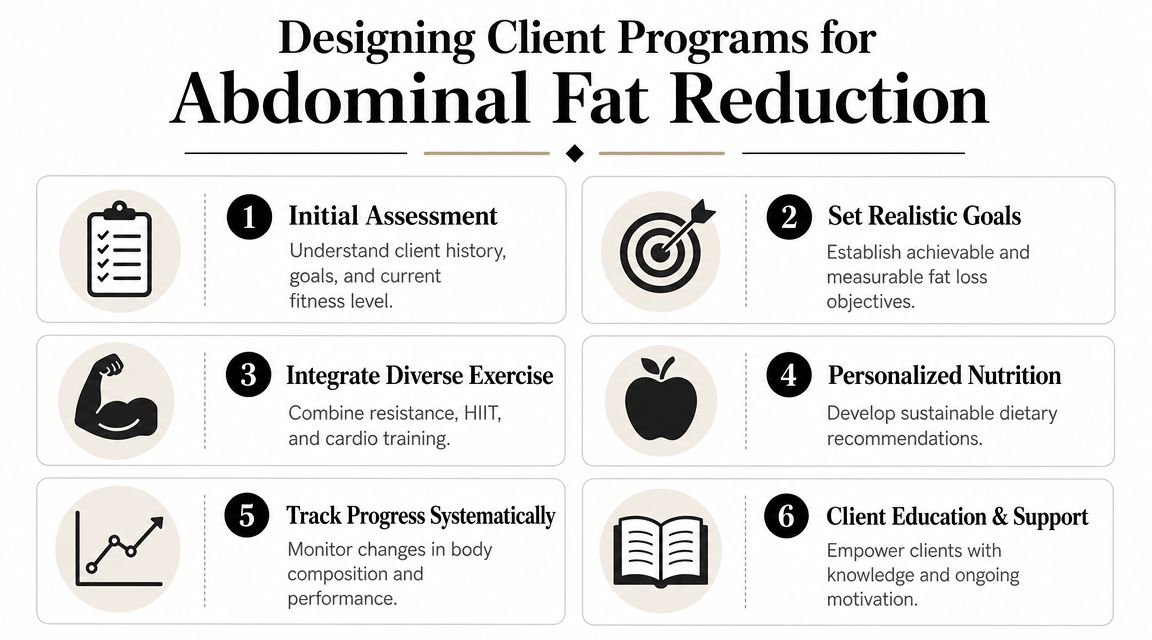
For abdominal fat reduction, the goal is not to cram more “core” work into the week. The goal is to organise enough total training volume, maintain lean mass, and control fatigue so the client keeps producing a useful energy deficit without seeing performance collapse or adherence drift. Coaches who miss that point often prescribe busy sessions that feel demanding but do little to change trunk fat over time.
A workable baseline is straightforward. Schedule regular aerobic sessions on equipment the client can use well, then pair that with full-body resistance training across the week. In practice, that usually means several moderate-to-hard cardio exposures and a smaller number of lifting sessions that preserve muscle and keep movement quality high. For practitioners who want tighter intake and expenditure monitoring alongside training, this guide on how to measure body composition accurately in practice is a useful companion to programme design.
A weekly structure that works in practice
A simple framework is easier to coach and easier to audit.
Three aerobic priority days
Use treadmill incline walking, bike intervals, rowing, or elliptical work. Pick one or two primary machines and progress them. Random machine rotation makes load tracking harder and usually adds novelty without improving results.Two resistance-focused days
Build the session around squat, hinge, push, pull, and carry patterns. Trunk exercises belong here, but as accessories that support force transfer, spinal control, and training tolerance.Optional low-intensity recovery work
Add easy walking, cycling, or similar movement when the client benefits from more activity but is not recovering well from another hard session.
The trade-off is simple. More hard sessions can increase weekly energy expenditure, but they also raise soreness, reduce output on later sessions, and increase dropout risk in deconditioned clients. Better programmes respect what the client can repeat for the next eight to twelve weeks, not what looks ambitious on paper.
A practical session menu might include:
- Steady aerobic session: continuous work on bike, rower, treadmill, or elliptical at a controlled pace that the client can sustain without technique breakdown.
- Interval session: harder and easier efforts on a machine the client can regulate confidently. Air bikes and rowers work well for some clients, but not if poor pacing turns every interval into a form problem.
- Resistance session: full-body lifting with moderate volume and sensible rest periods so the session supports body-composition goals without turning into unfocused circuit training.
- Hybrid session: short machine intervals paired with basic resistance exercises when time is limited and the client already tolerates both well.
Nutrition usually determines whether a good training plan produces visible abdominal change. If you want a concrete example to discuss meal structure around training goals, AI Meal Planner's 7-day plan is a practical template to review and adapt rather than asking clients to improvise.
This embedded example can also help some clients visualise a basic home-session format before you individualise it:
How to scale the same framework across client types
Beginners need stability more than variety. Start with machines that are easy to learn, easy to dose, and easy to recover from. Treadmill walking, upright or recumbent cycling, and elliptical work usually outperform rowing early on because technical failure is less likely and coaching time goes into consistency rather than constant correction.
Intermediate clients can handle clearer progression. Increase duration on one aerobic day, increase interval density on another, and progress resistance loads only if technique remains stable across the week. This is also the stage where clinicians and facility managers should start aligning programme changes with better measurement methods, especially if the stated outcome is abdominal fat reduction rather than generic weight loss.
Advanced clients rarely need more exercise categories. They need better sequencing. Hard lower-body intervals placed too close to heavy resistance work can reduce output in both sessions, particularly in clients already carrying high stress loads or limited sleep. In those cases, separating demanding interval work from lower-body lifting often produces better weekly performance and more reliable adherence.
Three programming rules hold across all levels:
- Reduce complexity before reducing effort.
- Choose equipment the client can push safely and repeat consistently.
- Judge success by adherence, progression, and validated abdominal change, not by how exhausted the client feels after a session.
Validating Progress with Professional Assessment Tools
Professionals shouldn't rely on scale weight alone to decide whether an abdominal fat-loss programme is working. That's too crude for the question being asked.
Why weight and waist alone aren't enough
A client can lose body weight with little useful improvement in body composition. Another can improve trunk composition while body weight changes modestly because lean mass is better preserved. Waist measures are valuable, but they can still miss relevant distinctions in tissue quality, hydration, posture, and measurement consistency.
That matters in abdominal work because clients are often specifically concerned with the midsection. If the intervention is supposed to change the abdomen, then direct or semi-direct methods of tracking abdominal tissue are more credible than guessing from a weekly weigh-in.
A practical hierarchy of assessment
A useful professional hierarchy starts with accessible field methods and moves upward to more precise technologies.
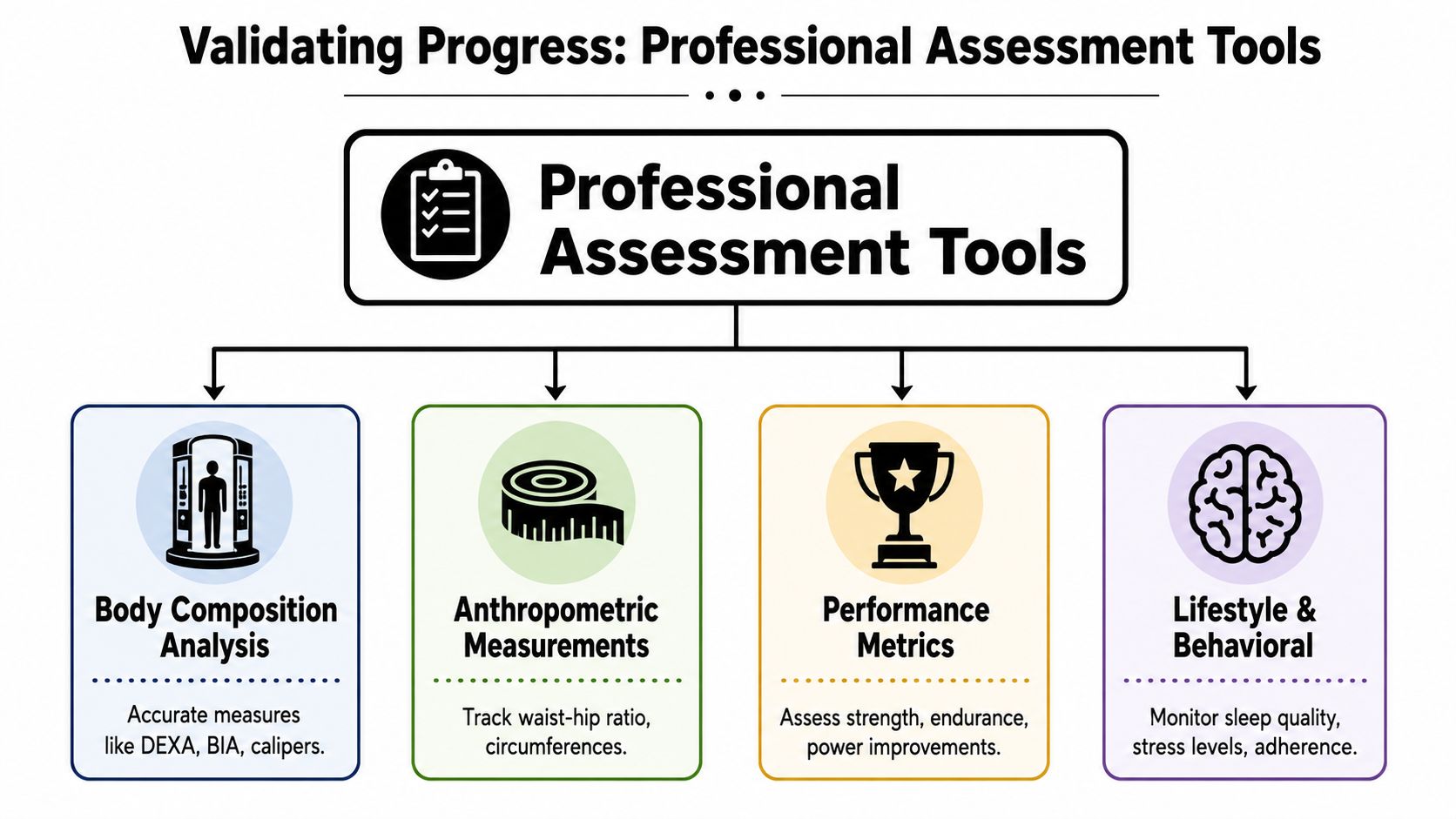
- Anthropometrics: waist circumference and site-based skinfolds can still be useful when the operator is skilled and protocols are standardised.
- Ultrasound: B-mode systems such as BodyMetrix can measure subcutaneous fat thickness at specific sites, which is highly relevant when practitioners want regional tracking rather than broad estimation.
- Metabolic testing: systems such as Cosmed analysers can help identify resting metabolic rate and substrate-use patterns, which improves prescription quality when progress stalls or client response is inconsistent.
- Performance markers: machine output, work tolerance, and resistance progression matter because better capacity often supports better fat-loss execution.
- Behavioural compliance data: attendance, session completion, and nutrition adherence often explain outcome differences more than the machine choice itself.
The more specific the goal, the more specific the measurement method should be.
For many facilities, the practical leap isn't going from tape measure to laboratory perfection. It's going from vague reassurance to repeatable protocols. If abdominal change is the service promise, assess abdominal change directly when possible. If energy expenditure is the strategy, validate whether the client's capacity and consistency are improving.
For a concise overview of field and professional options, this guide on how to measure body composition is a useful operational reference.
The commercial value is also straightforward. Better assessment improves programme decisions, reduces guesswork when clients plateau, and demonstrates professional credibility in a way generic “fat-loss scans” often do not.
Conclusion A Synthesized Strategy for Professionals
The best exercise equipment to lose belly fat isn't one machine. It's a system.
Use equipment that supports high, repeatable energy expenditure. Match the machine to the client's joints, skill level, and willingness to train hard enough often enough. Layer in resistance training so weight loss doesn't come at the cost of lean mass and performance. Be cautious with devices that are marketed aggressively but supported weakly.
Above all, validate the outcome with better tools. If the target is abdominal fat reduction, don't settle for vague feedback from scale weight alone when site-specific body-composition methods and metabolic assessment can give a much clearer picture.
Professionals add value by removing guesswork. That means replacing “What machine burns belly fat?” with a better standard: Which equipment helps this client sustain the workload required for fat loss, within a programme that can be measured and adjusted with confidence?
If you need validated tools to measure body composition, metabolic response, and field-test performance with more precision, Cartwright Fitness offers professional-grade assessment equipment and support for clinics, gyms, universities, and performance facilities.


