

Implementing evidence-based practice isn't just a concept you learn about; it's a systematic way of working. It means deliberately blending the best available research with your hard-earned clinical expertise and, crucially, your client's values and goals. This is a major shift from simply doing things "the way they've always been done."
Making this happen requires more than just good intentions. It demands a mix of sharp skills, a supportive environment, and the right tools to close the gap between knowing what's best and actually doing it.
Building a Foundation for Real-World EBP Success

Moving from theory to reality is where the real work of evidence based practice implementation begins. It’s an active process, fundamentally changing how clinicians and fitness pros make decisions every single day. The goal is to ground every choice in solid data, not just habit or a story you once heard.
When you get this right, the quality of care skyrockets. Applying the most current and effective methods consistently leads to better client outcomes, improved safety, and a higher standard of service across the board. Yet, we all know there's a big difference between understanding why EBP matters and actually making it happen in a packed clinic or bustling gym.
The Reality of the Implementation Gap
So many EBP initiatives start with enthusiasm but fizzle out because of real-world friction. The classic "train-and-hope" approach—sending staff to a weekend workshop and expecting them to transform their practice on Monday morning—almost never sticks. Lasting change is far more nuanced.
A recent global study of healthcare workers painted a stark picture of this gap. The average implementation score was a mere 40.4 out of a possible 90, and over half of the professionals (51.7%) scored even lower. This isn't a local problem; it’s a persistent, worldwide challenge in turning EBP principles into daily habits.
"True EBP implementation isn't just about reading research papers. It's about creating a system where asking questions, seeking evidence, and applying new knowledge becomes the default setting for everyone on the team."
Key Pillars for Sustainable Success
Lasting success isn't about one person's heroic effort. It depends on a solid foundation where several key components work together. This is a central theme in fields like evidence-based physical therapy, where outcomes are directly linked to this kind of methodical application. You can dive deeper into these principles in our guide on evidence-based physical therapy.
To build a framework that lasts, you need to focus on three core areas:
- Practitioner Skills and Beliefs: Your team needs to see that the new practices are relevant, practical, and will genuinely help their clients. They also need the confidence and skills to find and quickly evaluate evidence.
- A Supportive Environment: Leadership has to be the biggest cheerleader for this change. That means carving out time for learning, providing the necessary resources, and building a culture where it’s safe and encouraged to ask, "Is there a better way to do this?"
- Accessible Tools and Infrastructure: Simple protocols, easy-to-use resources, and straightforward ways to track progress are non-negotiable. These tools make it easier for practitioners to do the right thing and keep the whole team on the same page.
Without this three-pronged approach—skilled individuals, supportive leadership, and practical tools—even the strongest evidence will just sit on a shelf. The rest of this guide will walk you through building this foundation and overcoming the challenges you'll face along the way.
The Art of Asking, Acquiring, and Appraising Evidence

Putting evidence-based practice into action isn’t something you just do; it starts with a healthy dose of professional curiosity. Before you can apply any new insight, you first have to get good at asking the right questions, finding high-quality information, and then realistically sizing up its worth.
This whole process—Asking, Acquiring, and Appraising—is the real engine driving EBP.
Think of it like building a house. You wouldn't just start throwing up walls without a solid blueprint. In our world, a well-formed question is that blueprint. It guides your search, keeps you from getting lost in a sea of irrelevant studies, and ensures the evidence you ultimately stand on is solid, reliable, and actually makes sense for your client.
Formulating Focused Clinical Questions
Here’s a hard truth: vague questions get you vague, useless answers. A question like, "What's the best way to train for endurance?" is a dead end because it’s far too broad. To find something you can actually use, you need to get specific.
This is where the PICO framework becomes your best friend. It’s a simple but incredibly effective tool for adding much-needed clarity.
The PICO model forces you to break down your problem into four key parts:
- P (Patient/Population): Who, exactly, are we talking about? (e.g., "Post-menopausal women with osteopenia")
- I (Intervention): What is the specific strategy you're curious about? (e.g., "High-impact resistance training")
- C (Comparison): What’s the alternative you’re comparing it to? (e.g., "Compared to low-impact weight-bearing exercise")
- O (Outcome): What result are you trying to achieve? (e.g., "Improved bone mineral density")
When you put it all together, you get a focused, searchable question: "In post-menopausal women with osteopenia (P), does high-impact resistance training (I) lead to greater improvements in bone mineral density (O) compared to low-impact weight-bearing exercise (C)?".
Suddenly, you have a roadmap. You know exactly what you’re looking for.
Acquiring High-Quality Evidence
With a sharp question in hand, your next job is to find the best available research. This means going beyond a quick Google search. For credible answers, you need to dive into the professional databases where peer-reviewed research is cataloged.
Places like PubMed, the Cochrane Library, and PEDro (for physiotherapy) are where the good stuff lives. I know they can look intimidating at first. A good way to start is by using broad terms from your PICO question, like "resistance training" and "bone density," and then using the site’s filters to narrow the results. Focus on systematic reviews or randomized controlled trials (RCTs), as they often provide the strongest evidence for intervention questions.
A rookie mistake is to only read the abstract. An abstract is basically a sales pitch for the paper, designed to show off the most impressive results. The real story—the context, the limitations, the nuance—is always waiting for you in the full text, especially the methods section.
Getting good at searching is a skill you build over time. Learning to use search operators (like AND, OR, NOT) and specialized terms like MeSH (Medical Subject Headings) in PubMed can make you much faster and your results far more relevant.
Appraising Evidence with a Critical Eye
So you've found a few promising studies. Now comes the most important part: you have to appraise them with a critical eye. Not all research is created equal, and your job is to figure out a study's validity (are the findings true?) and its applicability (is this relevant to my client?).
A well-designed study should address a clear, focused issue—much like the PICO question you started with. As you read, think of yourself as a detective looking for clues about the study’s quality.
Key Questions for Your Critical Appraisal:
- Are the results valid? Was the study design right for the question? For intervention studies, were people randomly assigned to groups? Did a bunch of people drop out, potentially skewing the results?
- What are the results, really? How big and how precise was the effect? Don't just look at p-values. A result can be "statistically significant" but clinically meaningless if the effect size is tiny. Look for confidence intervals to understand the range of possible outcomes.
- Is this actually applicable to my client? Does the study population look like the person in front of you? Are the benefits of this intervention worth any potential downsides or costs? And critically, do you have the resources and skills to implement this safely and well?
This appraisal step is where your professional expertise really comes into play. It’s how you move from just accepting a paper's conclusions at face value to making an informed judgment about whether the evidence truly justifies a change in how you practice.
Translating Evidence into Clinical Action

Finding a great piece of research can feel like a major win, but let’s be honest—that’s only half the battle. The real work in evidence-based practice implementation begins when you have to bridge the gap between that study and the real-world client standing in front of you.
This is where your professional judgment truly shines. You’re not just mindlessly copying a protocol from a paper. Instead, you're tasked with blending three key ingredients: the best available evidence, your own hard-won professional wisdom, and—most importantly—your client’s unique situation and preferences. Getting this mix right is the very heart of EBP.
Crafting a Practical Action Plan
Okay, so you’ve found an approach that’s backed by solid evidence and seems like a great fit. Now what? You have to make it work on the ground. A protocol designed for a tightly controlled lab almost never translates perfectly to a bustling clinic or a busy gym floor. Your job is to adapt, not just adopt.
Let's say you've read a study on a new post-surgical rehab protocol that shows fantastic results. Before you roll it out, you have to ask some practical questions:
- Resources: Does my facility have the exact equipment used in the research? If not, what’s a safe and effective alternative I can use?
- Staffing: Will my colleagues need special training to implement this correctly? How do we fit this new protocol into our schedule without disrupting other appointments?
- Client Fit: How does this protocol square with my client’s current fitness level, their pain tolerance, and what they actually want to achieve?
Getting your team on board is crucial. Everyone involved needs to understand why you're making a change and what their role is. It helps to find a few "champions" among your more experienced staff who can help lead the charge, troubleshoot early issues, and build momentum.
Weaving in Patient Preferences and Values
Evidence doesn't treat people; practitioners do. A technically perfect plan is completely useless if your client won't stick with it. This is where you switch gears from being a researcher to being a collaborative partner.
The best evidence in the world means nothing if the client won't adhere to the plan. Shared decision-making isn't just a nice-to-have; it's a fundamental component of effective implementation. It respects patient autonomy and dramatically increases the likelihood of success.
Imagine the evidence points overwhelmingly toward a high-intensity interval training (HIIT) program for your client's goal. But when you bring it up, they tell you they absolutely hate intense exercise because of a bad experience years ago. Forcing them into that HIIT protocol is a recipe for failure.
Instead, you open a conversation. You explain the "why" behind your suggestion but also genuinely listen to their concerns. Maybe you work together to create a modified plan that introduces intensity more gradually. Or perhaps you explore a different, evidence-supported option that they find more appealing. This teamwork is what makes a plan both effective and sustainable.
Assessing the Results and Closing the Loop
The final, and ongoing, piece of the puzzle is asking one simple question: "Is this actually working?" Implementing a new strategy isn't a one-and-done task. It’s a constant cycle of action, evaluation, and refinement.
To do this right, you need to define your success metrics before you start.
Key Metrics to Track:
- Clinical Outcomes: Are their strength numbers improving? Is their range of motion increasing? Are their pain scores going down?
- Process Metrics: Are they sticking to the program? Are sessions being completed as planned?
- Patient-Reported Outcomes: How do they feel? Do they feel more confident? Has their overall quality of life improved?
Tracking this data creates a powerful feedback loop. You can find some excellent frameworks for objective measurement in various fitness testing protocols to help guide your assessments.
If the numbers look good, you've validated the change. If the results aren't what you hoped for, it isn't a failure—it's a learning opportunity. It’s a signal to revisit your original question, tweak the intervention, or rethink how you’re implementing it. This reflective cycle is what separates good practitioners from great ones.
How to Overcome Common Implementation Barriers
Even when you've found solid evidence, putting it into practice is often the hardest part. The journey from knowing a better way to actually doing it in a bustling clinic or gym is paved with real-world obstacles. These roadblocks are common, but thankfully, they aren't insurmountable.
The trick is to see these challenges coming and have a plan to dismantle them. It's rarely about the quality of the evidence itself; it's almost always about the human and systemic factors that push back against change.
This visual breaks down some of the most common hurdles practitioners run into.
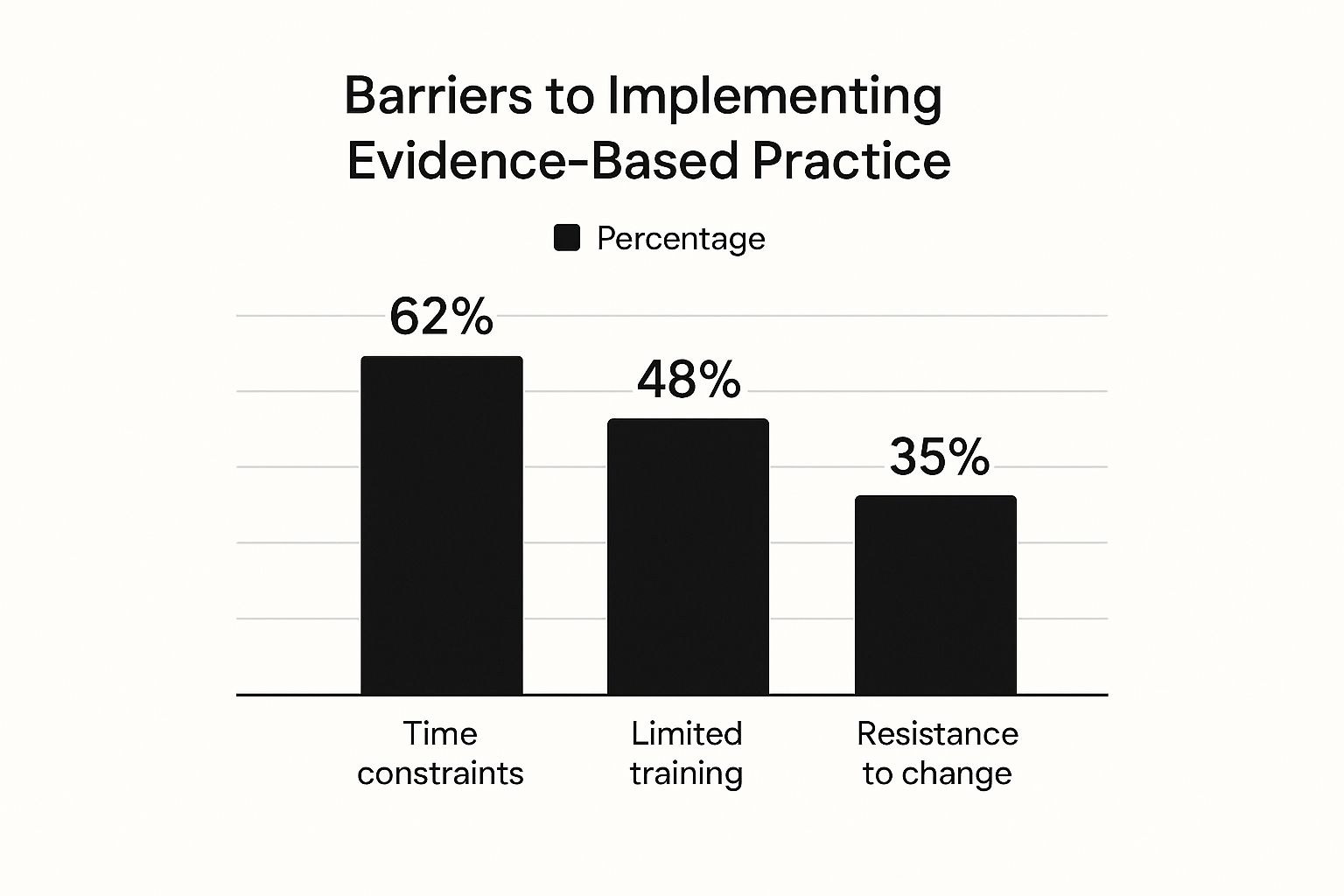
As you can see, practical issues like not having enough time are the biggest pain points, with gaps in training and organizational resistance following close behind.
To give you a head start, I've put together a table outlining these common barriers and some actionable strategies to help you navigate them.
Common EBP Implementation Barriers and Strategic Solutions
| Common Barrier | Individual Strategy | Organizational Strategy |
|---|---|---|
| Lack of Time | Form a "journal club" to divide research tasks; use efficient documentation tools like voice charting. | Allocate dedicated time for EBP activities; provide access to time-saving technologies and research databases. |
| Lack of Authority | Start with a small pilot project, meticulously track data, and present a compelling "before and after" case. | Create clear pathways for staff to propose changes; foster a culture where evidence-based suggestions are valued. |
| Research Isn't Applicable | Adapt, don't just copy. Use clinical judgment to modify protocols for individual clients while keeping core principles intact. | Offer training on how to critically appraise and adapt research for specific populations and settings. |
| Lack of Resources | Pool resources with colleagues; seek out free, high-quality open-access journals and databases. | Invest in subscriptions to key journals and databases; provide a budget for continuing education and EBP projects. |
These strategies aren't just theories; they are practical steps you can take starting today. By addressing challenges at both the individual and organizational level, you can build a more supportive environment for EBP.
Feeling Powerless to Enact Change
One of the most frustrating feelings is knowing there's a better way but feeling like you don't have the authority to change anything. You're not alone in this. A study of nurses revealed this was their single biggest obstacle, with a staggering 83.8% reporting they felt they lacked the power to change patient care procedures.
The solution is to become a powerful advocate for your ideas. Don't just drop a research paper on a manager's desk; build a case they can't ignore.
- Start small, document everything. Pick one specific, nagging problem. Implement your new approach on a small scale and track the results with obsessive detail.
- Translate data into impact. Frame your results in a language leadership understands: better client outcomes, saved time, or glowing testimonials. A simple chart showing the "before and after" is often more convincing than a 10-page report.
- Find your champions. You're probably not the only one who sees the problem. Identify a few respected colleagues who can back your idea and help you present a united front.
The "It Won't Work Here" Mindset
Another massive hurdle is the "it won't work for my clients" mentality. It's easy to look at a study conducted in a pristine lab and think it doesn't apply to your unique environment. The same study I mentioned earlier found that 81.5% of nurses felt evidence wasn't applicable to their specific workplace. That's a huge disconnect.
The answer isn't to toss the research aside, but to become a skilled translator.
Your job is not to be a research replicator but a clinical translator. You must bridge the gap between the study’s population and the individual in front of you, using your professional judgment to modify the protocol while preserving its core principles.
This is where your assessment skills become crucial. To confidently adapt an intervention, you have to be able to accurately measure its effect on your clients. Brushing up on foundational concepts, like https://www.cartwrightfitness.co.uk/assessment-reliability/, ensures the data you collect is trustworthy. When you can reliably track progress, you can confidently adapt any protocol.
Battling Time and Resource Shortages
This is the big one. Almost every practitioner I know feels like there just isn't enough time to add one more thing to their plate. The key isn't to work more; it's to work smarter and find efficiencies.
For instance, documentation can be a major time sink. Exploring tools that streamline this process can free up that precious time for EBP. Looking into the benefits of medical voice charting might show you how technology can carve out the minutes you need.
Another fantastic, time-saving strategy is to start a small "journal club" with a few colleagues. Instead of each person trying to find and read five articles, you can divide and conquer. This collaborative approach not only lightens the load but also deepens everyone's understanding through discussion, leading to smarter, more informed decisions.
Fostering an Organizational Culture of Inquiry
Let's be honest: putting evidence-based practice into action can feel like an uphill battle. It's not something one motivated clinician can do alone. For EBP to truly take hold and lead to lasting change, it has to be woven into the very fabric of your organization's culture. It’s about building an environment where asking "Is this the best way?" is the norm, not the exception.
This shift starts at the top. When leadership actively champions EBP, it’s a game-changer. I’m not just talking about a memo or a quick mention in a staff meeting. I mean leaders who allocate real resources, protect their team's time for learning, and create actual pathways for new, evidence-backed ideas to be heard and implemented. Without that genuine, visible support, even the most passionate practitioners will eventually hit a wall.
Championing Change from the Top Down
Getting clear, enthusiastic buy-in from management isn't just a "nice-to-have"—it's a must. Leaders set the tone. If the only thing that gets celebrated is hitting productivity targets, staff will quickly figure out that digging into research isn't a priority. But when a manager publicly praises a team for overhauling a protocol based on new evidence, it sends a powerful message to everyone: we value getting better at what we do.
What does this look like in the real world? It's about tangible actions.
- Protecting Time: Carving out even a few dedicated hours each month for things like journal clubs or brainstorming sessions.
- Providing Resources: Making sure your team has access to essential research databases and funds for continuing education.
- Celebrating Wins: Publicly recognizing individuals and teams who use evidence to improve client outcomes. It’s amazing how motivating a little recognition can be.
When clinicians see that their leaders are genuinely invested, they feel safe enough to question old habits and suggest better ways. This creates a powerful cycle where curiosity is rewarded, not stifled, and your practice becomes more dynamic and effective as a result.
An environment where it’s safe to say, "I'm not sure if this is the best way, let's see what the evidence says," is the bedrock of EBP. It’s what shifts the culture from one of just "doing things" to one of always improving.
The Power of Dedicated Training and Support
Just telling your team to "start using EBP" is like handing them a map without teaching them how to read it. To build real skill and confidence, you need dedicated, ongoing training and support. This isn't a one-and-done workshop; it's a continuous process.
Investing in EBP training has a direct, measurable impact. In a recent survey of over 1,200 nurses, participation in specific EBP training courses was a major factor in creating a positive environment for implementation. The study also highlighted that previous experience with EBP projects helped build momentum for future work. You can dig into the specifics of what drives this positive culture by reading the full study.
This is why building a structured support system is so critical. Consider offering things like:
- Hands-on workshops that walk people through creating PICO questions and navigating research databases.
- Mentorship programs pairing seasoned staff with those who are just getting started.
- Ready-made resources like appraisal checklists and simple project templates to make getting started less intimidating.
Initiatives like these take the pressure off individual practitioners and show a real commitment to their growth. It turns evidence based practice implementation into a shared mission, not just another task on someone's to-do list. By building this supportive infrastructure, you're giving your team the tools and the backing they need to not only find better ways of working but to make sure those improvements stick.
Your EBP Questions, Answered
As you start putting evidence-based practice into action, questions will inevitably pop up. That’s a great sign—it means you're thinking critically about how to make this work in your real-world setting. Let's tackle some of the most common questions I hear from practitioners.
I'm Swamped. How Can I Possibly Do This With Limited Time and Resources?
This is, without a doubt, the number one hurdle. The secret? Start small to win big. Forget about trying to overhaul your entire practice overnight—that's a fast track to burnout.
Instead, pick one single, nagging clinical question. Think about a problem you and your colleagues see over and over. Your goal is to get a small, manageable win under your belt to build momentum.
You don't need a fat budget for expensive journal subscriptions to begin. Some of the best resources are completely free:
- PubMed: The ultimate starting point for biomedical literature.
- Cochrane Library: The gold standard for systematic reviews, giving you high-level summaries of evidence.
- PEDro: An invaluable free database specifically for physical therapy evidence.
Another fantastic move is to team up. Grab a couple of like-minded colleagues and start a small journal club. This splits the workload of finding and appraising research, turning a lonely chore into a collaborative learning session. Once you have a successful project—even a small one—with clear, positive results, you'll have the best possible argument to convince management to invest more time and resources in EBP.
What's the Real Difference Between EBP and Quality Improvement?
It's easy to get these two mixed up. They're definitely partners in achieving better outcomes, but they play different roles.
Evidence-Based Practice (EBP) is all about the individual. It's the process of blending the best available research with your own clinical expertise and the patient's values to make the best decision for the person in front of you. EBP answers the question, "What does the research say is the best treatment for this specific problem?"
EBP gives you the "what"—the proven intervention. Quality Improvement gives you the "how"—the system to deliver that intervention reliably and consistently in your clinic.
Quality Improvement (QI), on the other hand, is about fixing systems. It’s a structured, data-driven approach to making changes within a specific organization.
Here’s a practical example: EBP tells you that a new ACL rehab protocol, based on a recent meta-analysis, is the most effective approach. A QI project would be the process you design to make sure every single therapist in your clinic implements that new protocol correctly 99% of the time, tracking adherence and smoothing out any hitches in the workflow.
Help! The Research I'm Finding Is Contradictory.
First off, don't panic. Finding conflicting studies isn't a sign you've hit a dead end; it's a normal part of the evidence based practice implementation process. It just means you need to put on your detective hat and apply some critical thinking.
Your first step should always be to consult the hierarchy of evidence. A robust systematic review from a source like Cochrane will almost always carry more weight than a single randomized controlled trial (RCT). An RCT, in turn, is generally stronger than an observational study.
If studies at a similar level of evidence are clashing, it's time to dig into the details. The "conflict" often comes down to key differences between the studies:
- Who were they studying? One study on elite college athletes will have different results than one on sedentary adults.
- What did they actually do? A slight change in exercise dosage, duration, or technique can lead to completely different outcomes.
- What were they measuring? Was the goal pain reduction? Functional improvement? Return-to-sport time?
This is precisely where your clinical expertise becomes non-negotiable. It's up to you to weigh the evidence, consider its relevance to your client's unique situation and goals, and work with them to make a truly informed, shared decision.
At Cartwright Fitness, we know that accurate measurement is the bedrock of effective EBP. To confidently roll out and track new protocols, you need equipment you can trust. Explore our range of professional-grade testing tools and see how our validated solutions can enhance your practice.