

If you're running a clinic, university lab, sports science department, or performance facility, you probably already know the feeling. One key device starts drifting, another is still working but unsupported, and finance wants a clear reason for replacement before approving anything. Meanwhile, you're trying to protect test accuracy, keep appointments moving, and avoid the embarrassment of explaining why a metabolic cart failed on a booked assessment day.
That's why equipment replacement planning matters so much in health and fitness settings. This isn't the same as swapping out a worn treadmill in a commercial gym. When you're dealing with body composition systems, spirometry tools, metabolic analysers, ECG equipment, ultrasound devices, or validated step test tools, failure has a second cost beyond repair bills. It can compromise confidence in the result itself.
The strongest plans aren't built around panic purchases. They're built around a disciplined inventory, a realistic view of clinical risk, and a budget that accepts replacement as a normal part of operating a serious assessment service.
Table of Contents
- Building Your Foundational Equipment Inventory
- Assessing Equipment Condition and Clinical Risk
- Prioritizing Replacements with a Scoring Matrix
- Strategic Budgeting and Financial Forecasting
- Executing Smart Procurement and Validation
- Managing Decommissioning and Responsible Disposal
Building Your Foundational Equipment Inventory
At 7:45 a.m., the first VO2 test of the day is booked, the client is checked in, and the metabolic cart powers up with a sensor fault no one logged. The spare cable is in another room, the calibration kit is missing, and the only service note sits in somebody's inbox. That is how replacement planning breaks down in clinical and performance testing settings. Not because teams lack good intentions, but because they are planning from an incomplete asset picture.
For equipment replacement planning to work, every high-value device and every test-critical accessory needs to sit in one asset register that people trust and use.

Start with one register, not five lists
A spreadsheet is fine if that is what the team can maintain consistently. What matters is control. One row per asset. One asset ID. One current owner. One agreed location.
In health assessment environments, the inventory has to go beyond the obvious headline devices. Yes, log the metabolic cart, ECG system, body composition analyser, and lactate analyser. Also log the items that can stop testing, distort results, or force staff to improvise. That includes calibration syringes, gas regulators, interface modules, manufacturer-specific cables, dedicated printers, validated tablets, docking stations, and software dongles. If the appointment fails without it, track it.
Practical rule: If a missing, failed, or inaccurate item can delay a test, invalidate a result, or break your reporting workflow, it belongs in the register.
The register can stay simple and still be useful. In practice, these tabs cover what most clinics and performance labs need:
- Asset register for the live equipment list
- Service history for faults, repairs, and downtime
- Replacement pipeline for expected renewals and pending approvals
- Supplier log for warranty terms, service contacts, and support status
Teams that manage testing laptops, connected tablets, or software-controlled devices can borrow methods from IT asset inventory optimization. The principle is the same. You need clear ownership, current location, and a quick way to see whether the asset is still supported.
What each asset record should contain
The weak point in many inventories is not the tool. It is the missing fields. If you skip key details now, you will spend the next replacement cycle chasing serial numbers, checking cupboards, and arguing about whether a device is still serviceable.
Each asset record should include:
- Asset identity including device name, manufacturer, model, serial number, and internal asset tag
- Location and ownership including site, room, and the staff member or department responsible for daily use
- Purchase details including purchase date, supplier, and original cost
- Lifecycle reference including expected service life, support end date, and any manufacturer retirement guidance
- Maintenance trail including calibration dates, preventive maintenance, repairs, recurring faults, and downtime notes
- Operational dependencies including software version, accessories, consumables, and whether a backup unit is available
- Testing role including which assessments the device supports and whether it is used for baseline screening, serial monitoring, or high-risk decision-making
That last field matters more than many teams expect. A body composition analyser used for casual wellness checks does not carry the same operational risk as one used for repeated patient progress reviews. A treadmill used for general conditioning is different from one tied to a validated submax or step-test protocol. The inventory should reflect that context.
For facilities buying specialist assessment tools, it also helps to classify assets by test purpose. Filtering by respiratory assessment, body composition, anthropometry, cardiovascular screening, rehabilitation testing, or field testing makes the register far more usable during budget reviews and service planning. A broad reference point for that kind of categorisation can be seen across this range of health assessment equipment.
A good register tells you what you own. A useful one tells you what can fail, what that failure interrupts, and which replacements will hurt if you leave them too late.
Assessing Equipment Condition and Clinical Risk
A device can look serviceable on the bench and still be the wrong unit to keep in a clinical testing room. That shows up fast with high-precision equipment. A metabolic cart that drifts between calibrations, or a body composition analyser that produces inconsistent repeat readings, creates a bigger problem than simple wear. It puts trend data, practitioner confidence, and appointment flow at risk.
Age still matters. It just should not lead the review on its own.
I have seen older systems stay dependable for years because the calibration routine was tight, the software was stable, and the manufacturer still supported parts. I have also seen newer units become replacement candidates early because sensors were unreliable, accessories kept failing, or the device spent too much time out of service. In testing environments tied to health assessment, condition and consequence have to be reviewed together.
Separate physical condition from measurement risk
Start by splitting the assessment into two lanes. First, examine the equipment itself. Second, examine the effect of failure or inaccuracy on the service.
A cracked casing, worn trolley wheel, or tired printer may need attention, but those faults do not carry the same weight as unstable gas analysis, failed calibration checks, intermittent ECG capture, or repeated impedance errors. Clinical and performance testing equipment should be judged by whether it still produces repeatable, defensible results under normal workload.
A useful financial warning sign is rising service spend relative to the value of the asset. If a device keeps absorbing repair costs, engineer time, loan-unit fees, and cancelled bookings, replacement usually becomes the better decision, as discussed in Oxmaint's article on predicting equipment lifespan and planning replacements.
Review the factors that drive replacement decisions
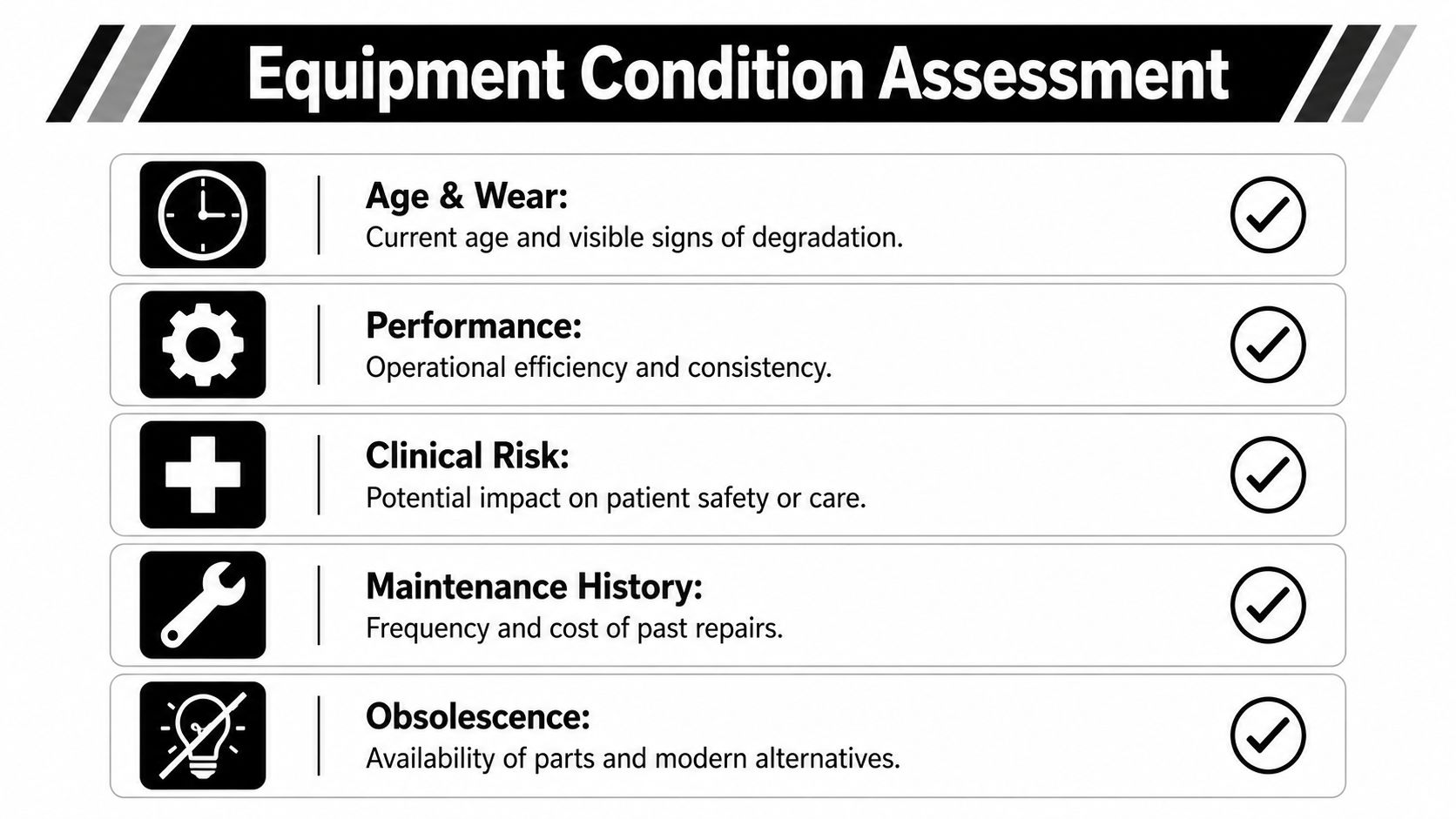
A practical condition review needs five checks. These are the areas that usually expose whether a unit is ageing safely or becoming a liability.
| Assessment area | What to look for in practice |
|---|---|
| Age and wear | True service age, visible degradation, heavy use, transport damage, and whether the workload has exceeded the original use case |
| Performance | Stable operation, successful calibration, repeatable outputs, failed self-checks, and staff confidence in the readings |
| Clinical risk | The effect of wrong results or downtime on screening, serial monitoring, exercise testing, rehabilitation, or return-to-play decisions |
| Maintenance history | Repeat callouts, recurring faults, parts replaced more than once, long service delays, and unresolved intermittent problems |
| Obsolescence | Parts availability, software support, operating system compatibility, cybersecurity exposure, and manufacturer end-of-support status |
That framework works well in health assessment settings because it reflects how these devices are used. A body composition analyser used for one-off wellness scans does not carry the same risk as one used to track change over months. A treadmill used for general exercise sessions is not the same as one tied to a validated clinical protocol. The same model can sit in two rooms and deserve different replacement timing.
Ask the questions that expose hidden risk
Teams often under-rate equipment that still powers up and passes a basic function test. That is where poor replacement plans start.
Ask direct questions:
- Are results still trustworthy enough for serial comparison? Small inaccuracies matter more when clinicians or coaches are comparing month-on-month change.
- Does the unit fail in ways staff can detect immediately? Some faults are obvious. Drift and intermittent errors often are not.
- Can the service continue if this device is down for a week? If there is no backup, downtime becomes a service risk, not just an engineering issue.
- Has support become slow, expensive, or uncertain? Delayed parts and ageing software can turn a minor fault into a long outage.
- Would you defend this device in an audit or complaint review? If documentation, calibration history, or validation records are weak, that answer is often no.
Quality assurance belongs inside this review, not after it. Replacement planning for clinical and fitness testing equipment should sit alongside calibration records, acceptance criteria, and documented performance checks. Facilities that want defensible measurement practice usually benefit from a structured medical device quality assurance process rather than treating maintenance, validation, and replacement as separate jobs.
One final test helps. If the device failed on your busiest assessment day, would the main problem be inconvenience, or would you lose trustworthy data and disrupt clinical decisions? That answer usually tells you more than the age label ever will.
Prioritizing Replacements with a Scoring Matrix
Once you've assessed condition, the next job is deciding what gets replaced first. At this point, many teams lose objectivity. The loudest department pushes hardest, someone remembers a bad breakdown from last quarter, and a lower-risk item jumps the queue.
A scoring matrix fixes that. It turns scattered opinions into a ranked list.
Use a matrix that removes emotion
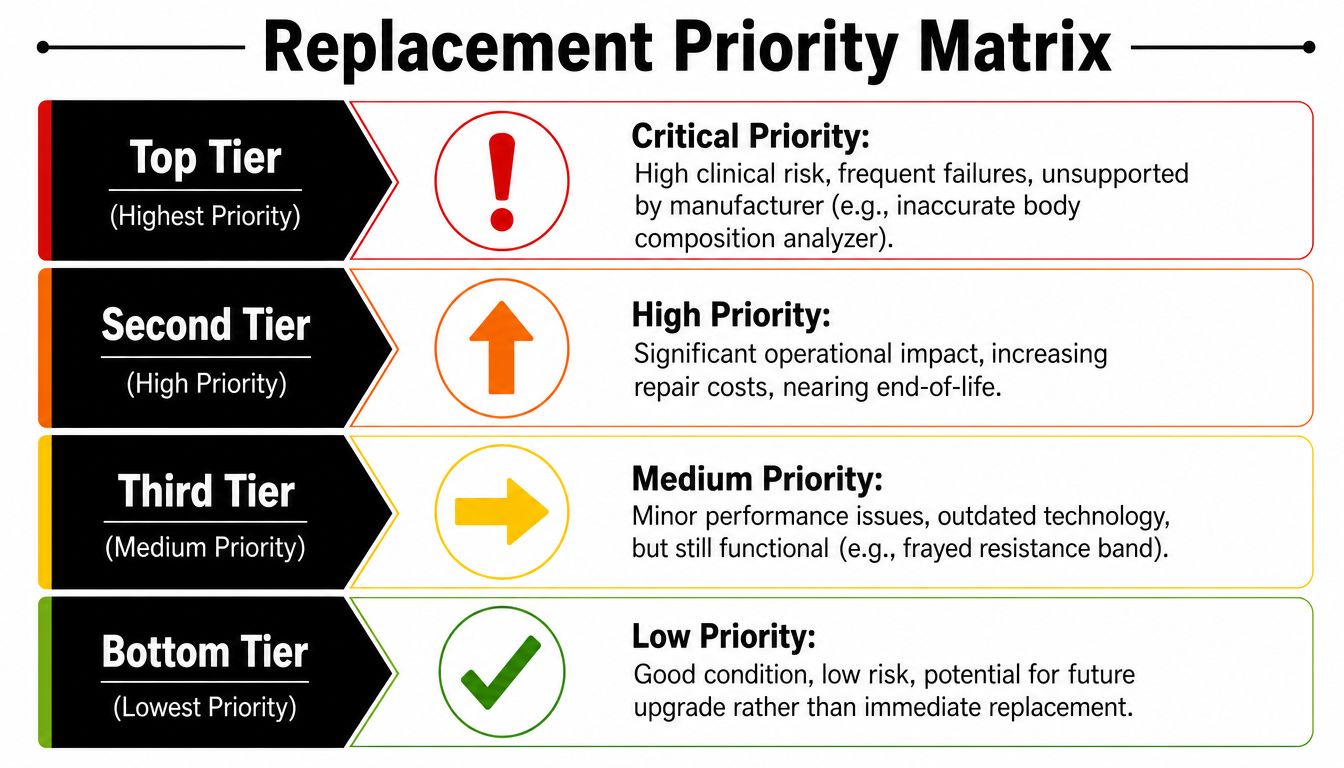
A practical method is to score each asset using a 2–6 priority matrix based on replacement need and cost, rather than relying on age or perception alone, as described by HFMA's equipment replacement methodology.
The structure is simple:
Need score
- Critical
- Moderate
- Low
Cost score
- Low
- Medium
- High
Add the two scores together to produce a range from 2 to 6. In this method, a score of 2 reflects critical need and low cost, so it should move immediately. Higher totals are not “better” assets. They often mean the replacement is more expensive, more complex, or better scheduled into a later budget cycle.
That matters because testing environments often contain an awkward mix of relatively low-cost essential tools and expensive specialist systems. A failed heart rate monitoring component or unsupported interface module might be inexpensive to replace but operationally urgent. A large analyser may be equally urgent clinically, but the funding path is different.
A practical example for testing environments
Here's how the matrix helps in real decisions:
Failing low-cost accessory linked to a core protocol
This often becomes an immediate action. If a small item can stop a validated process, delaying replacement makes no sense.Aging body composition analyser with rising faults and no easy backup
This usually lands high on the list because the clinical and reputational risk is too high to ignore.Older but stable device with acceptable output and good support
That may sit in a future cycle, even if staff would prefer a newer model.
Decision lens: Prioritise the assets that create the biggest operational or accuracy risk relative to what it takes to replace them.
A basic working table can look like this:
| Need level | Cost level | Typical action |
|---|---|---|
| Critical | Low | Replace now |
| Critical | Medium or High | Secure budget path and escalate |
| Moderate | Low or Medium | Schedule in current cycle if possible |
| Low | High | Monitor and defer unless risk changes |
This method also helps in meetings with finance. Instead of saying, “We really need to replace this analyser soon,” you can show why it sits above another asset. The matrix doesn't eliminate judgment, but it gives judgment a structure.
That's the value. It strips out politics without pretending every replacement decision is purely mechanical.
Strategic Budgeting and Financial Forecasting
A metabolic cart starts drifting out of spec in the middle of a busy assessment block. Service can patch it for a short period, but replacement is the safer call. If there is no budget path already in place, the team is forced into the worst options at the worst time. Delay the purchase, overspend in a rush, or cancel testing slots and explain unreliable output to clinicians, coaches, or clients.
That is why budgeting for replacement has to start before a device is in trouble. In clinical and performance testing settings, the cost is not limited to the invoice for a new unit. You are also protecting test accuracy, booking capacity, staff time, and confidence in reported results.

Build a replacement fund that matches operational reality
As noted earlier, a standing reserve for equipment replacement is a sound baseline. The important part is discipline. If that money sits in a general contingency line, it usually gets pulled into unrelated pressures long before a body composition analyser, ECG system, or metabolic unit fails.
Ring-fencing matters more with high-precision testing equipment because many devices appear serviceable right up to the point where they start producing inconsistent results, fail calibration, or create downtime that blocks a full testing session. By then, the service risk is already live.
I budget in three layers:
- Immediate replacements for assets already approved as urgent
- Known upcoming replacements expected within the next planning cycle
- Full changeover costs including install, validation, software setup, training, and lost capacity during transition
That third layer is where budgets often go wrong.
A replacement rarely stops at purchase price. A new analyser may need interface work, room time, network setup, staff familiarisation, disposables, or a temporary change to testing throughput. If those costs are ignored, the approved budget looks adequate on paper and falls short in practice.
Forecast by timing, not by hope
A useful forecast is tied to dates and approval windows. It is not a wish list.
For testing environments, I recommend splitting the plan into clear funding horizons:
| Time window | What belongs there |
|---|---|
| Current cycle | Approved high-risk items that should not be pushed further |
| Next 12 to 24 months | Equipment with rising service burden, aging software, or increasing calibration concern |
| Long-range capital plan | Expensive systems that need lead time, site planning, or phased approval |
This approach helps finance teams see the shape of demand instead of getting hit with isolated requests. It also gives department leads time to prepare the business case for larger items that cannot be absorbed easily.
For example, replacing a set of small peripherals is often an operating budget discussion. Replacing a metabolic cart tied to reporting software, staff protocols, and room booking templates is usually a capital project. Treating both the same causes delays.
Video can help frame these conversations with non-technical stakeholders, especially when you need to explain why reserve planning matters long before a device stops working.
Present the budget in terms leaders will act on
Finance rarely objects to replacement because the equipment matters too little. The problem is usually that the request is framed too narrowly. "We need a new machine" is weak. "We need to protect validated testing capacity and avoid reporting risk" is much harder to dismiss.
Use plain language around what the spend prevents:
- cancelled assessment slots
- repeat testing caused by questionable readings
- staff time lost to workarounds
- service disruption during peak demand
- reputational damage from inconsistent results
Supplier stability also belongs in the forecast discussion. A cheaper device with poor support can create a higher replacement cost over its life than a more expensive unit backed by dependable service and sensible parts availability. That is one reason good vendor relationship management for specialist equipment support has budget value, not just procurement value.
The goal is simple. Remove surprise from replacement spending as much as possible. In health assessment and performance testing environments, that is how you avoid rushed decisions, protect data quality, and keep the service running.
Executing Smart Procurement and Validation
A replacement project can still fail after budget approval. I have seen facilities buy a lower-cost metabolic cart, only to lose weeks sorting out software setup, calibration drift questions, and slow support responses while testing slots pile up. With clinical and performance equipment, the buying decision has to protect result quality and service continuity, not just capital spend.
The quote is only one part of the cost.
Buy for supportability, accuracy, and fit
High-precision testing devices create a different procurement risk than general facility equipment. If a treadmill motor fails, the impact is obvious. If a body composition analyzer or metabolic system produces inconsistent results, the problem can sit undetected until staff start questioning trends, repeat tests increase, or reports become harder to defend.
That is why procurement should screen suppliers against practical criteria that matter in live use:
- Validation support. Will the supplier help your team confirm the device performs properly in your setting before it goes into routine use?
- Service responsiveness. What happens when the unit is down during a busy assessment week, and who answers the call?
- Software continuity. Check reporting formats, user permissions, export options, security controls, and whether the platform will still fit your workflow a year from now.
- Consumables and calibration needs. Mouthpieces, gas supplies, printer media, electrodes, calibration kits, and subscriptions can reshape operating cost.
- Training and handover quality. A short install visit is not the same as staff being ready to run reliable tests.
Good procurement work also depends on clear expectations after the purchase. Teams that want a tighter process for service standards, escalation routes, and supplier accountability can use this guide to vendor relationship management for specialist equipment support.
A cheap unit with weak service cover often becomes expensive fast.
Validate the device before it touches live testing
Manufacturer installation is not the same as acceptance into service. For clinical and fitness testing environments, validation should confirm that the device is accurate enough for your use case, stable in your workflow, and usable by staff without workarounds that introduce error.
For a metabolic cart, that usually means checking calibration behaviour, gas and flow setup, report output, and side-by-side comparison against the outgoing system or another trusted reference where appropriate. For a body composition analyzer, it can mean verifying repeatability, settings consistency, user profile setup, and data transfer into your reporting process. The point is simple. Prove that the replacement works under your conditions, not just on the supplier's bench.
A practical acceptance checklist should cover:
- Delivery and installation checks
- Configuration of software, users, and reporting
- Calibration and performance verification
- Workflow testing in the actual assessment environment
- Staff sign-off after training
- Technical and operational approval before first live use
Document that sign-off. If results are later challenged, a documented acceptance process gives you a clear record of what was tested, who approved it, and when the device entered service.
If the outgoing unit stores user or patient information and is leaving the site as part of the replacement, include end-of-life handling in the procurement plan rather than treating it as an afterthought. This overview of ITAD for businesses and organizations is a useful reference for planning secure disposition alongside the new equipment rollout.
Managing Decommissioning and Responsible Disposal
Old equipment doesn't stop being your responsibility once the replacement arrives. Decommissioning is part of the lifecycle, and weak end-of-life handling creates fresh risks. Data can be left on devices, retired tools can linger in cupboards and reappear in use, and the asset register drifts out of reality again.
That's why the final stage needs as much discipline as the first.
Retire equipment with the same discipline used to buy it
For high-precision fitness testing environments, teams should compare current equipment age against the manufacturer's documented lifespan and retirement instructions to support decisions about accuracy and retirement, as outlined in this equipment replacement planning reference for fitness settings.
That's especially important for devices whose value depends on trust in the result. If a system is beyond its documented retirement point, unsupported, or no longer defensible for validated use, storing it “just in case” can become a bad habit.
A clean decommissioning checklist usually includes:
- Data handling for any device with stored user, patient, or client information
- Status control so retired equipment can't slip back into active service
- Trade-in review where manufacturers or suppliers offer value recovery
- Secondary market assessment if resale is appropriate and supportable
- Recycling route for equipment that has reached true end of life
For devices with digital storage or IT components, it helps to follow established disposal practices rather than improvising. A good plain-English overview of secure and responsible end-of-life handling is this guide to ITAD for businesses and organizations.
A clean exit protects the next planning cycle
The last administrative step matters more than people think. Record the retirement date, disposal path, and replacement reference in the asset register. Remove the old asset from active lists, update insurance or service records if needed, and make sure staff know it is out of service.
Here's where many facilities slip. They install the new device, celebrate that the problem is solved, and never properly close the record on the old one. A year later, the register is wrong again, the service history is fragmented, and planning quality drops.
A good replacement plan is circular. Inventory, assess, prioritise, budget, buy, validate, retire, then update the record so the next cycle starts clean.
If you need reliable, validated testing systems with practical support behind them, Cartwright Fitness supplies high-precision equipment for clinical assessments, sports science, rehabilitation, and academic testing environments. Their range covers specialist tools such as metabolic analysers, body composition systems, and official Chester Step Test equipment, backed by product expertise that helps facilities choose equipment they can trust in daily use.


