

A coach runs a threshold session and checks the wrist data between reps. The watch reports strong recovery. The athlete's breathing mechanics, pace decay, and response after the session point in the opposite direction. Poor measurement at high intensity leads to poor decisions.
Professionals need devices to measure health and performance that stay reliable under movement, sweat, impact, and rapid changes in speed. That standard is very different from what passes in day-to-day wellness tracking. A device can look convincing during rest, easy aerobic work, or controlled lab handling and still lose fidelity once the session becomes dynamic.
Consumer wearables have made self-tracking routine, and they have value for engagement and basic monitoring. In applied sport, usefulness is only part of the job. A critical question is whether the signal remains accurate, repeatable, and validated when an athlete accelerates, decelerates, changes direction, and works near threshold or above it.
At Cartwright Fitness, that is the line we use in practice. If a device cannot hold data quality during demanding training or testing, it should not drive programming, screening, return-to-play calls, or referral decisions.
Table of Contents
- Beyond the Numbers Game Why Professional Data Matters
- The Pillars of Trustworthy Measurement
- An Overview of Professional Measurement Device Categories
- Deep Dive Body Composition and Metabolic Analysis
- Deep Dive Cardiac Respiratory and Motion Analysis
- A Professional Buying Checklist and Maintenance Guide
- Integrating Data for Superior Professional Outcomes
Beyond the Numbers Game Why Professional Data Matters
Mid-session, an athlete is deep into repeated sprint work. The wrist tracker still reports a clean, reassuring picture. Meanwhile, the chest strap is dropping beats, sweat is interfering with skin contact, and the accelerometer is struggling to separate arm action from actual running load. If you rely on the wrong device in that moment, you can miss the difference between normal fatigue and a response that warrants a change in the session.
That is the gap between consumer data and professional measurement. The issue is rarely whether a device can produce a number. The issue is whether that number holds up when movement is fast, impact is high, signal quality is poor, and decisions have to be made straight away. In sport, those conditions are common, not exceptional.
Consumer wearables still have a clear role. They help with adherence, routine monitoring, and general activity awareness, as noted earlier. For habit formation, that is useful. For performance testing, return-to-play decisions, or load management, it is a thin foundation.
Professional practice asks more of the equipment and the workflow around it. The same athlete should be testable next week under the same protocol, by a different staff member, with results you can compare without wondering whether the device drifted, filtered the signal differently, or lost fidelity once intensity rose.
At Cartwright Fitness, that is usually the turning point in buying conversations. Coaches and clinicians are often less interested in extra features than in one practical question. Will this device still give me a defensible reading when the athlete is moving hard, sweating heavily, and changing direction at speed?
Practical rule: If a metric will influence training load, rehab progress, or a referral decision, get it from a validated process that matches the testing conditions, not from the most convenient screen.
Accuracy is only the start
A device can look accurate in a calm, steady protocol and still perform poorly in applied sport. High-intensity exercise introduces motion artefact, variable contact, vibration, impact, heat, and rapid physiological change. Those are the conditions that expose weak sensors and overconfident algorithms.
This matters because many popular outputs are processed estimates rather than direct measurements.
Calories, readiness scores, recovery ratings, stress summaries, and sleep-derived training recommendations may be useful prompts. They are a poor substitute for measurements you can verify against a criterion method or reproduce across repeated testing blocks. A polished dashboard does not reduce measurement error.
Why proprietary scores need scrutiny
The crowded device market makes specification sheets look more reassuring than they should. Terms such as AI-driven, performance-ready, or lab-grade do not tell you what signal was captured, how it was cleaned, or whether the result was validated during dynamic exercise.
Professionals need to separate three things. What the sensor measures. What the software estimates from that signal. What the brand infers to create a coaching-friendly score.
That distinction shapes day-to-day decisions. If you are prescribing intervals, screening fatigue, or tracking rehab progression, you need equipment that stays reliable under the conditions your athletes train in. That standard is higher than convenience, and it should be.
The Pillars of Trustworthy Measurement
If a device gives a different answer each time, or produces a neat-looking estimate that hasn't been benchmarked properly, it isn't helping your practice. It's adding noise. Professionals need a simple filter for judging equipment before they get impressed by software visuals or feature lists.
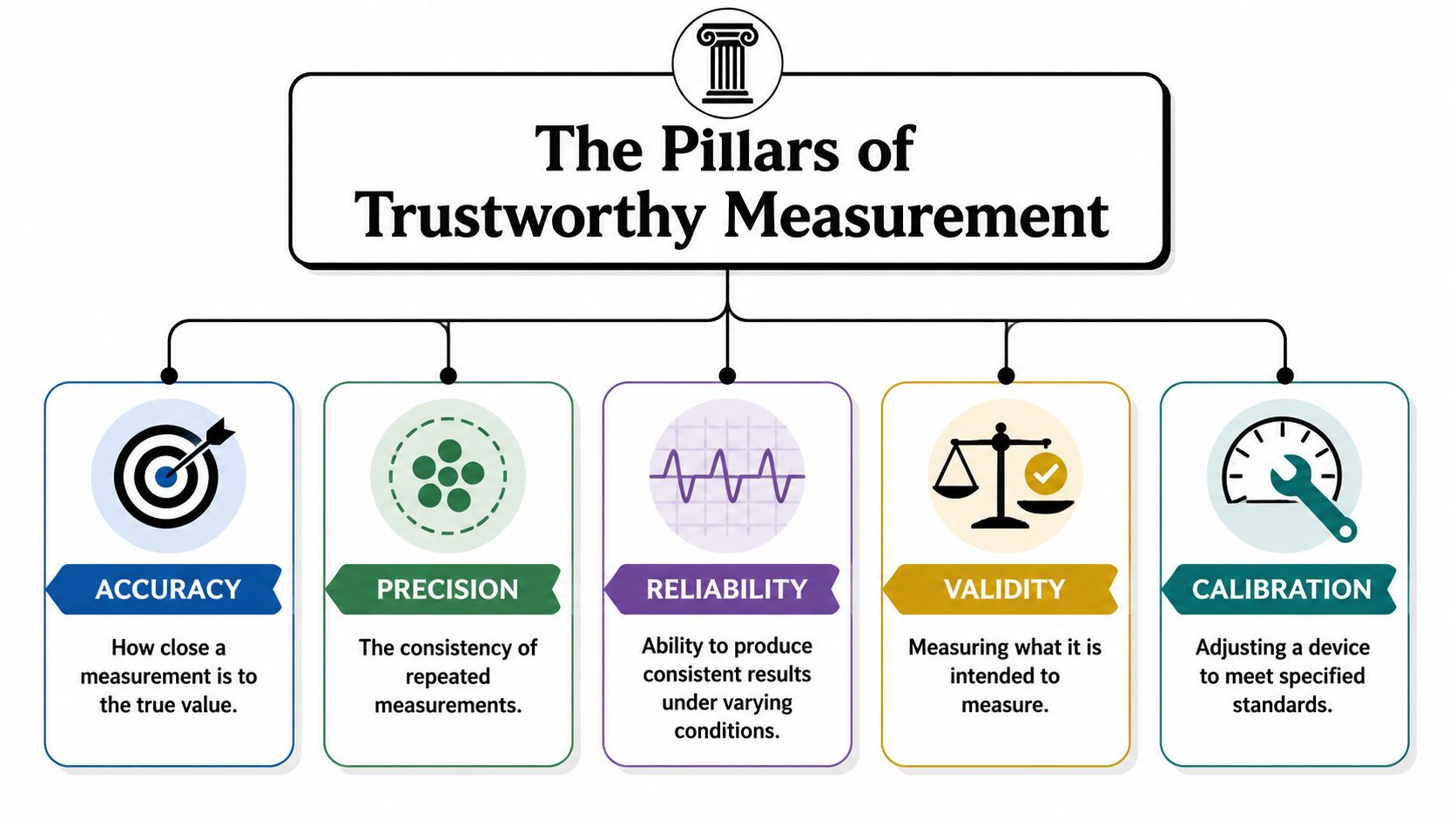
Accuracy is only the start
Accuracy asks one question. How close is the reading to the true value?
Precision asks another. If you repeat the same test under the same conditions, do you get tightly clustered results?
Reliability matters when conditions are less tidy. Can the device still perform consistently when the athlete is fatigued, moving dynamically, or being tested by different staff members?
Validity is narrower and more important than many buyers realise. A device can be reliable but still invalid if it measures the wrong thing well.
Calibration is what keeps all of the above from drifting over time. A device may have been excellent out of the box and poor a year later if nobody checked it.
A hospital thermometer and a cheap home thermometer both produce numbers. Only one is expected to hold up in a controlled clinical workflow. The same principle applies to body composition tools, gas analysis systems, force measurement platforms, and cardiac monitors.
Why proprietary scores need scrutiny
Advanced metrics often depend on software layers the buyer can't inspect. That's especially true for estimates such as V˙O2max, training effect, recovery metrics, and oxygen-related outputs. The review in this article on wearable sensors and algorithm-dependent estimates makes the point clearly. These values can vary significantly from gold-standard clinical measurements, so benchmark validation is essential before you act on them.
That doesn't make such metrics useless. It changes how they should be used.
Use them as prompts, not verdicts, unless the underlying system has been validated against a recognised standard in the context you care about.
A practical buying lens looks like this:
- Ask what is measured directly: Heart rate from a chest-based system is different from a derived recovery score.
- Ask what is estimated by algorithm: Calorie burn and training effect often sit here.
- Ask what standard it was compared against: Lab comparison matters more than marketing language.
- Ask whether the comparison included movement: Resting agreement doesn't guarantee field reliability.
A device that measures one core variable well is often more useful than a device that estimates ten variables poorly.
An Overview of Professional Measurement Device Categories
The professional realm is wider than most buyers first assume. Consumer products tend to bundle everything into one wearable. Professional setups split the job into categories because different questions require different sensors, protocols, and validation pathways.
The broader wearables market shows how varied measurement hardware has become. Among users of wearable health technology, 43% use fitness bands, 28% use smartwatches, and 12% use smart clothing, according to the University of Colorado Anschutz summary on wearable health measurement technology. That same overview notes earlier milestones such as wireless heart rate monitors in the 1980s and 3D accelerometers in the Nokia 5500. The lesson for professionals is straightforward. Form factor has expanded quickly, but clinical and performance usefulness still depends on the measurement job being matched to the right tool.
Where each category earns its place
Body composition analysers help you move beyond scale weight. In practice, these tools are used to track fat mass, lean mass trends, girths, and segmental change. They're common in clinics, performance facilities, and academic settings where nutritional strategy or rehab monitoring matters.
Metabolic analysers sit closer to exercise physiology. They're used to examine oxygen uptake, carbon dioxide production, resting metabolic rate, and exercise responses. These systems are most at home in labs, but strong field applications exist when protocols are tight.
Respiratory measurement tools focus on breathing mechanics and pulmonary response. They matter in fitness testing, respiratory screening, and exercise tolerance work. Depending on the setup, they can support both clinical and athletic assessment.
Cardiac monitoring equipment covers everything from chest-strap heart rate systems to more advanced setups used during graded exercise protocols. The professional distinction is less about whether heart rate is tracked and more about signal quality, artefact handling, and how the system performs under load.
Motion and force systems include timing gates, jump systems, force plates, and movement sensors. These are critical when the question is about power, asymmetry, deceleration, contact time, or movement strategy rather than just cardiovascular strain.
Professional Measurement Device Categories at a Glance
| Device Category | Primary Function | Key Metrics Measured | Primary Use Case |
|---|---|---|---|
| Body composition analysers | Assess physical tissue and size characteristics | Fat mass estimates, lean mass trends, girths, subcutaneous tissue measures | Nutrition planning, progress tracking, rehab monitoring |
| Metabolic analysers | Measure physiological response to rest or exercise | Oxygen uptake, carbon dioxide output, metabolic response | Exercise testing, conditioning prescription, research |
| Respiratory measurement tools | Examine breathing function and exercise response | Ventilatory patterns, breathing response during protocols | Clinical assessment, fitness testing, tolerance testing |
| Cardiac monitoring equipment | Capture cardiovascular response | Heart rate, rhythm-related response, effort-related trends | Exercise prescription, protocol monitoring, recovery observation |
| Motion and force systems | Quantify movement and mechanical output | Power, force, contact time, asymmetry, jump metrics | Performance testing, return to play, biomechanics |
One useful way to think about professional devices to measure is this. Some tools answer “how much.” Others answer “how well.” Scale weight and step count tell you how much. Metabolic data, force data, and validated exercise responses tell you how well the system is functioning.
That difference is what turns assessment into decision support.
Deep Dive Body Composition and Metabolic Analysis
A common scenario in applied sport is an athlete whose body mass has stayed stable while repeat sprint quality drops and fuelling decisions are being questioned. Basic tracking does not solve that problem. You need methods that separate tissue change from fluid shift, and metabolic testing that reflects how the athlete responds under load.
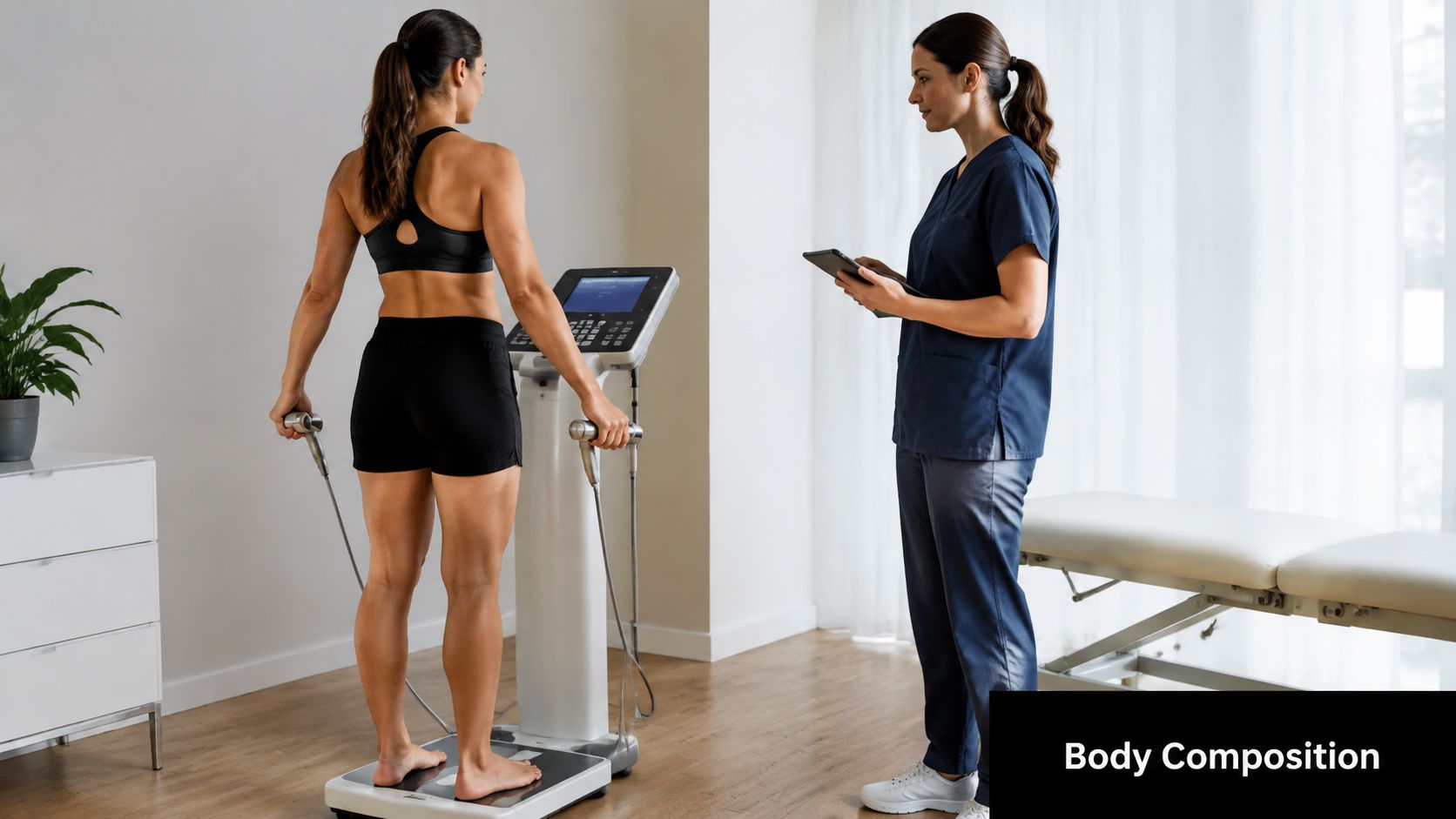
Body composition that guides action
Body composition data is easy to collect badly and easy to overinterpret. The method matters, but the testing discipline matters just as much. In practice, a consistent protocol usually does more for decision quality than an impressive-looking output screen.
Bioelectrical impedance analysis is useful for monitoring trends if hydration, recent training, food intake, and test timing are controlled tightly. If those inputs drift, the estimate drifts with them. That is why BIA works best as part of a standardised monitoring system, not as a one-off verdict on an athlete's condition.
Skinfolds and ultrasound give a more site-specific view of subcutaneous tissue. They also expose operator quality very quickly. Poor landmarking, variable pinch technique, or inconsistent probe placement will show up in the data, so staff training and repeatability checks are part of the method, not an optional extra.
A practical workflow usually includes:
- Girths for context. Tape measures often catch meaningful change that a single body fat estimate misses.
- A repeatable site method. Skinfold or ultrasound only works if the same landmarks and sequence are used every time.
- Tight pre-test controls. Time of day, prior session load, hydration status, and meals all affect interpretation.
- Trend review over single-read fixation. Longitudinal patterns are more useful than one dramatic reading.
Cartwright Fitness supplies tools used in this part of professional assessment, including anatomical tape measures, BodyMetrix Professional Ultrasound systems, and BIA-related testing equipment alongside other performance testing hardware.
The best body composition method is the one your staff can repeat accurately, under the same conditions, over time.
Metabolic analysis for programming, not guesswork
Metabolic testing answers a different question. It shows how the athlete is producing energy at rest and during exercise, which is where prescription gets sharper and coaching errors become easier to spot.
Indirect calorimetry systems, including setups commonly associated with Cosmed equipment, measure oxygen uptake and carbon dioxide output during rest or exercise. That gives practitioners a clearer view of metabolic response, substrate use, and exercise intensity than consumer estimates. It also matters more in sport settings where the primary challenge is keeping signal quality and protocol control intact as intensity rises, breathing rate changes, and movement becomes less tidy.
That high-intensity point is often missed. Plenty of devices look acceptable in steady conditions. Fewer hold their value when an athlete is working near threshold, transitioning quickly between stages, or trying to maintain mechanics under fatigue. For sports scientists and performance coaches, that is the difference between useful physiology and expensive noise.
A practical setup often pairs resting metabolic assessment with exercise testing. Resting data can support nutrition planning. Exercise data can help set training zones with more confidence and show whether the athlete is working at the intended physiological demand.
Here's a useful demonstration of the kind of metabolic assessment workflow professionals often build around:
When selecting metabolic devices to measure performance, a few details matter more than a long feature list:
- Mask fit and seal quality. Poor collection will undermine accurate hardware.
- Protocol design. Ramp rate, stage duration, and stopping criteria all shape the result.
- Consumables and serviceability. Ongoing costs often decide whether the system gets used properly.
- Software export and reporting. Clean analysis matters if the data will inform real programming decisions.
Good metabolic data comes from the full system: hardware, protocol, operator skill, and athlete compliance. Get those right, and the results are actionable in a way basic trackers are not.
Deep Dive Cardiac Respiratory and Motion Analysis
Many devices fall short under certain circumstances. Resting measurements are one thing. High-intensity movement is another. Once an athlete is accelerating, changing direction, sweating heavily, gripping handles, or producing repeated impacts, signal quality gets challenged from every angle.
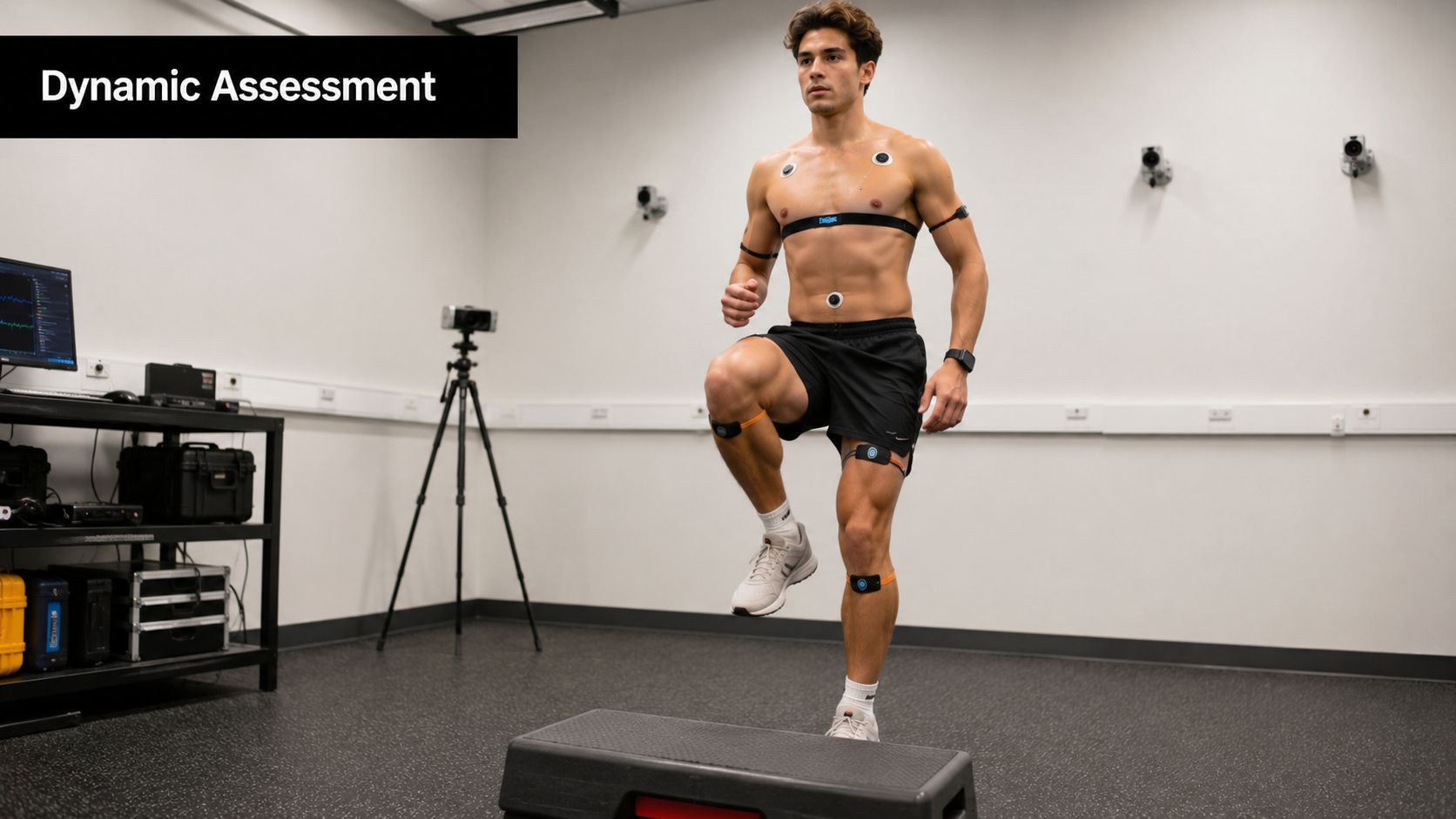
Dynamic testing changes the standard
Wearable heart rate and activity monitors often perform reasonably in steady, low-noise conditions. The problem is that sport rarely happens there. Research highlighted in this ScienceDirect paper on wearable sensor drift during exercise found that 52% of common wearable monitors showed error rates greater than 15% during high-intensity interval training compared with rest. That's the issue many buying guides ignore.
If your environment includes repeat sprint work, combat sport, team sport conditioning, loaded circuits, or step-based exertion protocols, you need to know how the system behaves under movement stress, not just in a seated validation test.
That's why validated chest-based cardiac monitoring, well-controlled respiratory testing setups, and properly anchored motion or force systems still matter. They're built around reducing artefact, preserving fidelity, and allowing the tester to trust the signal when the athlete's effort rises.
What robust field and lab setups do differently
In practical terms, good dynamic assessment systems do a few things well.
- They secure the sensor properly: Loose placement is one of the fastest ways to create junk data.
- They use protocols with known demands: Step tests, graded exercise tests, and repeated movement tasks let you interpret the response in context.
- They separate physiological signal from motion artefact: Better hardware and better filtering both matter.
- They pair the device with a testing method that has a defensible standard: The protocol is part of the measurement.
Cardiac and respiratory assessment during exercise often works best when you stop expecting one device to do everything. A solid heart rate system, a validated exercise protocol, and a simple motion or force tool can produce better applied insight than a single all-in-one wearable.
If a monitor performs well at rest but loses fidelity when the athlete moves hard, it isn't a performance tool. It's a resting tool.
Motion analysis follows the same principle. Force plates, jump systems, and structured movement sensors are valuable because they capture mechanics directly enough to support comparison over time. They aren't useful just because they produce many outputs. They're useful when those outputs remain stable across repeated efforts and standardised tasks.
For coaches and sports scientists, this changes the buying mindset. Don't ask whether a device can track exercise. Ask whether it can hold measurement quality during exercise.
A Professional Buying Checklist and Maintenance Guide
Buying equipment is easy. Building a measurement system is harder. The strongest setups usually come from teams that know exactly what question they need answered and refuse to be distracted by broad feature lists.
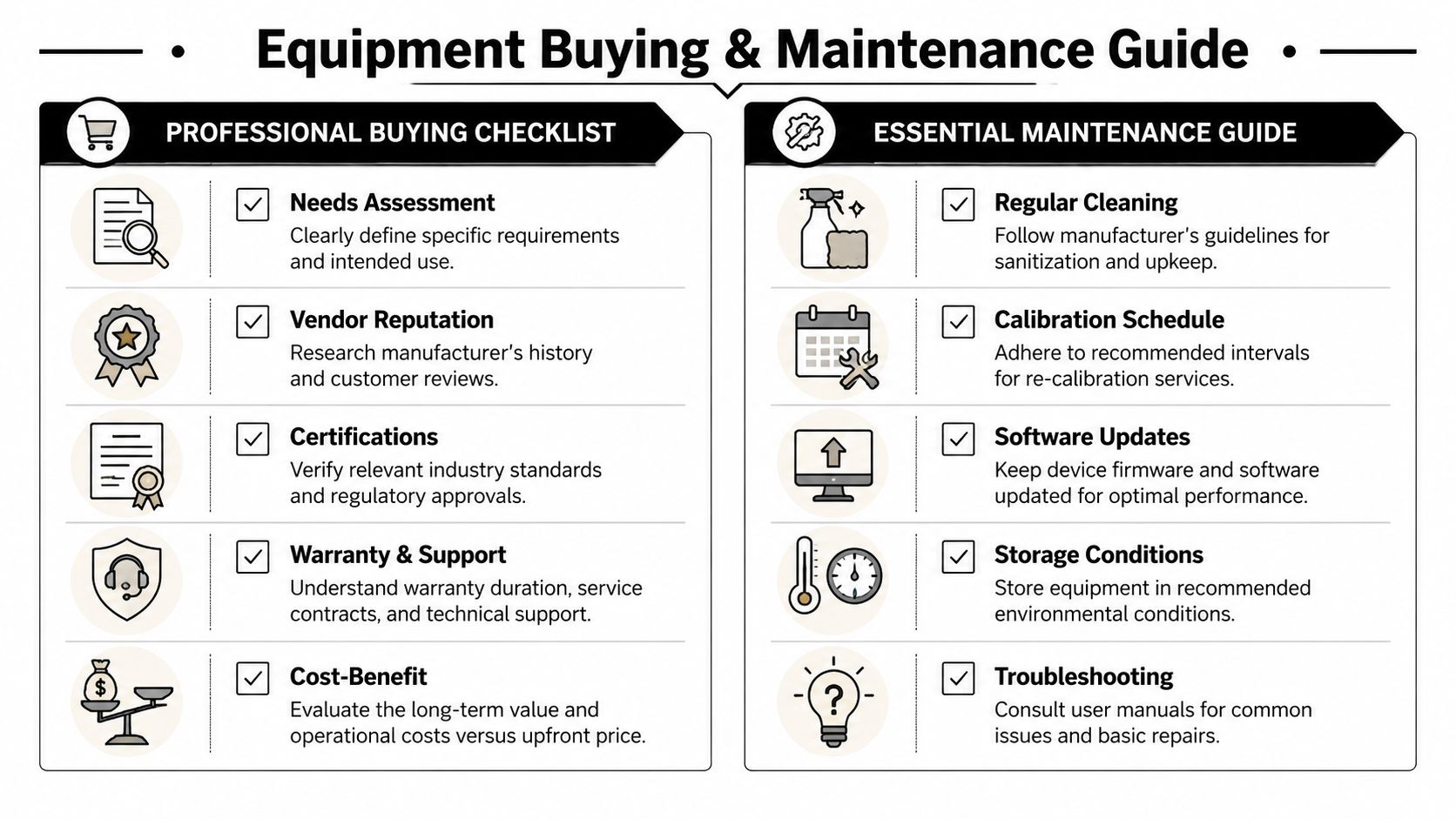
Questions worth asking before you buy
Start with the problem, not the product. Are you screening health risk, tracking training response, supporting rehab progression, or conducting academic testing? The right devices to measure one of those jobs may be poor for the others.
Then press vendors on evidence and workflow.
- What was the device validated against: Ask for the comparison standard, not just “validated” language.
- Under what conditions was it tested: Rest, steady-state exercise, and high-intensity movement are different worlds.
- Who was included in validation work: Population matters for interpretation and fairness.
- How is calibration handled: User calibration, factory service, or both.
- What data can be exported: If the system traps data in a closed dashboard, your analysis options narrow.
- What support exists after purchase: Consumables, servicing, training, and turnaround times all affect real use.
One issue deserves more attention than it usually gets. Validation across diverse populations. The evidence discussed in this review on wearable validation gaps in underserved populations notes that 65% of lower-cost devices used in underserved communities lacked calibration against medical standards. For professionals, that isn't just a public health issue. It's a practice quality issue. If your client base is diverse, your equipment choice needs to reflect that reality.
Maintenance is part of measurement quality
Many teams treat maintenance as an admin task. It isn't. It's part of the measurement chain.
Create a written schedule for cleaning, firmware checks, strap replacement, battery checks, calibration, sensor inspection, and staff refresher training. If your testing team changes hands often, include protocol audits too. Poor operator consistency can make good equipment look unreliable.
A workable maintenance routine should include:
- Pre-session checks: Sensor condition, charging status, straps, cables, and consumables.
- Scheduled calibration review: According to manufacturer guidance and internal quality control.
- Protocol standardisation: Same setup, same timing, same instructions where possible.
- Logging deviations: Missed calibrations, changed parts, and unusual test conditions should be recorded.
Equipment quality declines quietly when nobody owns the calibration schedule.
Specification sheets don't usually warn you about this. They'll list features. They won't tell you whether your team has the discipline to keep the system trustworthy. That part is on the operator.
Integrating Data for Superior Professional Outcomes
The most useful professional setups don't rely on one heroic metric. They combine several validated measures into a profile that helps you act. Body composition can show whether mass is changing in a useful direction. Metabolic testing can show how the athlete or client is producing energy. Cardiac, respiratory, and motion data can show how that physiology expresses itself during effort.
That integrated view is where better decisions come from. You stop chasing isolated readings and start looking for patterns that agree with each other. If multiple validated tools point the same way, your prescription gets stronger. If they conflict, that's a sign to investigate before making a major programming call.
For professionals, that's the true value of investing in better devices to measure health and performance. Not more dashboards. Better evidence.
Cartwright Fitness supports practitioners who need validated testing equipment for body composition, metabolic assessment, respiratory measurement, and protocol-based fitness testing. If you're reviewing your current setup or replacing consumer-led workflows with professional systems, explore the range at Cartwright Fitness.