

A VO₂ result can look precise on a report while still leaving a laboratory team uneasy. The treadmill protocol was slightly different, the operator rushed calibration, or a resting measurement was collected in a mode that behaves differently at low workload. When a patient, athlete, student cohort or occupational-health decision depends on the result, “the machine produced a number” isn't enough.
A COSMED metabolic cart is a professional measurement system, not a fitness device with a display. Its credibility depends on the relationship between gas analysis, flow measurement, calibration, protocol selection and interpretation. That distinction matters to clinical physiologists, sports scientists, rehabilitation teams, university laboratories and occupational-health providers.
This guide explains how a COSMED system works, how Quark CPET and portable platforms differ, why breath-by-breath and mixing-chamber modes shouldn't be treated as interchangeable, and how UK purchasers can think about servicing and consumables. It also places metabolic testing alongside wider professional assessment, including the 14 tests in metabolic panel resource, Chester Step Test, dynamometry and anthropometry.
Table of Contents
- Introduction Why Accurate Metabolic Measurement Matters
- What a Cosmed Metabolic Cart Is and How It Works
- Key Cosmed Metabolic Cart Models and Features Compared
- Validation Accuracy and Protocol Considerations You Should Know
- Setup Calibration and Maintenance for Reliable Results
- How to Choose the Right Cosmed Metabolic Cart for Your Use Case
- Putting Metabolic Testing Into Professional Practice
Introduction Why Accurate Metabolic Measurement Matters
A practitioner may begin with a straightforward question: what is this person's aerobic capacity, resting energy expenditure or physiological response to a defined workload? The difficult part comes later, when the result needs to be compared with a previous assessment, explained to a referring clinician, or defended in an occupational-health report.
A metabolic cart measures respiratory gases and ventilation directly, then uses those measurements to derive variables such as oxygen uptake and carbon dioxide production. That makes it different from a consumer estimate based mainly on heart rate, movement or an algorithm. The equipment can provide a much stronger physiological basis, but only when the testing conditions and operating method remain controlled.
Professional rule: A defensible result is produced by the system, the operator and the protocol together.
COSMED has been active since 1980, giving the company 46 years of experience by 2026 in cardiopulmonary, metabolic and body-composition assessment technologies, as documented in its company and product history. In the UK, COSMED metabolic carts are used in professional exercise testing and clinical settings, including a documented Fitmate PRO deployment at McBride Physiotherapy for VO₂max testing. Independent validation has also examined portable systems against stationary metabolic carts, supporting the brand's position as a mature measurement platform rather than an emerging category.
That history doesn't remove the need for local quality control. A validated cart can still produce biased data if a gas cylinder is incorrectly connected, a flow sensor is not verified, a mask leaks, or a test mode doesn't suit the question being asked. The right approach is to treat each assessment as a controlled measurement process.
The practical questions are therefore broader than “which model has the most features?” A professional team needs to ask what population it tests, whether the work is resting or exercise based, whether the system must travel, how often testing takes place, what integration is required, and how recurring ownership costs will be managed.
What a Cosmed Metabolic Cart Is and How It Works
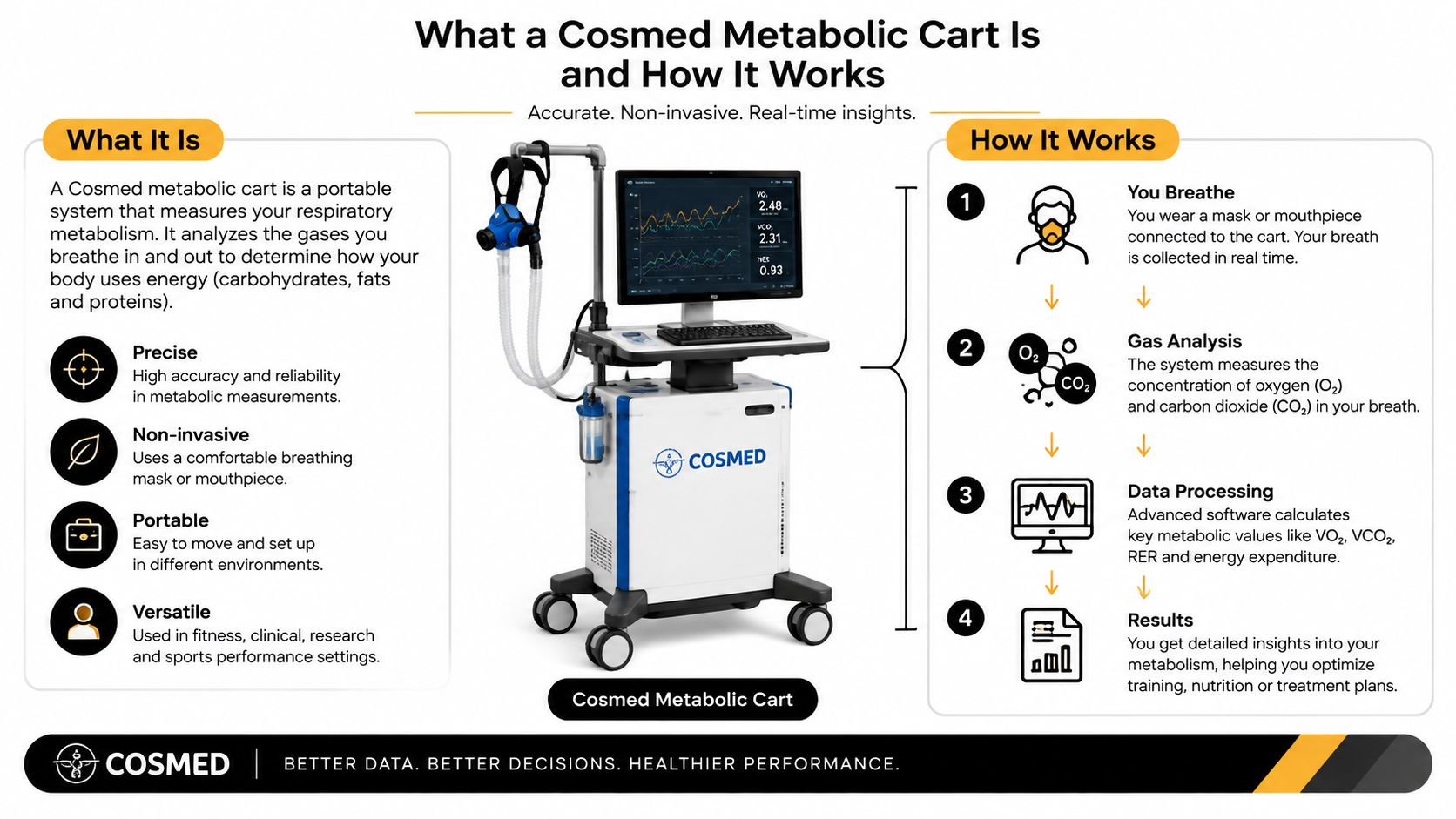
Indirect calorimetry estimates energy metabolism from the gases a person breathes. The system measures the oxygen entering the respiratory circuit and the carbon dioxide leaving it, alongside the volume and timing of ventilation. From those signals, software calculates variables such as VO₂, VCO₂, minute ventilation and related respiratory measures.
A useful analogy is a laboratory balance. The balance doesn't guess an object's mass from its appearance. It measures a physical signal, checks the instrument against a known reference and then reports the result. A metabolic cart follows the same logic, except the measured inputs are respiratory flow and gas concentrations.
The measurement pathway
During a test, the participant breathes through a mask or mouthpiece connected to a flow sensor and gas-analysis system. The flow measurement describes how much air moves and when it moves. The gas analysers determine the oxygen and carbon dioxide fractions, allowing the software to calculate gas exchange over individual breaths or across a mixed sample.
In breath-by-breath mode, the system follows rapid changes in each breath. This can be valuable when the protocol includes changing workloads, short stages or low-intensity responses that need close temporal resolution. In mixing-chamber mode, expired gas is mixed before analysis, producing a smoother signal that can be useful in selected applications but shouldn't automatically be assumed to have identical behaviour at rest or during submaximal work.
The cart also depends on a defined software workflow. The operator selects the participant, equipment configuration and protocol, verifies calibration, records the test and reviews the output for artefacts or implausible transitions. Results should be interpreted with the workload, heart rate, symptoms, perceived exertion and test termination criteria in view.
The metabolic gas analysis equipment range places COSMED systems within a broader professional category that includes resting and exercise assessment rather than consumer fitness tracking. A compact analyser such as the Cosmed Q-NRG Max Metabolic Analyser is listed for metabolic analysis, individual assessment and aerobic-capacity work, with an easy workflow and ready-to-use format. Price and further information are available from Cartwright Fitness at sales@cartwrightfitness.co.uk.
Key Cosmed Metabolic Cart Models and Features Compared
Model selection starts with the job the equipment must perform. A stationary cart such as Quark CPET is designed around cardiopulmonary exercise testing and laboratory workflow. A portable system such as K5 is more relevant when the measurement needs to move with the participant, whether that means a field protocol, walk test or extended exercise assessment.
COSMED's validation material describes Quark CPET as a gas-exchange metabolic cart for VO₂ and VCO₂ measurement during exercise or resting protocols. The platform can therefore sit naturally in a clinical physiology laboratory, university teaching environment or performance centre where controlled test conditions and repeatable workstation operation are priorities.
Portable systems change the practical balance. They can support field testing and reduce the assumption that every assessment must happen beside a fixed laboratory treadmill or cycle ergometer. Independent research concluded that the COSMED K5 was “almost as accurate as a state-of-art stationary metabolic cart” and could measure energy expenditure reliably for more than 2 hours of continuous work (independent K5 validation research). That makes portability relevant to field-based occupational testing and longer-duration performance work, while still requiring careful operator control.
Cosmed Metabolic Cart Options at a Glance
| System | Best For | Key Features |
|---|---|---|
| Quark CPET | Clinical, laboratory and structured exercise testing | Gas-exchange measurement for VO₂ and VCO₂ during exercise or resting protocols, with breath-by-breath operation and selected mixing-chamber use |
| K5 | Portable laboratory and field assessment | Wearable metabolic testing, portable operation and breath-by-breath measurement, with field-use relevance |
| Fitmate PRO | VO₂max and professional metabolic testing | Documented UK use for VO₂max testing at McBride Physiotherapy, within the wider COSMED product family |
The table isn't a substitute for a technical specification review. It highlights a more important distinction: stationary precision and portable flexibility solve different operational problems. A clinical service with a fixed exercise-testing room may gain little from prioritising mobility. An occupational-health provider assessing workers away from a laboratory may value transportability and deployment more highly.
Validation Accuracy and Protocol Considerations You Should Know
“Validated” describes evidence that a device has been compared with an established reference under defined conditions. It doesn't mean every configuration, sampling mode or workload produces the same level of agreement. The operator must therefore read validation as a protocol-specific question, not as a universal label.
COSMED validation work has compared Quark CPET with the Douglas bag system during aerobic exercise. Independent evaluations from the Australian Institute of Sport and Swedish Sports Confederation have also supported its accuracy for athlete metabolic-rate assessment, while later portable-system research examined K5 performance against a stationary metabolic cart. These comparisons are useful because they relate COSMED measurements to reference methods used in human-performance and physiological laboratories.
Why sampling mode changes the interpretation
The most important practical issue for low-intensity work is the difference between breath-by-breath and mixing-chamber operation. In an independent comparison of the COSMED Quark CPET, breath-by-breath mode matched a stationary reference well, while mixing-chamber mode overestimated VO₂ by 13.4% at rest and 5.8% at 60 W (COSMED Quark CPET product and validation information).
For occupational-health screening, resting metabolic assessment, submaximal exercise and rehabilitation, that finding has a direct operational consequence. Breath-by-breath mode is the safer default when the clinical question concerns low workloads or small changes in response, unless a laboratory has a specific reason to use another configuration and has verified its behaviour under that protocol.
Independent reliability testing using methanol combustion found that COSMED Quark CPET measured all three core variables within 2% of true values (COSMED Quark CPET reliability evidence). The result supports the instrument's measurement capability, but it doesn't remove the need for local gas calibration, flow calibration, leak checks and verification.
A validation paper answers whether the instrument can perform under tested conditions. A quality-control process answers whether today's measurement deserves trust.
Setup Calibration and Maintenance for Reliable Results
A consistent station begins before the participant enters the room. The operator should stabilise the testing environment, inspect tubing and masks, confirm the correct gas supply, check power and allow the system to reach a stable operating condition. Small omissions can become large sources of variation when several operators share the same cart.
A repeatable daily routine
The sequence below gives a practical structure for a UK clinical, university or occupational-health laboratory:
Prepare the room and equipment. Keep the environment stable, remove unnecessary movement around the breathing circuit and inspect all connections for damage or leaks.
Calibrate the gas analysers. Use the prescribed reference gas and check oxygen and carbon dioxide channels according to the manufacturer's workflow. A calibration is only useful when the correct cylinder, regulator and connection path are used.
Calibrate flow. Use the appropriate calibration syringe or flow device to verify volume measurement across the intended range. Flow errors affect ventilation and gas-exchange calculations together.
Run a verification check. A metabolic simulator or equivalent verification procedure can show whether the complete system behaves plausibly after calibration. The operator should record the outcome rather than relying on memory.
Standardise participant preparation. Record posture, rest period, mask or mouthpiece choice, exercise equipment, protocol, environmental observations and any deviations. The same instructions should be used when results are compared longitudinally.
Maintain hygiene and consumables. Clean reusable components, replace filters where required, inspect seals and keep a stock record for items that can interrupt testing. Maintenance should be scheduled rather than postponed until a result looks unusual.
The COSMED metabolic cart calibration guidance can support teams building a documented calibration and maintenance pathway. A simple quality-control log should include the date, operator, equipment configuration, gas and flow checks, verification outcome, service actions and any incident affecting interpretation.
Rushed calibration is a common workflow risk. Environmental drift, inconsistent mask fitting and undocumented changes in protocol can make a longitudinal dataset look more variable than the participant's physiology. The remedy isn't always more technology. Often, it is a shorter, clearer operating procedure that every trained operator follows in the same order.
How to Choose the Right Cosmed Metabolic Cart for Your Use Case
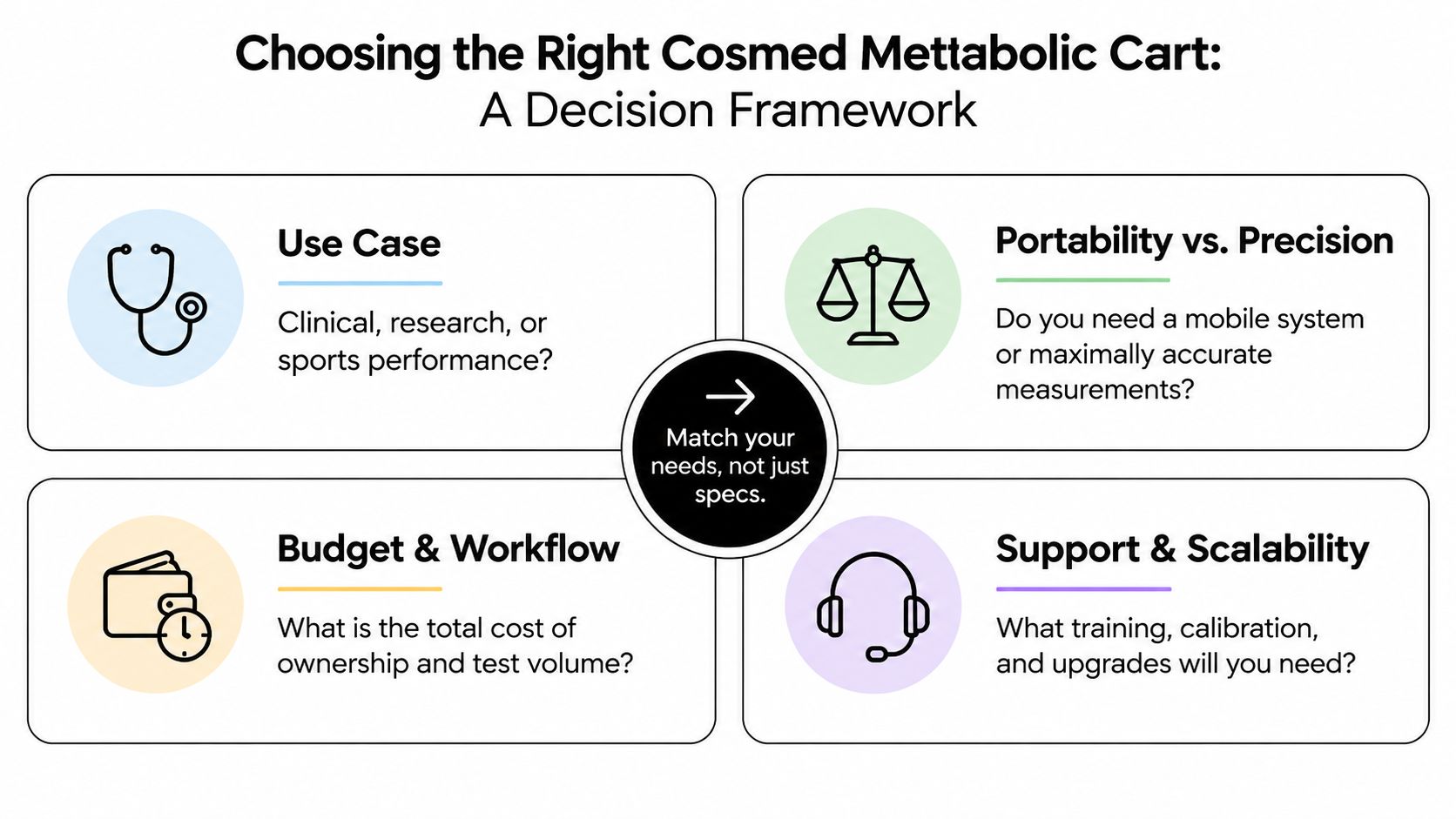
The right COSMED metabolic cart is the one that fits the assessment question and the service around it. A university laboratory teaching cardiopulmonary exercise testing may prioritise a stable workstation, accessible software workflow and repeatable demonstrations. An occupational-health provider may need a system that can travel, tolerate varied locations and produce reports that different practitioners can interpret consistently.
A clinical physiology service should first define whether it needs resting measurement, exercise gas exchange, spirometry, CPET integration or a combination of these functions. A sports-performance laboratory may place greater emphasis on portable testing, field deployment and longer-duration exercise. Rehabilitation teams need particular care with low workloads, symptom-limited protocols and interpretation of small physiological responses.
Use the decision questions that procurement documents often miss
Start with the population. Healthy athletes, clinical patients, occupational cohorts and students bring different practical requirements. The assessment environment, contraindications, supervision and reporting pathway should be specified before the model is shortlisted.
Define the protocol before comparing specifications. If the service relies mainly on resting or low-intensity testing, the team should consider how sampling mode affects bias. If testing moves between sites, portability becomes a workflow issue rather than a marketing feature.
Calculate ownership, not just purchase price. A UK public procurement notice for COSMED metabolic carts and portable analysers separately budgeted annual servicing, preventive maintenance and consumables over a five-year contract. The published figures were £8,000 per year for servicing and £10,000 per year for consumables across the contract period (UK public procurement notice for COSMED metabolic carts). Those figures indicate the scale of recurring costs that procurement teams should model, including calibration gases, service visits and consumables, rather than treating the cart as a one-off purchase.
Plan the reporting pathway. Equipment produces measurements, but practitioners still need standardised interpretation, assessment histories and professional reports. Cartwright Fitness is developing Cartwright Assess, a professional assessment software platform intended to standardise testing, calculate and interpret results, maintain client assessment histories and generate professional reports. Teams should assess how any software fits their existing governance, data and reporting processes.
The strongest procurement case links each requested feature to a defined task. For example, a fixed CPET laboratory may justify a stationary Quark CPET because its main requirement is controlled cardiopulmonary exercise testing. A field-based occupational service may justify a portable K5 because the measurement must follow the worker and the assessment setting. The decision becomes easier when the team documents the job to be done, the acceptable sources of variation and the total cost of keeping the service operational.
Putting Metabolic Testing Into Professional Practice
Metabolic testing becomes most useful when it sits inside a wider, standardised assessment pathway. VO₂ and VCO₂ can describe cardiorespiratory response, while the Chester Step Test offers a progressive submaximal occupational fitness measure. The Chester protocol uses five 2-minute stages, progressing from 15 to 35 steps per minute in 5-step increments, with a maximum duration of 10 minutes. It ends when heart rate reaches 80% of age-predicted maximum or perceived exertion reaches Borg RPE 14 (Chester Step Test protocol).
The test requires a low step, heart-rate monitoring and an RPE chart. Its published protocol calculates aerobic capacity by entering stage heart rates into dedicated Chester Step Test software or a graphical datasheet (original Chester Step Test publication). That makes it a standardised occupational assessment, not a generic step routine.
Metabolic testing can also complement grip dynamometry, back and leg strength, body composition, anthropometry and functional assessment. Each method answers a different question. The quality of the service depends on matching the instrument and protocol to that question, then documenting the conditions well enough for another practitioner to understand and repeat the assessment.
A sustainable service therefore needs four elements:
- Validated equipment: A COSMED system selected for the actual population and test environment.
- Controlled protocols: Defined preparation, sampling mode, workload, termination and reporting rules.
- Operator competence: Training in calibration, artefact recognition, participant supervision and interpretation.
- Ongoing quality assurance: Service records, consumables management, verification logs and consistent software workflows.
The purchase decision should be followed by implementation planning. Teams should define who calibrates the cart, who authorises protocol changes, how abnormal data are reviewed and how reports are stored. That work turns a capable analyser into a dependable professional measurement service.
Cartwright Fitness supplies professional assessment equipment and solutions for COSMED metabolic and respiratory testing, aerobic-capacity assessment, Chester Step Test, dynamometry, body composition and occupational fitness workflows. Visit Cartwright Fitness to discuss suitable equipment, calibration support, training and assessment software for a defensible testing pathway.


