

Acquiring a new client can cost up to 5x more than retaining an existing one, and repeat buyers spend about 67% more than first-time shoppers, according to customer retention statistics compiled by Flowlu. That's the clearest reason to take client retention strategies seriously. If you run a clinic, performance lab, university department, or coaching business, your best growth often comes from helping current clients stay active, confident, and consistent.
Too many businesses still treat retention like a follow-up email and a discount code. That approach misses the true drivers of loyalty in professional health and fitness settings. When clients rely on tools like Chester Step Test kits, BodyMetrix systems, Cosmed metabolic analysers, Seca body composition devices, or Omron monitoring equipment, retention depends on trust in the data, confidence in the protocol, and support that keeps the workflow moving.
The strongest retention systems in 2026 aren't generic. They connect service, training, maintenance, reporting, and reassessment into one predictable client journey. That matters even more in periodic testing environments, where clients don't pay a monthly subscription but still need repeat evaluations, calibration support, consumables, and technical reassurance to keep using the equipment properly.
If you want stronger renewal behaviour, more repeat orders, and fewer clients drifting away unnoticed, start with the tools and workflows your clients already depend on. Use them to create habits, milestones, and value that are hard to replace.
Table of Contents
- 1. Personalized Equipment Training & Certification Programs
- 2. Proactive Technical Support & On-Site Maintenance Services
- 3. Client Success Metrics Dashboard & Reporting Portal
- 4. Loyalty & Rewards Program with Tiered Benefits
- 5. Industry-Specific Content Marketing & Thought Leadership
- 6. Customized Solutions & Consultation Services
- 7. Community Building & User Forums/Groups
- 8. Predictive Churn Analysis & Proactive Intervention
- 9. Multi-Year Partnership Agreements & Service Bundles
- 10. Regular Business Reviews & Account Management
- Top 10 Client Retention Strategies
- Turn Insights Into Loyalty Your Next Steps
1. Personalized Equipment Training & Certification Programs

Clients stay when they feel competent. If a coach buys a BodyMetrix Professional Ultrasound system or a clinic installs a Cosmed metabolic analyser and the team only understands half the workflow, usage drops fast. Low confidence turns precise equipment into an expensive shelf item.
Build a structured training programme around every core device you sell or support. For a Chester Step Test kit, that might mean setup, protocol selection, result interpretation, and client communication. For Cosmed or Seca systems, go further into repeatability, data handling, and common operator errors.
Build confidence before you sell the next service
A trainer who can explain results clearly will schedule more reassessments. A physiotherapist who trusts the protocol will bring the tool into routine case reviews. That's how training becomes retention.
Use principles of exercise prescription guidance as part of a wider education pathway so staff connect measurement with programming, not just device operation.
Practical rule: Certify people on interpretation, not only button clicks.
Create a training ladder clients want to complete
Don't stop at one onboarding session. Offer basic, intermediate, and advanced levels with renewal expectations, live demos, short refresher videos, and equipment-specific quick guides. Give each level a clear use case, such as entry-level testing for gym inductions, advanced metabolic profiling for sports performance, or repeat body composition reviews for clinical progress tracking.
This works especially well in facilities with staff turnover. New team members need a fast route to competence, and existing staff need a reason to stay sharp.
A simple structure works well:
- Basic level: Safe setup, standard protocol delivery, and cleaning routines
- Intermediate level: Result interpretation, repeat testing standards, and troubleshooting
- Advanced level: Complex cases, staff mentoring, and audit-ready documentation
Later in the training cycle, add a demonstration resource clients can revisit:
2. Proactive Technical Support & On-Site Maintenance Services
Support quality has a direct effect on retention. Independent guidance consistently highlights omnichannel support, response time, resolution rate, and proactive customer-success touchpoints as powerful retention drivers, as noted in UserTesting's retention guidance. In clinical and fitness settings, that doesn't just mean answering emails quickly. It means preventing disruption before clients lose trust.
A university lab with a delayed calibration check doesn't face mere inconvenience. It risks unusable comparison data, delayed teaching sessions, or missed testing windows for athletes and participants.
Remove downtime before it becomes churn
Offer scheduled maintenance and service outreach as standard, not as an afterthought. For equipment like Cosmed analysers, blood pressure monitoring devices, and body composition tools, clients want to know when they should service, recalibrate, replace consumables, or review accessories.
That's why maintenance should be visible. Give every client a digital service history, expected review dates, and named contacts for technical support.
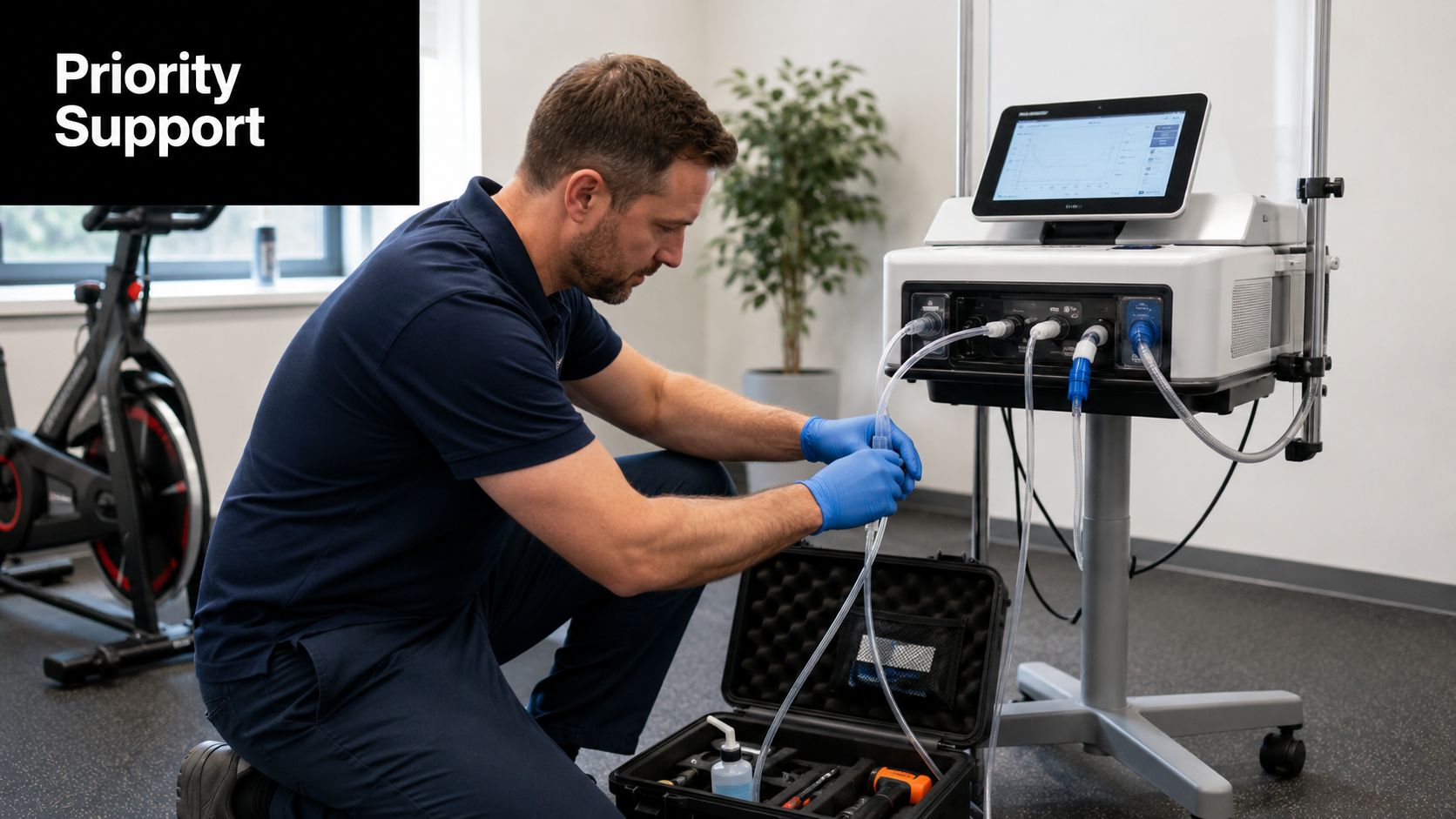
Turn maintenance into a retention touchpoint
Use service visits to inspect the broader workflow. Ask whether staff are still following protocol correctly. Check whether software is being used fully. Review whether the client needs spare parts, additional consumables, or refresher training.
A practical reference point is a documented fitness equipment maintenance checklist. Even if a client runs a small facility, a formal checklist helps staff spot neglect before it causes reputational damage.
Clients often judge a supplier less by the original sale and more by what happens when something goes wrong.
Offer support packages in levels. Basic support can cover remote troubleshooting and scheduled reminders. Premium support can include priority response, annual on-site visits, and calibration planning. Enterprise support can bundle multi-site coordination and documentation for regulated environments.
3. Client Success Metrics Dashboard & Reporting Portal
If clients can't see value, they assume value is falling. A reporting portal solves that by turning activity into evidence. That matters in every setting where decisions need to be justified to gym owners, clinical leads, department heads, or procurement teams.
A dashboard doesn't need to be complex to work. It needs to show what clients care about: usage patterns, testing frequency, reassessment intervals, protocol adherence, and visible trends in outcomes over time.
Make value visible
A sports performance facility using a Cosmed metabolic analyser and a Chester Step Test workflow should be able to show how often tests are run, when follow-ups are due, and where clients are overdue for review. A clinic using Omron and Seca tools should be able to export clean summaries for internal records and patient progress discussions.
That reporting layer helps retain accounts because it supports internal advocacy. The practitioner no longer says, “We think this equipment is useful.” They can show regular use and structured follow-up.
Track the signals that matter
Zendesk notes that modern retention measurement depends on metrics such as customer retention rate, churn rate, customer lifetime value, repeat purchase rate, and purchase frequency, and it recommends annual measurement to capture seasonality and long-term behaviour in its retention framework. In a professional testing environment, translate that into operational signals your clients can act on.

Useful dashboard views include:
- Usage trends: Which devices are active, underused, or dormant
- Reassessment timing: Which clients are due for a repeat test based on protocol timing
- Outcome reporting: Progress snapshots that staff can use in reviews or planning meetings
- Export options: Data summaries for internal reports, research files, or stakeholder updates
If you need a client-facing model for showing progress clearly, build it around the same logic used in fitness progress tracking. Simple visuals, clear dates, and repeatable metrics keep clients engaged.
4. Loyalty & Rewards Program with Tiered Benefits
Loyalty programmes work when they reward the behaviours that strengthen the relationship. In this market, that rarely means offering a random discount on a high-precision device. It means recognising repeat purchasing, training participation, referrals, consumables reordering, and long-term operational commitment.
For a physiotherapy clinic, the most useful reward might be priority access to a training seminar. For a university department, it might be added service support or a preferred consumables arrangement. For a gym chain, it might be easier access to replacement parts and onboarding sessions for new staff.
Reward the right behaviours
Make the programme visible. Clients should know what tier they're in, what gets them to the next level, and which benefits help them run better assessments. If your business offers Chester Step Test calculators, BodyMetrix systems, and Cosmed accessories, link points or credits to behaviours that increase competent use.
A useful outside example is the way loyalty programs using guest Wi-Fi are built around repeat engagement and identifiable return visits. The principle applies here too. Track meaningful interaction, then reward it consistently.
Design benefits clients will actually use
Avoid generic gifts. Give clients benefits that support their workflow.
- Training access: Free or priority places on refresher sessions and interpretation workshops
- Service perks: Faster technical response or scheduled health checks for key accounts
- Consumables support: Credits or bundled reordering options for products used regularly
- Recognition: Milestone messages for long-term clients, certifications completed, or referral activity
A strong loyalty structure also helps account managers start better conversations. If a clinic is close to a higher tier, the next purchase or service package becomes easier to justify because the benefit is immediate and relevant.
5. Industry-Specific Content Marketing & Thought Leadership
Generic retention content doesn't do much for professional buyers. Coaches, clinicians, and researchers stay engaged when your content helps them solve real testing problems. If you sell advanced assessment tools, your content should answer operational questions that come up after purchase.
Write for the moment when a practitioner asks, “How do I standardise repeat measurements across staff?” or “When should I schedule reassessment in a rehab pathway?” or “How do I explain body composition findings without overpromising?”
Teach clients how to get more from the equipment
The strongest content keeps the equipment active. Publish protocol explainers, reassessment schedules, interpretation guides, setup videos, and short notes on common operator mistakes. A trainer using a Chester Step Test kit needs different advice from a lecturer overseeing student practicals or a clinician validating repeat measurements.
Mainstream retention advice still rarely explains how to retain clients in periodic or assessment-based services. Despite InMoment's discussion of customer retention highlighting the growing shift toward lifecycle-triggered and behavioural-triggered retention in 2026, professional testing environments need that idea translated into operational scheduling. Tie communication to season planning, athlete screening windows, review appointments, and recertification cycles.
Good retention content answers, “What should I do next with this tool?” not just, “Why is this tool valuable?”
Match content to real buying contexts
Segment your publishing by audience. Personal trainers want commercially usable insights. Clinics need defensible workflows and documentation. Universities need consistency, methodology support, and confidence that students or researchers can repeat the protocol properly.
Formats that work well include short articles, recorded demos, quick-reference PDFs, seminar recaps, and protocol update briefings. Keep each one tied to a concrete use case. If the content makes the next test easier to run, clients will keep coming back to you for guidance.
6. Customized Solutions & Consultation Services
Some clients don't need more products. They need a better system. Consultation keeps those accounts close because it shifts the relationship from vendor to partner.
A sports performance centre may need help combining metabolic testing, field tests, and body composition reviews into one athlete pathway. A clinic may need a lighter setup with fewer devices but stronger repeat-assessment scheduling. A university department may need a solution that works for teaching, dissertations, and staff-led research.
Sell fit, not just hardware
Start with a discovery process. Ask who runs the tests, who interprets them, how often reassessment happens, where results are stored, and what decisions depend on the data. Then build the recommendation around the workflow, not around the catalogue.
That approach directly supports retention because clients are less likely to leave when your setup matches their operational reality. They aren't comparing one product against another. They're comparing one working system against the risk of rebuilding it elsewhere.
Package advice into the relationship
Offer formal consultation packages before and after purchase. Include protocol design, room setup advice, testing sequence recommendations, staff role planning, and review schedules. For example, a gym adding BodyMetrix and Chester Step Test services may need help turning assessments into a bookable member journey. A rehab team using Omron and body composition tools may need tighter documentation and consistent reassessment intervals.
Use a standard deliverable so the advice feels concrete:
- Workflow map: Who performs each task and when
- Protocol pack: Standardised testing instructions and retest timing
- Staff rollout plan: Initial training and refresher expectations
- Review model: How the client uses data in consults, case reviews, or reports
This is one of the most practical client retention strategies because it raises switching friction in a positive way. The client stays because the system works.
7. Community Building & User Forums/Groups
Clients trust peers. If you create a strong user community, your clients get value even when they aren't talking directly to your team. That increases attachment to your brand and keeps your equipment embedded in daily practice.
The best communities in this sector aren't built around vague networking. They're built around practical exchange. Coaches discuss how they explain metabolic results to athletes. Clinicians compare ways to standardise follow-up appointments. Lecturers share how they introduce students to testing protocols without compromising consistency.
Give clients a place to compare practice
Set up a private online group and keep it moderated. Seed it with prompts that matter, such as best practice for repeat Chester Step Test delivery, managing calibration routines, comparing assessment packages, or using BodyMetrix findings in client consultations.
You don't need a huge audience. You need enough active professionals to create useful discussion and a reason to return.
Keep the community practical
Run regular expert sessions, but don't let the group become a broadcast channel. Ask members to share examples, common mistakes, and process improvements. Highlight strong contributions and connect newer users with experienced operators.
Community also supports retention by reducing uncertainty. A practitioner who sees how others are using the same equipment is more likely to keep using it rather than questioning whether the purchase was worthwhile.
A user group becomes valuable when members leave with one change they can apply that week.
Offline versions work too. Small breakfast workshops, user roundtables, or seminar add-ons can strengthen the same effect. In high-trust categories, face-to-face exchange often does more than another promotional email.
8. Predictive Churn Analysis & Proactive Intervention
By the time a client says they're unhappy, the damage is usually old. Predictive churn work helps you act earlier. In B2B retention, one of the most useful signal sets is a churn-risk model built from structured lifecycle data such as product usage telemetry, support ticket velocity, customer-success notes, QBR outcomes, billing behaviour, and contract history, according to Directive Consulting's B2B retention guidance.
That model fits professional equipment businesses well because churn rarely starts with cancellation. It starts with low usage, missed reviews, unresolved support friction, or a team that stops booking reassessments.
Watch behaviour, not just invoices
For a Cartwright-style client base, useful warning signs include fewer logins to reporting tools, slower consumables reordering, missed training renewals, reduced test frequency, and postponed service visits. A university lab that stops ordering accessories may be shifting away from the protocol. A clinic that hasn't booked refresher training may be relying on one confident staff member while everyone else disengages.
Map these behaviours into simple risk bands. You don't need a complex model on day one. A rules-based approach is enough if the triggers are clear.
Trigger action early
Each risk signal should lead to a specific response.
- Usage drop: Offer workflow coaching or a reporting review
- Support friction: Escalate to a named technical contact
- Missed review cycle: Prompt a reassessment planning call
- Training gap: Invite the account to a refresher session
The point isn't more automation for its own sake. The point is timely intervention that matches the likely reason the client is drifting. When clients feel seen before the problem becomes painful, retention improves.
9. Multi-Year Partnership Agreements & Service Bundles
Retention improves when clients buy into an operating model, not just a device. Multi-year agreements work best when they cover the full testing service a clinic, lab, or performance facility delivers.
For businesses using advanced assessment tools, that means packaging equipment with the support systems that keep results credible and staff confident. A body composition service does not run on hardware alone. It depends on calibration routines, refresher training, replacement parts, protocol consistency, and clear upgrade paths as demand changes.
Build bundles around outcomes
Base each agreement on the client's testing model. A physiotherapy clinic needs a different bundle from a university lab or a strength facility running repeat athlete assessments. Sell the package that supports delivery over 12 to 36 months, not the package that looks good on a quote.
That usually means defining what the client must have to keep testing accurate, repeatable, and commercially useful across the full term.
In high-precision environments, service bundles should protect three things. Uptime, staff competence, and trust in the numbers. If any one of those slips, usage drops and retention follows.
Price for continuity, not just acquisition
A strong bundle reduces the small frictions that kill long-term accounts. Clients should not have to chase service visits, scramble for accessories, or guess when a team refresher is due. Put those items into the agreement from the start.
That also makes the commercial case stronger. Better retention improves profitability, as noted earlier. For equipment providers, a key advantage is that bundled agreements make future support, software help, consumables, and reassessment planning part of the normal relationship instead of an extra sale every time.
Good multi-year bundles usually include:
- Core equipment: The testing tools required for the primary assessment service
- Calibration and service schedule: Planned maintenance, validation checks, and support access
- Training plan: Initial onboarding, new-staff training, and scheduled competency refreshers
- Consumables and accessories: The practical items needed to keep sessions running without delays
- Protocol support: Documentation and workflow guidance that protect consistency across repeated tests
- Expansion terms: Pre-agreed options for adding devices, modules, or locations without rebuilding the contract
This structure fits businesses that sell evidence-based services. If a Cartwright-style client uses precise testing data to justify treatment plans, athlete programming, or research outputs, the retention play is obvious. Make the agreement responsible for keeping that data reliable and usable year after year.
Clients stay longer when the contract removes uncertainty from the work they already need to do.
10. Regular Business Reviews & Account Management
Some clients don't leave because they're unhappy. They leave because no one is steering the relationship. A structured review cycle fixes that.
Assign account ownership to clients with meaningful long-term value. The account manager should understand the equipment, the testing workflow, the client's service model, and the pressures on the people using the tools day to day. In professional environments, that context matters more than polished sales language.
Keep accounts from going quiet
Use scheduled business reviews to discuss what's changed since the last meeting. Review product usage, support history, staff confidence, upcoming testing cycles, and whether the current setup still fits the organisation. For a sports facility, that may mean pre-season and in-season planning. For a clinic, it may mean care pathway reviews. For a university, it may mean semester timing and dissertation demand.
Another often-missed retention factor is trust in accuracy. Contentstack's retention article notes the growing importance of preference management, dedicated account leads, and proactive check-ins, but in high-stakes equipment settings the practical issue is reassurance. Clients retain vendors when they receive calibration reminders, methodology updates, and documentation that helps them defend the reliability of their results.
Use reviews to schedule the next phase
A business review should always end with agreed actions. Book the next training session. Set the service date. Confirm the reassessment cycle. Identify consumables that need replenishment. Recommend an upgrade only when it supports a real operational need.
Retention improves when every review produces a calendar date, an owner, and a next step.
Many client retention strategies succeed or fail based on the ongoing support provided. If no one owns the relationship after the sale, clients drift. If someone helps them use the equipment better, prove value internally, and plan the next phase with confidence, they stay.
Top 10 Client Retention Strategies
| Strategy | 🔄 Implementation Complexity | ⚡ Resource Requirements | 📊 Expected Outcomes | 💡 Ideal Use Cases | ⭐ Key Advantages |
|---|---|---|---|---|---|
| Personalized Equipment Training & Certification Programs | Medium–High (3–6 months initial; quarterly updates) | Instructors, LMS, equipment for workshops, assessment tools | Improved testing accuracy, reduced liability, higher engagement | Clinics, training centres, high-value equipment buyers | Justifies premium pricing; improves data quality ⭐⭐⭐ |
| Proactive Technical Support & On‑Site Maintenance Services | Medium (1–2 months protocols; 3–6 months network) | Skilled technicians, spare parts inventory, scheduling logistics | Reduced downtime, increased trust, service revenue | Multi-site gyms, clinical sites with critical equipment | Reliability and data integrity; strong client trust ⭐⭐ |
| Client Success Metrics Dashboard & Reporting Portal | High (4–8 months custom; shorter for white‑label) | Developers, data engineers, security/compliance (GDPR/HIPAA) | Real‑time insights, ROI demonstration, data‑driven decisions | Large enterprises, research institutions, clinics | Enables upselling and measurable ROI ⭐⭐⭐ |
| Loyalty & Rewards Program with Tiered Benefits | Medium (2–4 months basic; 6–12mo for full) | Loyalty platform/CRM integration, program manager, marketing | Increased repeat purchases, referrals, higher CLV | High-frequency consumable buyers, distributors | Cost‑effective retention and referral growth ⭐⭐ |
| Industry‑Specific Content Marketing & Thought Leadership | Medium (ongoing; 1–2 months strategy) | Subject‑matter experts, content production, distribution channels | Improved credibility, organic leads, long‑term visibility | Academic, clinical, and specialty practitioner audiences | Builds authority and inbound lead flow ⭐⭐ |
| Customized Solutions & Consultation Services | Medium–High (1–3 months frameworks; ongoing) | Senior consultants, discovery tools, templates | Deep partnerships, tailored workflows, high-margin services | Large facilities, hospitals, research labs | High switching costs and premium revenue ⭐⭐⭐ |
| Community Building & User Forums/Groups | Low–Medium (1–2 months launch; 6–12 months to scale) | Community manager, platform (Slack/forum), moderators | Peer support, product feedback, advocacy | Distributed user bases, product ecosystems | Network effects and organic support; low long‑term cost ⭐⭐ |
| Predictive Churn Analysis & Proactive Intervention | Medium–High (3–6 months initial; ongoing optimization) | Analytics tools, clean customer data, data scientists | Early risk detection, targeted re‑engagement, lower churn | Subscription customers, high‑usage service clients | Cost‑effective churn reduction; actionable signals ⭐⭐⭐ |
| Multi‑Year Partnership Agreements & Service Bundles | Medium (2–4 months to design contracts) | Legal, pricing strategy, contract management, sales enablement | Predictable recurring revenue, higher CLV, commitment | Enterprise buyers, large clinics, managed service partners | Revenue predictability and stronger customer commitment ⭐⭐⭐ |
| Regular Business Reviews & Account Management | Low–Medium (1–3 months to establish) | Account managers, CRM, reporting templates | Improved retention, systematic expansion, early issue ID | Strategic/high‑value accounts | Personalized attention and proactive growth management ⭐⭐⭐ |
Turn Insights Into Loyalty Your Next Steps
Client retention strategies work best when they're built into daily operations. They don't succeed as a side project run once a year or as a generic loyalty campaign pasted onto a professional service. In clinics, gyms, labs, and university departments, retention comes from making your tools easier to trust, easier to use, and easier to justify over time.
That's why the most effective retention approach starts with the assessment workflow itself. If you use high-precision equipment, you already have a strong foundation. You have measurable outputs, repeatable protocols, natural reassessment points, and practical reasons to stay in contact with clients after the first purchase or first test. Those are advantages many businesses don't have. Use them deliberately.
Start with one change this quarter. If your clients struggle with confidence, launch structured equipment training. If accounts go quiet after purchase, introduce scheduled business reviews. If usage fades between service intervals, create dashboard alerts and follow-up triggers. If clients only hear from you when something breaks, build a maintenance and calibration communication plan. Simple systems, applied consistently, beat ambitious plans that never leave the whiteboard.
Keep your retention model aligned with your market. Fitness professionals need commercial clarity and repeatable client journeys. Clinicians need trust, accuracy, and documentation. Researchers and academic teams need standardisation and support that protects the validity of the process. One message won't work for all of them. Segment your outreach, your training, and your service model accordingly.
Don't rely on discounts to do a job that support, education, and planning should do better. In this category, clients often stay because they trust the reliability of the numbers and the competence of the partner behind the equipment. If your business helps them maintain protocol quality, staff confidence, and useful reporting, you become hard to replace.
The strongest retention systems also recognise that many professional services are periodic. Reassessment windows, seasonal athlete screening, clinical review points, and annual teaching cycles create natural retention opportunities. Put those dates into your CRM, trigger outreach before they arrive, and make repeat testing the default next step. That one shift can turn an occasional buyer into a long-term account.
At Cartwright Fitness, the opportunity is clear. The products themselves already support precise, defensible assessment. When you combine that with training, service, technical support, and proactive account management, you create a client experience built for loyalty. The sale gets the relationship started. Ongoing value keeps it growing.
If you want help turning advanced testing equipment into a stronger retention engine, speak with Cartwright Fitness. From Chester Step Test tools and BodyMetrix systems to Cosmed metabolic analysers, training support, and practical guidance for clinics, coaches, and researchers, Cartwright Fitness can help you build a client experience that keeps people coming back.