

A workplace screening day is about to begin. The physiotherapist has a step platform, a phone with a metronome app, and a wrist-worn heart-rate monitor, but the first results look strangely inconsistent. One participant's predicted aerobic capacity seems unexpectedly low, while another's appears difficult to compare with previous records. Nothing obviously went wrong during the test, yet the equipment may have introduced variation before the protocol even started.
That's the central issue with Chester Step Test equipment. The step, cadence source, heart-rate monitor, timing method, and recording process work as a matched system. A generic aerobics step or an unreliable pacing signal can change the workload without making the error obvious. This guide explains what the test measures, which equipment choices support repeatability, and how to select step heights for mixed-age occupational, clinical, rehabilitation, and sports populations.
This page is Chester-specific. For a broader comparison of equipment used across different step-test protocols, see our step test equipment guide.
Table of Contents
- Why the Right Kit Matters Before You Start
- What the Chester Step Test Measures
- The Core Components of a Validated Equipment Kit
- Choosing the Right Step Height for Your Population
- Setting Up and Running the Test Correctly
- What the Numbers Really Tell You
- Buying Checklist and Final Recommendations
Why the Right Kit Matters Before You Start
A clinic room is ready for testing. The participant can step confidently, the operator has a metronome ready, and the heart-rate monitor is charged. Yet a small mismatch between those three items can alter the workload or obscure the response before the first result is calculated.
The Chester Step Test is a practical method for estimating aerobic capacity and VO2max through standardized progressive stepping. Its published description uses five stages with two-minute stages, alongside a low step, external cadence control, and heart-rate monitoring (protocol and equipment description). These parts are linked. The step sets the mechanical demand, the metronome controls how often that demand is repeated, and the monitor records how the participant responds.
Small substitutions can change the result
A platform taller than the selected protocol height increases the work of every step. A metronome that pauses, drifts, or cannot be heard clearly changes cadence. A heart-rate sensor that responds slowly during repeated arm and leg movement may miss the stage-ending reading needed for interpretation.
The participant may still complete the movements, so the error can remain invisible during testing. It often appears later, when a result does not fit the participant's previous record or when two sites produce different values from apparently similar assessments.
Under-publicised step-height evidence also matters when one service tests mixed-age groups. A height suitable for younger, fitter adults may impose a different practical burden on older adults or people in rehabilitation. Buyers should therefore match the step to the population and protocol, rather than treating any adjustable aerobics platform as equivalent.
Practical rule: Treat the step, metronome, and heart-rate monitor as one measurement system. Check whether they preserve the intended workload and recording conditions, not merely whether each item functions.
A suitable kit should provide:
- Protocol fidelity: the intended stepping workload at every stage.
- Measurement quality: heart rate captured consistently at the required points.
- Repeatability: another operator can recreate the setup for follow-up testing.
The Chester protocol requires its own equipment decisions, particularly for step height, pacing, heart-rate recording and the calculation method used to interpret the test.
What the Chester Step Test Measures
A participant can match the metronome and still produce a misleading result if the equipment does not create consistent conditions. The Chester Step Test is a sub-maximal, progressive stepping assessment. It estimates aerobic capacity and VO2max from heart-rate responses to set stepping workloads, rather than measuring oxygen consumption directly with a metabolic cart.
The commonly used protocol has five stages, each lasting two minutes. Cadence starts at 15 steps per minute, then rises in 5-step-per-minute increments toward 35 steps per minute in the described setup. An audio track or metronome controls the pace, while a heart-rate monitor records the cardiovascular response at the relevant stage points (research description of the progressive protocol).
Why the test uses stages
Each stage supplies a defined workload. The participant steps at the prescribed rate, completes the stage, and has heart rate recorded. The operator then combines the stage information with the heart-rate response, using the appropriate calculation method or plotting sheet.
This staged format suits settings where a maximal laboratory assessment would be impractical, costly, or inappropriate. Occupational health teams can use it as a repeatable fitness screen. Rehabilitation and clinical services can apply progressive exercise when a participant can tolerate a controlled increase in demand but should not be taken immediately to an all-out effort. University departments can also demonstrate exercise-testing principles in a limited space.
Traditional Chester Step Test protocols use a submaximal stopping/progression criterion based partly on reaching around 80% of age-predicted maximum heart rate, commonly estimated as 220 minus age, alongside perceived exertion and the participant's clinical presentation. The exact criteria should follow the protocol or software version being administered. This makes heart-rate monitoring part of the measurement process, not an optional accessory.
Why equipment choices affect interpretation
Step height changes the work performed at the same cadence. A taller platform requires the participant to raise their body through a greater vertical distance on every repetition. Their heart rate may therefore be higher than that of someone using a shorter platform, even though both participants follow the same metronome.
For that reason, the step, metronome, and heart-rate monitor function as a matched system. The operator needs to record the selected step height, apply the corresponding protocol information, maintain the prescribed cadence, and capture heart rate at consistent stage points. The equipment does not merely support the test. It establishes the conditions from which the aerobic estimate is produced.
The Core Components of a Validated Equipment Kit
A clinic room may have a step, a metronome, and a heart-rate monitor, yet still produce an inconsistent test if those items do not work as one system. The step height sets the vertical workload, the cadence source controls how quickly that workload is repeated, and the heart-rate monitor records the participant's response. Timing, recording, and recovery equipment complete the setup.
The standard equipment arrangement uses an adjustable step within the protocol range, external pacing, timing, heart-rate monitoring, and a method for calculating or plotting the result. Independent Chester Step Test guidance also includes a calculator and VO2max plotting sheet for the post-test process. These tools help the operator derive an estimate from the heart rate recorded at the end of a stage, rather than relying on perceived effort alone.
What each component contributes
Step platform: Choose a rigid, stable, non-slip platform with a known effective height. A step that flexes, slides, or measures differently from its stated height changes the work performed on every repetition. A purpose-designed single step or secure adjustable platform is easier to standardize than an improvised gym accessory.
Cadence source: A metronome or recorded audio track keeps the stepping rate even. A phone can provide the signal, but the operator must check its volume, setting, battery, and notifications before starting. A brief pause or incorrect tempo changes the workload while the test may still appear to be following the protocol.
Heart-rate monitor: The monitor should provide a usable reading at the relevant stage points. A chest-based device is often easier to position consistently across repeated tests. Wrist optical devices can be affected by movement, contact, or delayed readings. The practical test is whether the selected monitor gives stable readings during stepping.
Timing and records: A stopwatch, printed form, or digital log should record stage completion, cadence, heart rate, symptoms, and any protocol deviation. A clear record allows another practitioner to reconstruct how the result was produced instead of seeing only a final VO2max estimate.
Safety and recovery items: Keep a chair available for recovery and prepare the clinical equipment required by the service's risk assessment. A blood-pressure monitor and a reference chart for predicted maximum heart rate may also support supervision. They do not replace local screening procedures, stopping rules, or clinical governance.
Comparison of common choices
| Component | Role in Protocol | Suitable Choice | Common Substitute and Its Failure Mode |
|---|---|---|---|
| Step platform | Sets the vertical workload | Rigid, non-slip step at the selected protocol height | Generic step that flexes, slides, or has an unverified height |
| Metronome or audio | Controls stepping cadence | Dedicated metronome or checked pacing track | Phone timer or app that becomes inaudible, pauses, or uses the wrong setting |
| Heart-rate monitor | Captures stage response | Consistently positioned monitor with dependable readings | Wrist sensor that lags or loses contact during movement |
| Timer and recording form | Documents stage completion and heart rate | Stopwatch plus paper or digital test record | Memory-based recording that misses stage-ending data |
| Safety and recovery equipment | Supports observation and recovery | Chair, relevant monitoring equipment, and local safety procedures | Room without a clear recovery or stopping process |
Cadence errors need close attention. If the pacing signal changes, the participant performs a different workload even though the operator may still believe the intended stage is underway. That can influence the final estimate more than a small difference in device convenience.
Teams comparing packaged options can examine the Chester Step Test kit as an example of a matched setup. Check the included step height, pacing method, heart-rate equipment, and calculation support rather than treating the package as a generic step-and-stopwatch purchase. In shared rooms, cleaning is part of equipment management. Facilities should set a repeatable cleaning process based on the equipment manufacturer's instructions and local infection-control procedures.
Choosing the Right Step Height for Your Population
A clinic may test a fit young adult in the morning and an older participant later that day. The same platform, metronome, and heart-rate monitor cannot automatically suit both. Step height is a test-design decision, because the platform determines the mechanical workload while the pacing signal and heart-rate readings show how the participant responds.
The Chester protocol uses 15, 20, 25, and 30 cm step heights, each with its own MET stage table. Lower platform options can reduce the mechanical workload and may be more appropriate for some participants, but step height should be selected according to the Chester protocol/calculation method and the individual's suitability rather than age alone. A taller platform increases the external work at the same cadence. It may suit a fit participant, but can make the test inappropriate for restricted mobility, limited exercise tolerance, or rehabilitation groups. A lower step reduces that mechanical demand and may allow a more controlled progression.
A practical comparison
| Step Height | Typical METs per Stage | Best-Suited Population | Key Trade-off |
|---|---|---|---|
| 15 cm | Use the corresponding 15 cm protocol table | Older adults, less active participants, and restricted-mobility groups | More accessible, but may provide less challenge for fitter users |
| 20 cm | Use the corresponding 20 cm protocol table | General adult occupational and health screening | Practical middle ground, but not ideal for every mixed population |
| 25 cm | Use the corresponding 25 cm protocol table | Fitter adults and selected exercise-testing groups | Raises workload, which can reduce suitability for lower-capacity participants |
| 30 cm | Use the corresponding 30 cm protocol table | Younger, fitter, or athletic cohorts | Stronger challenge, but greater mechanical demand and accessibility concerns |
The table provides a starting point, not an automatic assignment. Screening policy, medical status, mobility, previous exercise experience, and the assessment purpose still influence the choice. Select and document the height before testing, then pair it with the matching MET information and prediction method. The metronome must also match the selected protocol, since changing the platform without changing the reference table makes the final estimate difficult to interpret.
Why a generic aerobics step can mislead
A general-purpose step may appear suitable, yet its surface, edge design, feet, and effective height can differ from a purpose-built platform. Rounded edges or unstable feet may change the participant's confidence and movement. Even a small change in vertical displacement alters the workload while the audio cadence stays the same.
A single fixed platform can work well for a facility testing a consistent population. Mixed-age occupational health programmes, rehabilitation services, and university teaching environments usually benefit from access to more than one validated height. The guide to selecting Chester Step Test height helps buyers match the platform to the people being tested and the equations used by their service. That is why the step, metronome, and heart-rate monitor should be chosen as one matched system, rather than as separate pieces of a generic step-and-stopwatch kit.
Setting Up and Running the Test Correctly
A participant can follow the cadence perfectly and still produce a questionable result if the room, step, metronome, and heart-rate monitor are poorly matched. Set up these parts as one system before anyone starts climbing.
Prepare the room and participant
Use a flat, firm floor, then check that the platform does not rock or slide. Leave enough clear space for supervision, movement around the participant, and a safe stop. Clothing and footwear should permit controlled, comfortable stepping.
Explain the up-and-down sequence before the formal test. Let the participant practise the cadence at an easy level so unfamiliarity does not become confused with cardiovascular limitation. This short rehearsal also reveals whether the selected step height or room layout creates a movement problem.
Fit the heart-rate monitor according to its instructions and confirm that a reading appears before the first stage. Record the step height, monitor type, and protocol version in the test documentation. Those details give a later reviewer the context needed to compare results.
Control the pace
Use the published stage cadence and test the audio or metronome in the actual room. Background noise can overwhelm a phone speaker, while notifications or calls can interrupt an otherwise suitable app. A dedicated audio source or external speaker may be preferable in a busy clinic or teaching laboratory.
The commonly used Chester setup progresses from 15 to 35 steps per minute in 5-step increments, with two-minute stages. The Chester Step Test protocol guide provides a practical reference for setting the cadence and stage sequence. At each stage endpoint, record the heart-rate response immediately and consistently. A value recalled several minutes later is not equivalent to a timed stage reading.
Apply the stopping rule carefully
In the traditional Chester Step Test, the assessor uses the protocol's submaximal criteria, including around 80% of age-predicted maximum heart rate and rating of perceived exertion, together with symptoms and other reasons to terminate the test. Age-predicted maximum heart rate is commonly estimated as 220 minus age, but the exact progression and stopping rules should follow the Chester protocol or software version being used.
Use the effort and safety criteria defined by your service. A participant may stop because of fatigue, discomfort, breathlessness, poor coordination, or an inability to maintain the cadence. Record the reason and the stage reached. An early stop caused by coordination difficulty should not be interpreted in the same way as one caused by cardiovascular strain.
Document the outcome
After the final stage, guide the participant through recovery and continue observation according to local practice. Enter each stage-ending heart rate into the validated calculator or plotting sheet, then store the raw readings with the resulting estimate.
Staff training should cover the equipment check, cadence control, stopping decisions, and recording method. Each organisation also needs its own standard operating procedure, consent process, escalation pathway, and audit trail.
What the Numbers Really Tell You
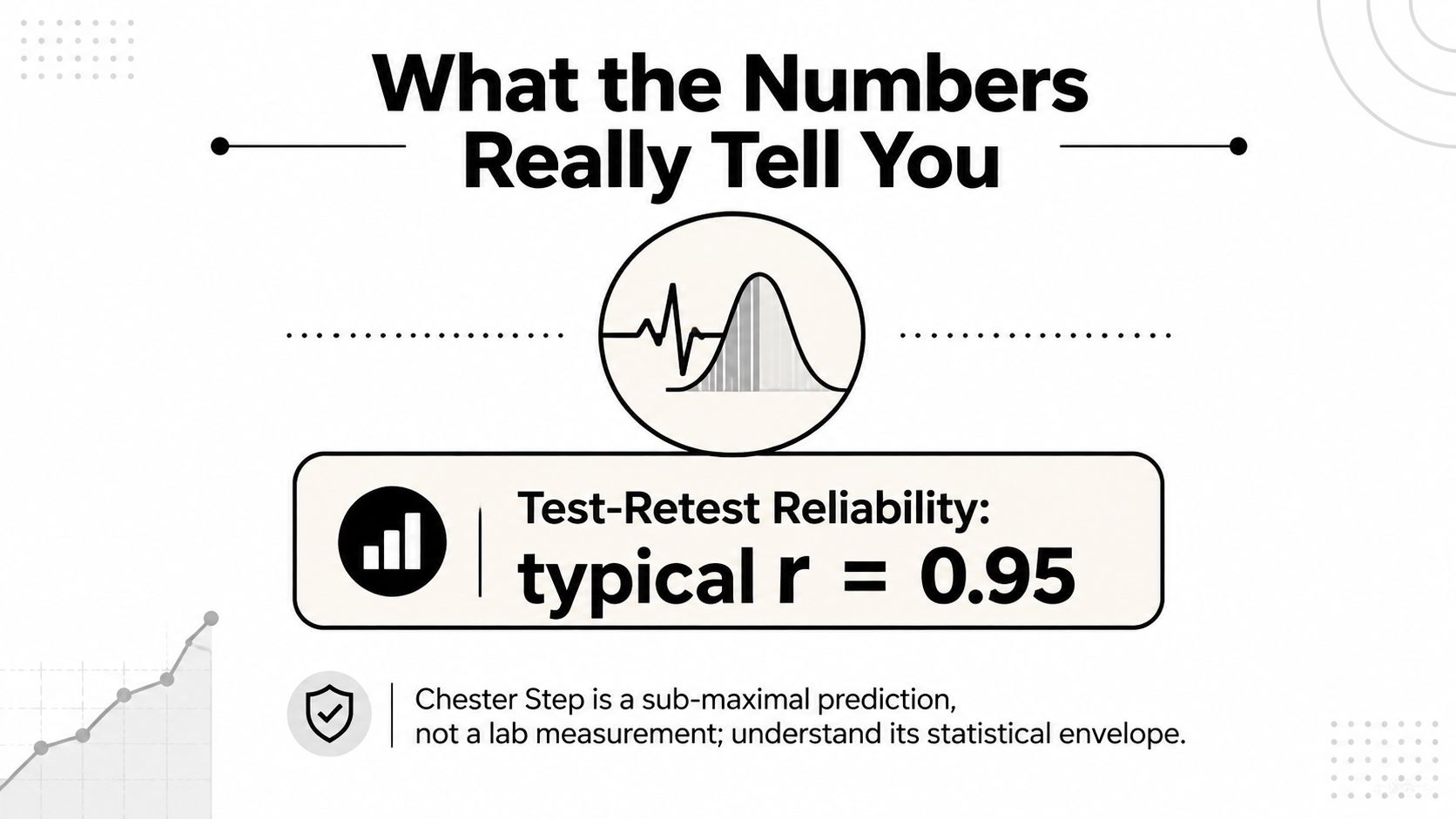
A participant can finish the test, produce a neat heart-rate record, and still receive an estimate rather than a direct laboratory measurement of oxygen consumption. The Chester Step Test is a sub-maximal prediction. That distinction guides whether the result fits screening, progress tracking, or a high-stakes fitness decision.
A PubMed-indexed reliability and validity study found the test reliable when repeated, while raising questions about the validity of its VO2max prediction. Its prediction error came more from estimating VO2 at each stage than from estimating age-predicted maximum heart rate (reliability and validity study). Separate research in people with interstitial lung disease found excellent reliability for the number of steps completed (ICC 0.95 to 1.0) and a strong relationship with six-minute walk distance. That study evaluated exercise-capacity performance in a clinical population; it should not be treated as validation of the Chester VO2max prediction equation.
Use the estimate for the right decision
With the same step height, metronome, heart-rate monitor, instructions, and recording points, the equipment and protocol can support fitness ranking, baseline assessment, follow-up comparison, and occupational screening. The matched kit matters because a different cadence source or monitor can change the conditions, making a result harder to compare.
The estimate has limits. It is less suitable as a stand-alone answer for precise elite-athlete selection, diagnostic decisions, or rigid pass/fail gates. Published validation has shown good test-retest reliability but also meaningful uncertainty in predicted VO2max, including stage-level VO2 estimation errors and individual limits of agreement. Treat the outcome as an estimate rather than a direct physiological measurement. See the published reliability and validity study for the underlying data.
A repeatable estimate can still guide decisions without being exact. Match the decision to the measurement's limits.
Buying Checklist and Final Recommendations
A clinic may test older adults in the morning and university students later that day. The same Chester Step Test setup must keep the step height, metronome, and heart-rate monitor matched to the protocol, or comparisons become difficult. Buy for the population and decision, not for the word “complete” on a product page.
Use this purchasing checklist
- Match the platform to the population: Confirm the intended validated height and ensure the calculation method supports that choice.
- Keep cadence consistent: Choose a metronome or audio track that remains audible and stable in the testing room.
- Capture heart rate reliably: Check monitor performance during repeated stepping and define where staff will position it.
- Record raw inputs: Store stage, cadence, heart rate, symptoms, and any deviations alongside the final estimate.
- Check construction: Look for a non-slip surface, secure feet, easy cleaning, safe storage, and portability if equipment will move between sites.
- Request measurement documentation: Ask for the equation, intended population, limitations, and available reliability information before purchase.
A fixed-height platform works well when one facility tests a consistent group. A multi-height system better serves mixed-age clinics, occupational health programmes, and teaching departments, provided its adjustment mechanism is secure and every height has a corresponding protocol option. Flexibility creates confusion if staff cannot identify the correct table or equation for each setting.
For workplace deployment, give priority to portability, quick setup, cleaning, spare batteries, and clear staff training. A sports science laboratory may place greater value on precise cadence control and dependable physiological monitoring than on compact storage. Assess suppliers on documentation quality, protocol fit, product support, reliability and suitability for the way your service will actually run assessments.
Cartwright Fitness offers Chester Step Test tools, including step platforms and calculator support, alongside other assessment equipment. Compare its specifications with your population, protocol, and required measurement quality before selecting a package.
The video below provides a visual reference for teams training staff on the testing process.
If you are equipping a clinic, workplace programme, university lab, or sports service, start with the Chester Step Test kit and choose the step height and monitoring setup that match your protocol. For a broader workflow across Assessments, Results, repeat testing and practitioner Competency, see Cartwright Assess. If staff also need a consistent administration standard, explore Chester Step Test training and competency.