

A practitioner can have a patient, an athlete, or a worker in front of them, a clock running, and only one question that matters, which cardiovascular endurance test makes sense today. In a perfect world, everyone would go through a full lab assessment with gas analysis. In the world, VO2max testing is often unavailable, impractical, or too demanding, so the job is to choose a test that is defensible, safe, and still useful for decision-making.
Table of Contents
- Why Cardiovascular Endurance Testing Matters in Practice
- The Physiology Behind Cardiovascular Endurance
- Lab Tests Versus Field Tests for Cardiovascular Endurance
- Step-by-Step Protocols for Key Cardiovascular Endurance Tests
- Equipment Selection and Calibration Standards
- Safety Protocols and Population-Specific Adaptations
- Interpreting Results and Reporting Cardiovascular Endurance
- Choosing the Right Cardiovascular Endurance Test for Your Setting
Why Cardiovascular Endurance Testing Matters in Practice
A worker arrives for a pre-placement screen, a rehab patient is ready for progression, or a runner needs a baseline before training changes. The test you choose shapes what happens next, from how much confidence you can place in the result to whether it can be used in the setting in front of you. In practice, cardiovascular endurance testing guides occupational health, rehabilitation, sport, and corporate wellness decisions.
Cardiorespiratory fitness, or CRF, is still underused in routine practice, even though it often gives a clearer view of functional capacity than self-reported activity alone. In athlete settings, practitioners may also use training guidance such as the performance guide for athletes, but the bigger issue is matching the test to the setting, the person, and the clinical or performance question. Occupational health teams often need a defensible screen that does not overburden the participant. Rehabilitation teams need something safe to repeat and sensitive enough to show change.
Practical rule: choose the smallest test that can answer the core question without compromising safety or usefulness.
Many generic guides still assume lab access, healthy volunteers, and enough time for maximal testing. That does not fit workplace screening, community programs, or a lot of clinical pathways. Objective CRF assessment is still underused, and field-based submaximal testing often becomes the practical fallback in settings where full laboratory testing is unavailable or unrealistic (source). For underserved populations and resource-limited settings, the question is usually not whether a perfect test exists. It is which test can be delivered safely, interpreted accurately, and repeated with the equipment on hand.
The practical payoff is direct. Better test selection improves compliance, reduces wasted sessions, and makes results easier to defend to managers, coaches, or clinicians. Get the test choice right, and the rest of the workflow becomes easier.
The Physiology Behind Cardiovascular Endurance
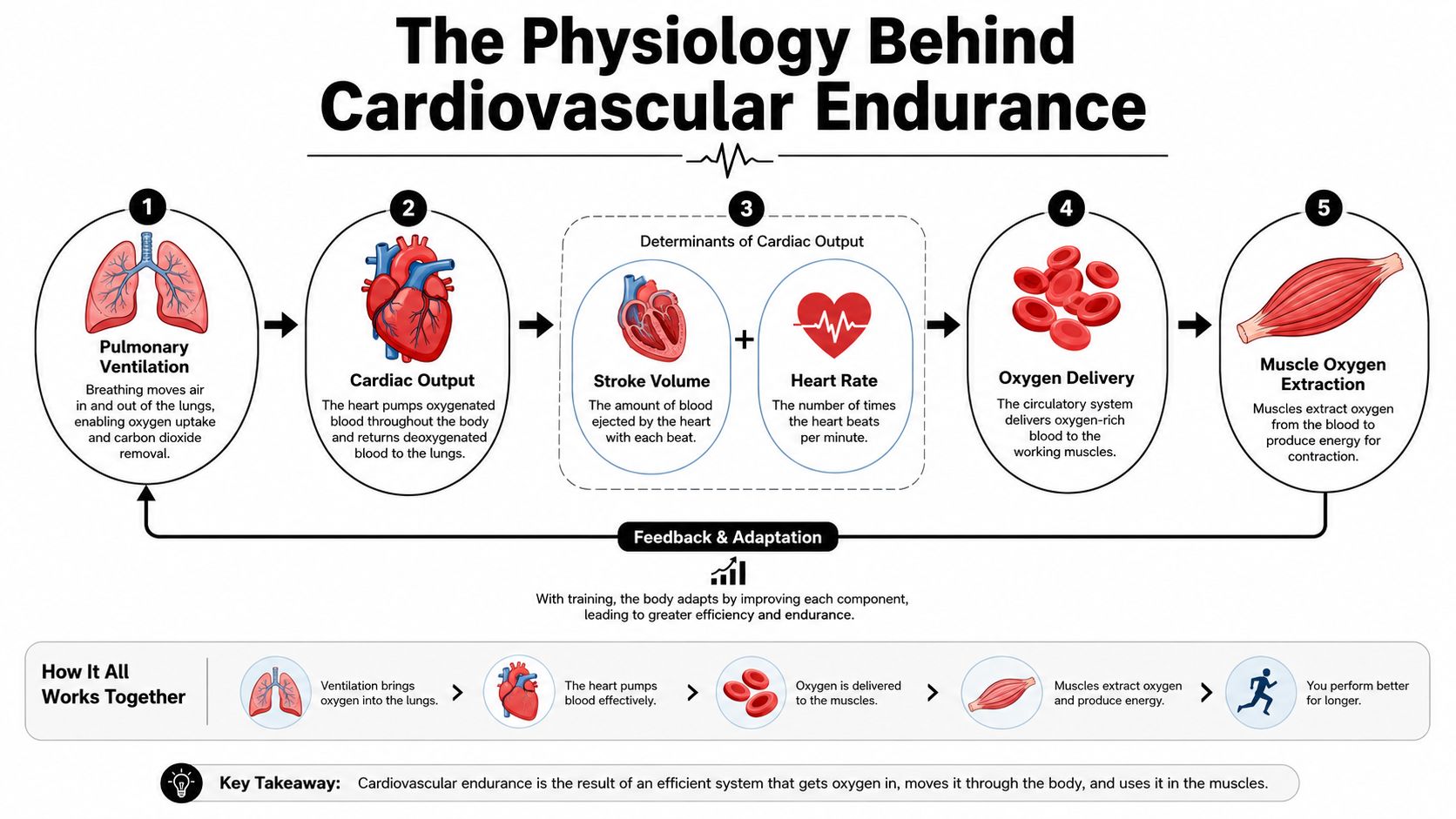
A practical cardiovascular endurance test starts with a simple question. How well does oxygen move from the air into blood, across the circulation, and into the working muscle when the workload rises? That chain depends on ventilation, cardiac output, blood flow distribution, and muscular oxygen use. If any link is weak, performance drops under load, and the test exposes it.
Understanding VO2max
VO2max is the highest rate at which the body can take in, transport, and use oxygen during exercise. It reflects the combined output of the lungs, heart, blood vessels, and working muscles, not a single organ in isolation. In field settings where full laboratory testing is unavailable, Cartwright Fitness provides a practical example of a treadmill-based approach, VO2 max treadmill test, that sits closer to controlled testing than a casual fitness screen.
The heart usually sets the ceiling in healthy people, while the lungs often have reserve capacity. Stroke volume matters because it determines how much oxygenated blood reaches the muscles with each beat. Arteriovenous oxygen difference matters because it shows how much oxygen the muscles remove from that blood. Those two factors, delivery and extraction, shape aerobic capacity in the real world.
The test score is only as meaningful as the physiology behind it.
Why submaximal tests still work
Many field tests do not measure oxygen uptake directly. They estimate CRF from heart rate response, workload, distance, or stage completion under standardised conditions. That works because heart rate usually rises in a predictable way as work increases, until fatigue, heat, anxiety, medication, or poor pacing distort the response. The estimate remains useful, but it is still an estimate.
That is why submaximal cardiovascular endurance testing always carries some error. The body does not behave like a fixed-output machine, and any test that avoids maximal effort has to infer capacity from another signal. In low-resource settings, recent guidance supports approximating intensity with ergometry or other functional tests, then refining the result using Borg RPE and the Talk Test (source). That is a more honest approach than treating a simple test as if it were gas analysis.
For underserved populations, that distinction matters. A field test that can be delivered safely, repeated with the equipment on hand, and interpreted without overstating precision is often the better choice than a lab protocol that cannot be completed consistently. It also keeps room for adaptations in people who are deconditioned, anxious, in pain, or working in settings where maximal effort is not realistic.
Why thresholds matter
A person can be fit enough to walk briskly and still show a steep rise in heart rate as intensity climbs. The point where work begins to feel disproportionately harder is part of why threshold concepts matter in endurance assessment. It explains why one person finishes a step test smoothly while another reaches symptoms or strain early, even if both are active.
Thresholds also help with protocol choice. In a workplace screen, community programme, or rehabilitation pathway, the goal is rarely to expose the true ceiling of aerobic capacity. The goal is to match the test to the person and the setting, then get information that can guide decisions without overshooting safety or practical limits. That is the same logic behind boosting endurance with VO2 max workouts when training is the aim, but in testing the priority is different, because the question is what the person can tolerate and what the setting can support.
Lab Tests Versus Field Tests for Cardiovascular Endurance
A firefighter fit for duty, a clinic patient returning after illness, and a runner preparing for competition do not need the same testing setup. Lab testing gives you the highest physiological precision. Field testing gives you something else, a result you can collect in real settings when a full VO2max visit is impractical or impossible. The choice depends on which category matches the setting, the participant, and the decision at hand.
What lab testing gives you
Lab-based protocols use metabolic carts and gas analysis to measure oxygen uptake directly. That makes them the most precise option for VO2max assessment, especially when you need ventilatory thresholds, respiratory exchange data, or a tightly controlled research protocol. They are valuable in sports science labs, hospital exercise departments, and performance centres where trained staff, calibrated equipment, and controlled conditions are available.
The trade-off is straightforward. Lab testing needs more equipment, more operator skill, more setup time, and a participant who can tolerate near-maximal exertion. For some populations, that is exactly the right level of detail. For others, it is a poor fit because the person cannot travel, cannot sustain maximal effort, or does not need that degree of precision for the decision being made. A treadmill-based lab protocol such as the treadmill VO2 max test reference shows how structured laboratory testing is usually organised.
What field testing gives you
Field tests estimate CRF with simple tools, often using a step platform, a stopwatch, a measured route, or an audio track. The Chester Step Test, Cooper 12-minute run, and multi-stage fitness test are common examples. They do not give the same precision as gas analysis, but they can be run in gyms, clinics, workplaces, or community spaces with minimal equipment.
That practical difference matters in underserved populations. Community services, occupational health teams, and rehabilitation programmes often need a test that can be delivered safely with the equipment already on hand, rather than a protocol that depends on specialised hardware and maximal effort. Community-based step tests are also more feasible in neighbourhood settings, especially when transport, cost, or anxiety about lab testing gets in the way (source).
Here is the practical divide in one table.
| Attribute | Lab Tests (VO2max) | Field Tests (Step, Run, Beep) |
|---|---|---|
| Measurement type | Direct gas analysis | Estimated from performance or heart rate |
| Equipment burden | Higher | Lower |
| Operator demands | Higher | Lower to moderate |
| Setting flexibility | Controlled | More flexible |
| Participant burden | Often maximal | Often submaximal or staged |
If the result is going to feed directly into training, the next question is how that information will be used. The connection to programming matters, and boosting endurance with VO2 max workouts is a useful companion example because the test choice should match the intervention that follows.
Lab precision is useful when the decision depends on direct physiological measurement. Field testing is the better fit when the priority is access, repeatability, and a protocol the participant can complete.
Step-by-Step Protocols for Key Cardiovascular Endurance Tests
A good protocol is not just a list of instructions, it is what makes the result repeatable. Small inconsistencies in pacing, cadence, or monitoring can turn a useful field test into noise. Standardisation matters more than elegance.
Chester Step Test
The Chester Step Test is built around incremental stepping rates and heart rate monitoring. Use it when you need a submaximal estimate that can be repeated in clinics, workplaces, or fitness settings. The participant steps to a set rhythm on a fixed-height platform, and the cadence increases by stage.
Start with the same platform height, same audio cue, same monitoring method, every time.
Before the test, screen the participant, confirm they can step safely, and check resting heart rate and blood pressure if your protocol requires it. A warm-up should be brief and easy, not fatiguing. During the test, keep the participant's posture and foot placement consistent, and record heart rate at the prescribed point in the stage sequence.
Termination should occur if the participant reaches the protocol end point, shows unsafe symptoms, or can't maintain the stepping rhythm. The test only works if the cadence is controlled and the heart rate reading is captured correctly.
Cooper 12-minute run or walk
The Cooper test is simple, but simple doesn't mean casual. The participant covers as much distance as possible in 12 minutes, usually on a measured track or flat route. It can be run, jogged, or walked if that's the protocol decision, but pacing matters from the first minute.
Start with a clear warm-up and make sure the route is measured accurately. Tell the participant to avoid sprinting early, because an aggressive start ruins the later minutes and makes the distance less representative. Record total distance only, and keep conditions as consistent as possible if you plan to retest.
Multi-stage fitness test
The beep test is a shuttle protocol driven by audio cues. The participant runs between marked lines, turning on the beep, and the stages get progressively harder. It's efficient, familiar, and useful in group settings, but it's also easy to mis-administer if the turn zone, audio volume, or line markings are inconsistent.
The test ends when the participant fails to reach the line in time on the prescribed number of occasions, depending on the protocol version. Keep the surface, lane setup, and audio device constant. If you use it in occupational health, treat it as a structured screen, not a loose fitness game.
For a protocol example used widely in practice, the Chester Step Test protocol page is a useful reference point.
The short video below is helpful for staff training and demonstrates the practical feel of the Chester Step Test setup.
Equipment Selection and Calibration Standards
The best test can fail if the equipment is sloppy. A step platform that wobbles, a heart rate monitor that drops signal, or a metabolic analyser that hasn't been checked properly can all undermine the result. In cardiovascular endurance testing, equipment choice and equipment control are part of the test, not separate from it.
What you actually need in each setting
A field screening setup can be very lean. A step test needs a stable platform with the correct height, a timer or metronome, and a way to record heart rate. A beep test needs a marked area, reliable audio, and enough room to turn safely. Lab systems demand more, including metabolic analysers, masks, calibration gases or equivalent procedures, and trained operators.
Heart rate monitors are the most common bridge between field practicality and meaningful data. Use devices that hold signal during movement, and check strap fit before testing. If you're using a metabolic system, routine calibration and service checks matter because gas exchange measurement only helps if the device is behaving consistently from session to session.
Where the investment makes sense
If you run repeat testing in occupational health or sport, it's rational to invest in validated equipment rather than improvising with consumer tools. Cartwright Fitness supplies validated testing tools for this work, including step-test equipment and metabolic testing hardware, which is relevant when you need consistent workflow rather than one-off convenience. For metabolics specifically, the metabolic testing equipment page is the right place to review the kinds of systems used in professional settings.
A practical purchasing rule is this, buy for the result you need to defend, not the feature list you hope to use someday.
Calibration and quality control
Daily checks should be routine. Verify that the step platform is stable, confirm the audio cue runs correctly, and make sure heart rate devices are paired and reading cleanly. For lab systems, follow the manufacturer's calibration routine every session or as required by your governance process, and keep maintenance records.
Quality assurance is also about human handling. Staff should know how to position the participant, start the protocol, stop the protocol, and document anomalies. If the result will be used for clearance, progression, or return-to-work decisions, weak equipment governance is a liability.
The best equipment strategy is not the most expensive one. It's the one that gives you repeatable, defensible data without creating operational friction.
Safety Protocols and Population-Specific Adaptations
A cardiovascular endurance test can be valid on paper and still be the wrong choice for the person standing in front of you. In practice, safety screening comes first because testing only has value when the participant can complete it without avoidable risk. Pre-participation screening, clear stop criteria, and population-specific adaptation belong in the protocol, not as afterthoughts.
Before testing starts
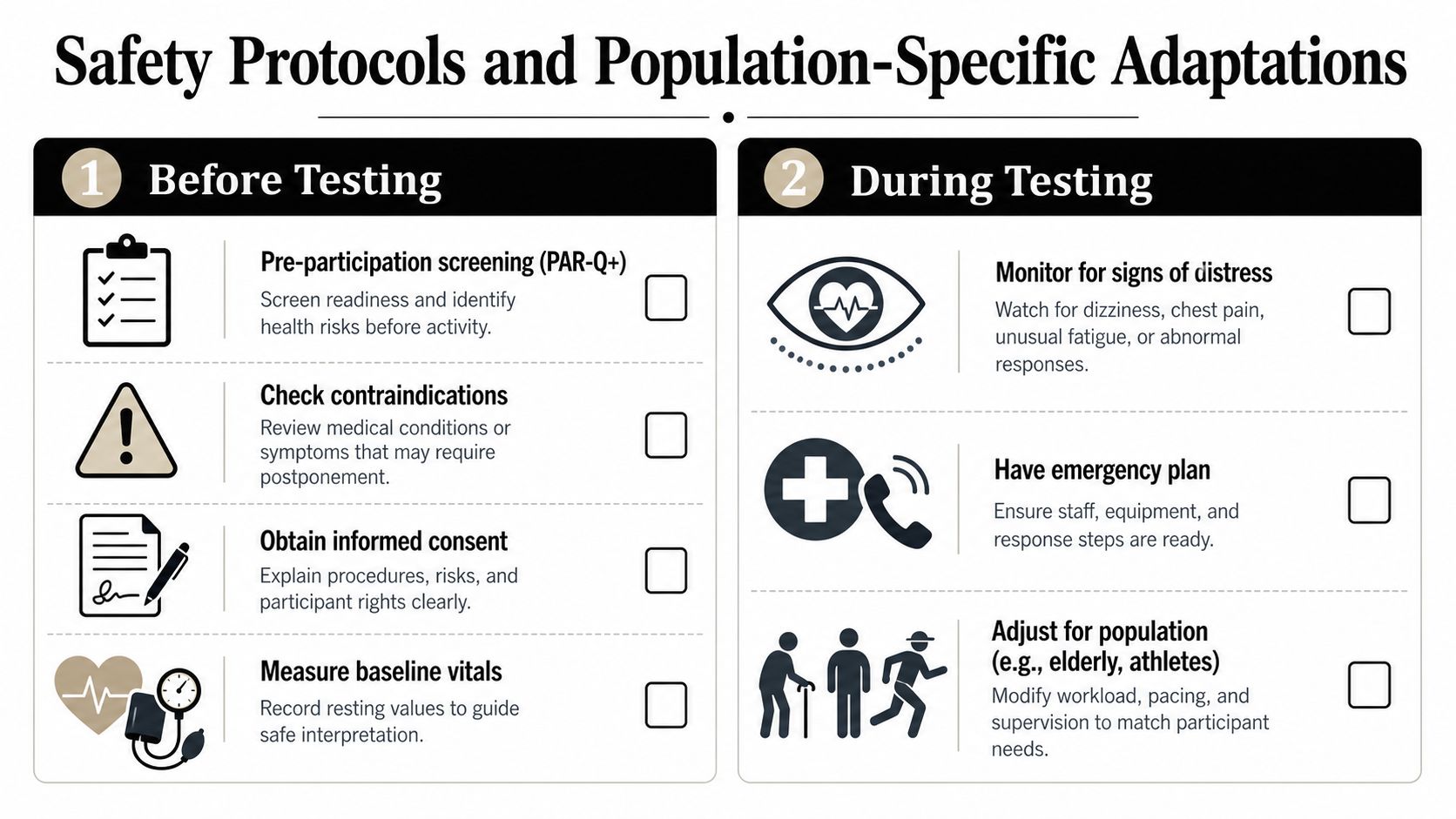
Use a screening tool such as the PAR-Q+, check contraindications, and make sure the participant understands what the test involves. If your protocol includes baseline vitals, record them before exercise begins. In occupational and clinical settings, informed consent is part of safe administration, not a box-ticking exercise.
If the participant reports chest pain, dizziness, acute illness, or a recent change in health status, stop and escalate appropriately. A test should be modified or deferred when the risk profile does not fit the protocol, even if the schedule is tight or the requester wants a result quickly.
During testing
Watch for distress, abnormal symptoms, poor coordination, or a heart rate response that looks out of proportion to the work being done. Have an emergency plan in place before you start. In group testing, staff need a clear division of labour, who stops the test, who speaks to the participant, and who manages the rest of the room.
Older adults often need the most careful adaptation. Step testing can be limited because quadriceps strength may not be enough for some older participants, and heart rate and blood pressure should be checked before and after testing (source). That is the practical problem with many field tests, they look simple until the participant has to perform them safely and repeatably.
Matching the test to the person
Deconditioned patients may not reach the intensity required by more demanding protocols. Forcing a maximal effort in that setting lowers both safety and usefulness. In lower-resource settings, a 6-minute walk test can serve as a fallback when objective testing is not available, and a 2025 randomized crossover trial found that a 2-minute marching test was equivalent to the 6-minute walk test for estimating VO2max in healthy volunteers (source). That does not mean every population should use the shortest test available. It means shorter, lower-burden protocols deserve serious consideration when maximal effort is not appropriate.
Accessibility improves when the test fits the population, not when the population is forced into the test.
Field-based step tests can also widen access in underserved groups because they require little equipment and can be run in neighbourhood settings. Fairness and comparability still matter, especially for older adults, deconditioned patients, and diverse populations. The same principle applies when teams compare results across sites or interpret American Cardiology Group interpretation tips from a different setting, the protocol still has to suit the person and the context, not just the spreadsheet.
Safety is not a separate layer added later. It is the filter that decides whether the result should exist at all.
Interpreting Results and Reporting Cardiovascular Endurance
Raw data only becomes useful when someone knows what to do with it. A distance, stage, or heart rate response needs interpretation in the context of the test type, the participant's age, sex, training status, and the reason for testing. Without that context, reporting becomes a number dump.
From result to meaning
If you used a submaximal test, your first task is to convert the result into an estimated aerobic capacity or a structured performance summary using the method tied to that protocol. If you used a field test, keep the interpretation anchored to the protocol, not to a generic fitness label. The point is to tell the recipient what the result suggests about current capacity and whether repeat testing is warranted.
A report for an occupational health manager should focus on functional tolerance and any limitations that affect work decisions. A report for a coach should focus on pacing, repeatability, and how the score fits the training cycle. A report for a clinician should emphasise safety, tolerance, and trends across time.
What a useful report includes
- Test name and protocol: State exactly what was used, including step height, distance, stage format, or treadmill protocol.
- Participant conditions: Note warm-up, footwear, medication issues, or factors that may have affected the response.
- Result summary: Give the raw result and the interpreted meaning in plain language.
- Limitations: Record anything that reduced confidence in the result.
- Next action: State whether to retest, progress training, refer, or hold steady.
Good reporting explains the result without making it sound more exact than it is.
Tracking change over time
Repeatability matters more than a single impressive score. If the test is the same and the conditions are controlled, changes over time become more meaningful. If conditions differ, the comparison weakens even if the number looks better.
When you need more context for interpretation discipline in clinical reporting, the American Cardiology Group interpretation tips are a useful reminder that structured reading and clear wording improve decision-making. The same discipline applies here, even though the test modality is different.
The strongest report is not the longest one. It's the one a manager, coach, or clinician can use without calling you back for clarification.
Choosing the Right Cardiovascular Endurance Test for Your Setting
The right test is the one that fits the question, the population, and the resources available. Clinical settings usually prioritise safety and standardisation. Athletic environments care more about precision and specificity. Occupational health programmes need speed and scale. Research protocols need methodological rigour above all else.
A practical decision framework
Start with the use case, then work backwards.
- If the decision is clinical clearance or rehab progression, favour a submaximal or functional test unless you have a strong reason to go maximal.
- If the decision is performance programming, use the most precise protocol your environment can support.
- If the decision is workplace screening, choose a repeatable field test that can be administered consistently across many participants.
- If access is limited, use the simplest valid protocol that your population can complete safely.
When VO2max testing is unavailable or unrealistic, a submaximal field test is often the most practical fallback. In lower-resource settings, intensity can be estimated with ergometry or other functional tests, then checked with Borg RPE and the Talk Test. That keeps the result useful without pretending the setup is more controlled than it is.
Matching test type to setting
Occupational health teams usually benefit from step-based or short field protocols because they are scalable and do not require a full lab build-out. Rehab teams often do better with walk-based or submaximal methods because they reduce burden and support repeat assessment. Sports scientists should use lab testing when they need threshold data, but a field test can still serve as a seasonal check or a large-group screen.
The community-access angle matters too. Standard CRF testing often requires specialised equipment, while field-based step tests are easier to deploy in neighbourhood settings and underserved populations. Accessibility becomes part of test validity, not an afterthought, because a protocol that cannot be delivered consistently does not help the people who need it most.
My practical bias is simple. If you need maximal detail and can control the environment, use the lab. If you need a dependable decision in everyday practice, use the field test that your participant can complete.


