

You're in a clinic or gym with a patient, client, or employee who needs a fitness number you can trust, not a glossy estimate that falls apart under scrutiny. The test looks simple on paper, then the wrong protocol lands on the wrong person, the morning runs long, and everyone leaves with data that's hard to defend. Cardiorespiratory testing works only when the setting, the question, and the person line up.
That's why the field has always been more than a single treadmill test. It grew from early workload-based protocols such as the Master's Step Test in 1929, then Bruce's treadmill framework in 1956, toward standardized testing that could answer a clinical question instead of just proving someone could keep going for a bit longer (UNM history review). Today, the practical choice is rarely “maximal or nothing.” It's which test gives you the right level of certainty without wasting time, money, or goodwill.
Table of Contents
- Why the Right Cardiorespiratory Test Matters
- The Physiology Behind Every Cardiorespiratory Test
- The Main Families of Cardiorespiratory Tests
- Choosing the Right Test for Each Setting
- Pre-Test Preparation, Indications and Safety
- Reading and Reporting the Results
- Setting Up Cardiorespiratory Testing in Your Facility
- Common Pitfalls and Where Cardiorespiratory Testing Is Heading
Why the Right Cardiorespiratory Test Matters
A Tuesday morning at an occupational health clinic usually starts with a list, not a philosophy. One referral says “baseline fitness,” another says “return-to-work,” and somebody has already booked the wrong person onto the wrong protocol. I've seen a 60-year-old forklift driver arrive for a maximal treadmill session designed for an athlete. That's not a small scheduling error, it's a mismatch between clinical risk, operational need, and test validity.
The history matters because it shows why the field moved away from informal observation. In 1950, maximal stair-climbing exercise was reported as 88% sensitive for detecting coronary artery disease, compared with 39% for submaximal exercise, and in 1932 ST depression was present in only 75% of patients with angina during exercise (UNM history review). Those early data didn't make testing perfect, but they made one thing obvious, workload alone isn't enough.
The decision is about fit, not prestige
A maximal CPET can be the right answer in the right setting, but it's overkill when the question is simpler. In occupational health, the goal may be to establish a defensible baseline or determine whether someone tolerates a known work demand. In a sports lab, the same protocol may be necessary to validate an athlete's ceiling. In a clinic, the question may be whether symptoms appear early, whether the person desaturates, or whether a rehab plan needs to be modified.
Practical rule: choose the least complex test that still answers the referrer's question cleanly.
The same VO2 value can mean different things depending on the setting. A number used for pre-season screening is being interpreted against training potential, but the same number in an occupational baseline may just tell you whether the person can meet the task in front of them. That's why this guide is built around four audiences, occupational health, clinical rehabilitation, fitness professionals, and university departments. The useful question is never “What can the lab do?” It's “What does this person and this setting need?”
The Physiology Behind Every Cardiorespiratory Test
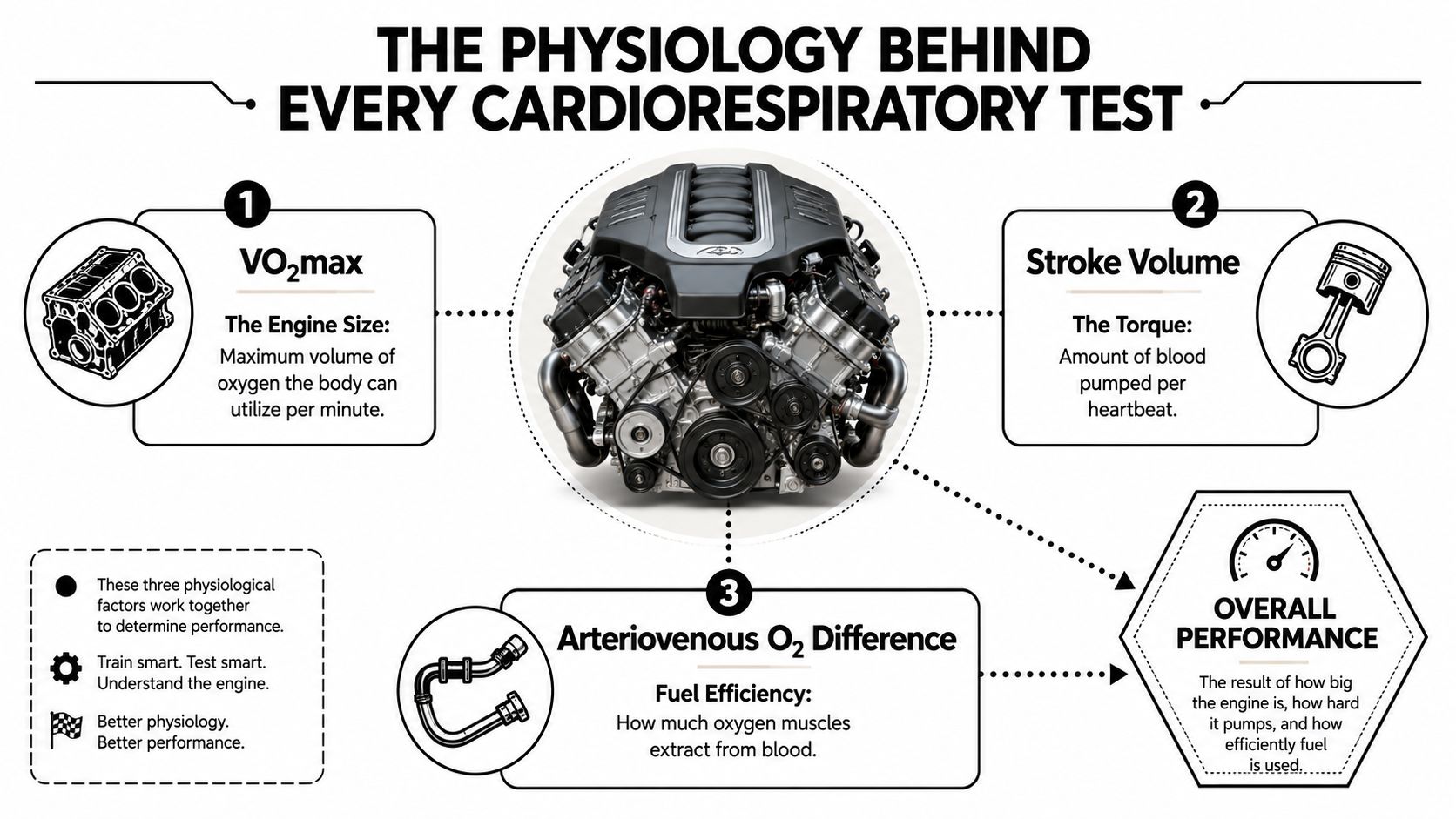
Every cardiorespiratory test is trying to answer the same physiological question, how well can the body deliver oxygen, use it, and keep doing that under load? The practical difference between tests is how much of that system they expose. A clinic may only need a controlled submaximal response. A sports lab may need the full ceiling. An occupational setting often sits somewhere in between, where the test has to be defensible without being more elaborate than the job demands.
VO2max is the highest rate at which oxygen can be taken up and used during intense exercise. Stroke volume is the amount of blood ejected with each beat. Arteriovenous oxygen difference is how much oxygen the muscles remove from the blood that arrives. Those three factors are the core of the physiology, and each test emphasizes them differently depending on the workload, the protocol, and the person in front of you.
Key variables explained
VO2max is the highest rate at which oxygen can be taken up and used during hard exercise. In many sessions you will not see a true plateau, so the more honest report is often VO2peak, the highest value reached in that test. VT1 and VT2 are the points where breathing begins to rise more sharply because the workload has moved from comfortable effort into harder sustained work. RER, the respiratory exchange ratio, helps show whether effort was maximal. MVV, maximal voluntary ventilation, reflects how much air the person can move at their limit.
The Fick equation keeps the whole picture honest because it separates oxygen use into delivery and extraction. The heart and blood deliver oxygen, then the working muscles take it up and use it. Two people can produce the same VO2max and still present very differently at threshold, during recovery, and in how they tolerate effort, because one may have stronger delivery while the other is better at extraction.
The ECG piece matters here as well. If you need a clearer view of what the tracing is showing, the The Lagom Clinic ECG heart guide is a useful companion for understanding the cardiac side of the response.
What matters for each population
For endurance athletes, the threshold profile can matter as much as the top number. For cardiac patients, oxygen delivery, symptom response, blood pressure, and ECG behavior may matter more than peak performance. For occupational baselines, the question is usually whether the person can sustain the physical demand safely and repeatably. The setting changes the interpretation, so the same test can be very useful in one place and unnecessarily complex in another.
That is why lab testing only makes sense when it matches the question. A field test or step test can be the right call when the goal is to see whether someone can tolerate a known demand in a real-world setting, while a full CPET is better when the physiology itself is the issue and the answer needs more detail. For a broader practitioner overview, the cardiopulmonary exercise testing guide is a useful companion resource.
A clean way to remember it is this. Cardiorespiratory testing measures the integrated capacity of the heart, lungs, blood, and muscles to deliver and use oxygen under stress.
Cardiorespiratory testing measures the integrated capacity of the heart, lungs, blood and muscles to deliver and use oxygen under stress.
The Main Families of Cardiorespiratory Tests
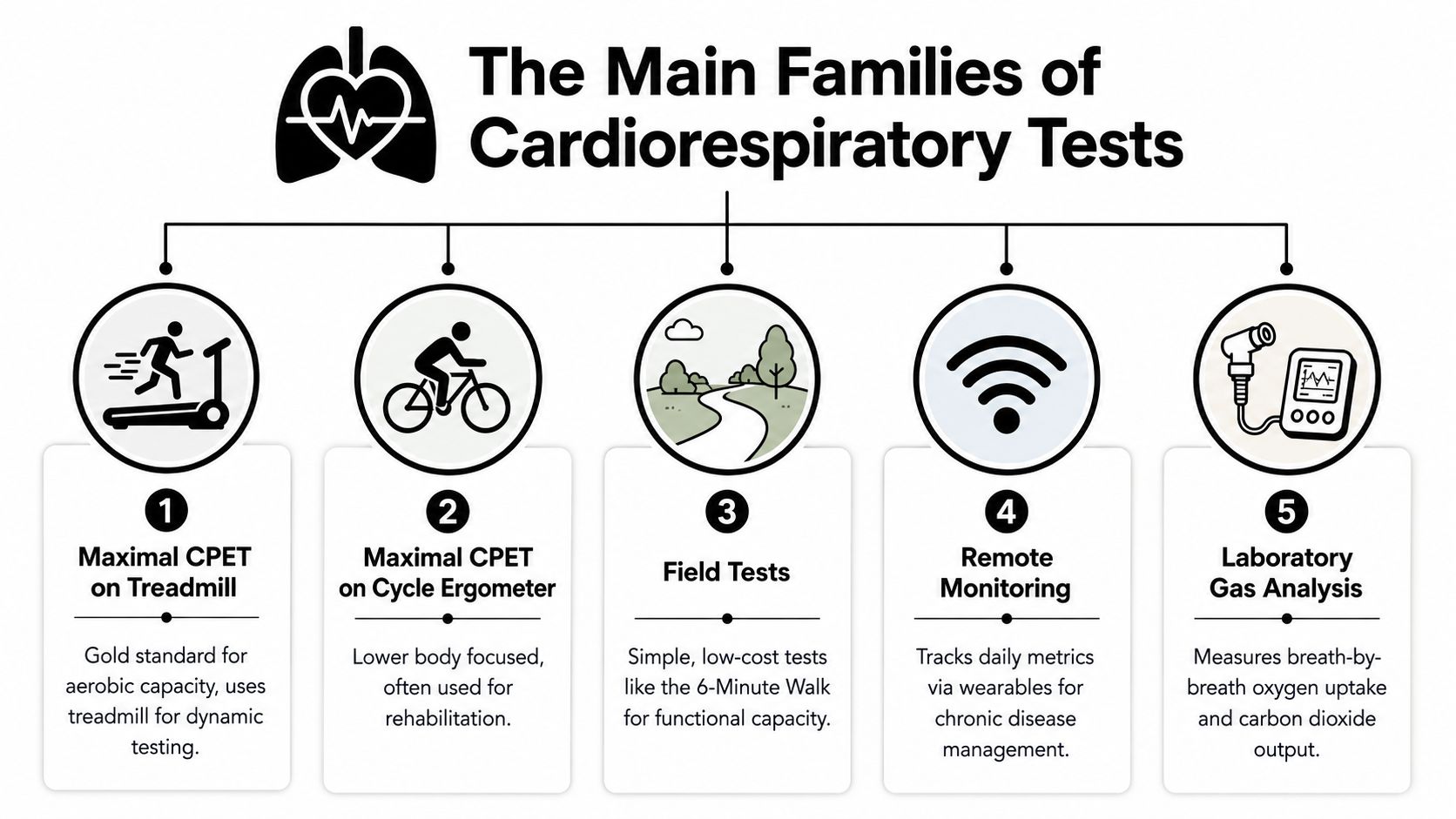
A patient turns up for “exercise testing” and expects one answer. In practice, there are several families of cardiorespiratory tests, and each one answers a different question. The right choice depends on whether you need diagnostic detail, a workplace baseline, a functional check, or a simple way to see how someone tolerates effort in the everyday world.
Maximal CPET
Maximal cardiopulmonary exercise testing, CPET, is the lab standard because it combines workload progression with breath-by-breath gas analysis, usually on a treadmill or cycle ergometer. It gives you VO2, ventilation, thresholds, heart-rate response, blood pressure behavior, and often ECG context. That makes it the right choice when the question is medical, performance-critical, or detailed enough that you need to see the physiology rather than just the outcome.
The trade-off is practical. It needs trained staff, calibrated equipment, and a participant who can tolerate a genuine maximal effort. If the setting is a community baseline, a simple occupational screen, or a gym referral with a narrow question, CPET can be more laboratory than the case needs. For practitioners who want a clearer picture of how this fits into day-to-day decision-making, the cardiopulmonary exercise testing guide for practitioner workflows is a useful companion resource, and ECG interpretation can be paired with The Lagom Clinic ECG heart guide when you need a practical cardiac reference alongside exercise data.
Submaximal treadmill and cycle protocols
Submaximal protocols sit in the middle. They suit referrals where you want a structured estimate, a lower participant burden, and a wider safety margin than a maximal test would give you. In occupational health and general clinic work, that balance is often better than chasing full physiological detail that the setting does not require.
Step tests
Step tests, including the Chester Step Test, are often the most workable option in real-world settings. They are portable, easy to stage in a small room, and useful where a treadmill or metabolic cart is not realistic. If you need a comparable aerobic estimate without turning the room into a laboratory, this is often the first family worth considering. Cartwright Fitness also supplies Chester Aerobic Fitness Tests and related tools, which helps teams use this family in a repeatable way without rebuilding the setup from scratch.
Field tests
The 6-minute walk test and shuttle-style field tests are most useful when function matters more than precision. They fit rehab, community, and workplace settings because they are quick, repeatable, and easy to explain to participants and managers. The limitation is context. A field test can be very good at tracking change in a known environment, but it is a poor substitute when you need detailed physiological profiling or threshold data.
Metabolic cart assessment
A metabolic cart is not really a test family by itself, it is the measurement engine that sits behind the most detailed family of tests. It provides breath-by-breath oxygen uptake and carbon dioxide output, which is what makes threshold analysis, validation, and careful interpretation possible.
For respiratory reporting, the spirometry interpretation guide is worth keeping close, because breathing data is often reported with more confidence than precision. That matters when a team is comparing exercise findings with resting pulmonary tests and needs a consistent way to describe what the lungs are doing.
A practical comparison
| Setting | Primary test | Best low-cost alternative | Operator skill required |
|---|---|---|---|
| Occupational health | Submaximal treadmill or step test | Chester Step Test | Moderate |
| Clinical rehab | Cycle CPET | 6-minute walk test | High |
| University sports science | Maximal CPET with gas analysis | Shuttle or step test | High |
| Community or workplace wellness | Step test | Field walk test | Moderate |
Choosing the Right Test for Each Setting
Occupational health, rehab, elite sport, and community wellness all ask different questions. If you use the same protocol everywhere, you end up with either unnecessary burden or weak data. The right choice is the one you can defend on accuracy, cost, operator skill, participant burden, and turnaround time.
Occupational health and safety-critical roles
For safety-critical work, I want a test that is repeatable, low-friction, and easy to explain to managers. A step test or submaximal treadmill/cycle protocol usually fits better than a maximal CPET unless the referral specifically demands deeper physiological detail. In this setting, the point is not to produce the most heroic number. It's to establish whether the person can meet the relevant workload and whether the test itself is proportionate.
Clinical rehabilitation and pre-op work
Clinical rehab is where CPET earns its keep. If you need symptom correlation, threshold information, or a more detailed risk picture, the lab often earns its place quickly. That said, when staffing or access is limited, a 6-minute walk test can be a sensible surrogate for functional tracking, as noted in recent reviews, while a submax test can fill the gap when the full lab is not available (recent review).
Sports performance and university labs
Maximal testing belongs most naturally in these scenarios. If the athlete needs threshold data, peak validation, or a training prescription built on direct physiology, don't pretend a field test gives the same answer. It doesn't. A metabolic cart and a properly run CPET are the right tools when the downstream decisions depend on precision.
Community and workplace wellness
Community work needs methods people will complete. The latest community-partnered work also points out that standard maximal testing can be inaccessible, partly because it needs specialized equipment and higher participant burden, while submaximal step tests are easier to deploy in neighborhood or community facilities (community-partnered study). That's the trade-off: accessibility often improves when precision is modestly reduced.
Decision filter: if the answer changes a safety decision, lean toward the more rigorous test. If the answer informs coaching, education, or screening, the simpler tool often wins.
Pre-Test Preparation, Indications and Safety
No test is good enough to ignore screening. I'd rather postpone a session than force a maximal protocol through a poor pre-test setup, because the bad session wastes more time than the delay ever does.
What the pre-test screen has to cover
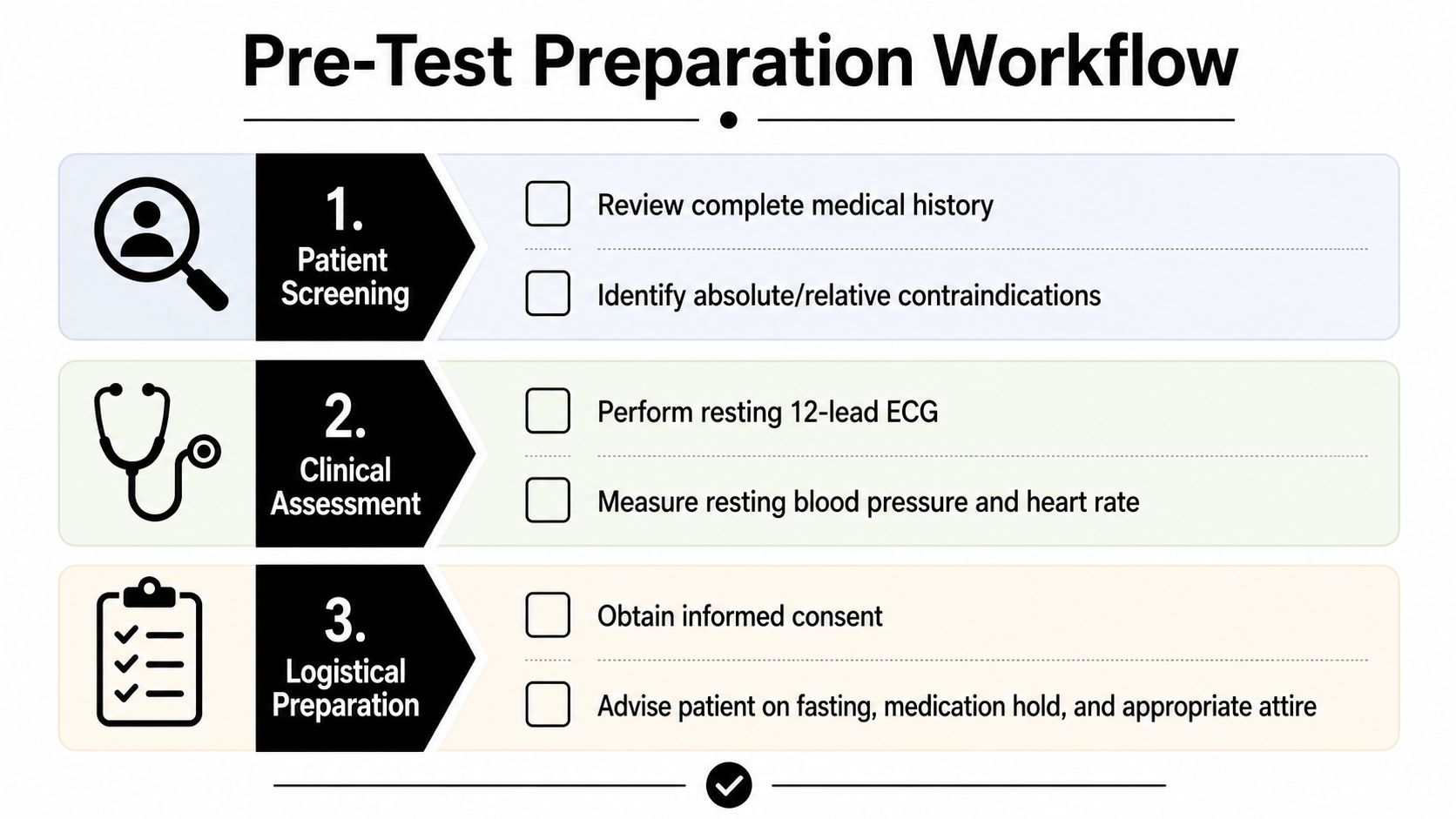
Start with medical history, current symptoms, medications, recent illness, and consent. Beta-blockers and bronchodilators matter because they can change the exercise response, and resting blood pressure and ECG should be checked where indicated. If you're running a lab, gas calibration, volume calibration, lead integrity, emergency equipment, and crash trolley checks need to happen before the first person arrives.
Absolute contraindications to maximal exercise testing include unstable angina, recent myocardial infarction, uncontrolled arrhythmia, and severe aortic stenosis. If those are in play, don't improvise. Downgrade to a safer option or postpone entirely.
A simple workflow that staff can actually use
- Review the history: confirm symptoms, recent illness, medications, and consent.
- Check the physiology: record resting blood pressure, heart rate, and resting ECG where required.
- Confirm the logistics: calibrate the equipment, check emergency access, and make sure the person knows what to wear and what to expect.
Hydration, caffeine, and fasting guidance should be brief and written in plain language. Anxious people do better when they know the test has a start, a middle, and a stop point.
Safety script: “We're going to build the workload gradually, and we'll stop if symptoms, ECG changes, blood pressure response, or exhaustion tell us to stop.”
If the person looks unwell on the day, the sensible move is to defer. A calm reschedule beats a rushed result every time.
Reading and Reporting the Results
A printout only becomes useful when the report reads like a clinical account, not a dump of variables. The report should answer the referral question first, then give the supporting physiology.
VO2max versus VO2peak
This distinction matters because it changes how the result should be read. VO2max implies a true plateau, while VO2peak is the highest value reached during the test. In patients and many non-athletic clients, VO2peak is usually the more honest label. Calling a peak a max sounds stronger, but it muddies interpretation and makes later comparison less clean.
Effort, thresholds, and clinical context
RER is one of the first validity checks I look at because it helps show how hard the person pushed. Threshold identification, whether by breath-by-breath pattern or a laboratory method, helps translate the test into training zones, rehabilitation loading, or symptom-limited tolerance. Heart rate, blood pressure, SpO2, and ECG then tell you whether the physiology stayed clean or became part of the problem.
The report also has to fit the reader. The referrer wants the conclusion, the patient wants plain language, and the athlete wants usable zones and trend data. A one-page summary works well when it is tight and direct, because it gives the decision-maker the part that matters without burying them in exports.
A cardiorespiratory test report should answer the question the referrer actually asked, not just list every variable the software can export.
For anyone who wants a respiratory-reporting analogue, the spirometry interpretation guide is a useful reminder that interpretation should be structured, not decorative.
A clean summary usually includes three things, the key metric, the main interpretation, and the action. If the person had a normal response, say so plainly. If the result was limited by effort, symptoms, or a submaximal stop, say that too. That distinction matters when you are deciding whether the test supports return to exercise, further investigation, or a different test altogether.
Setting Up Cardiorespiratory Testing in Your Facility
The right room setup saves more sessions than any flashy software feature. Small problems, bad layout, missing consumables, a forgotten adaptor, or a calibration check skipped because everyone is busy are usually what derail a day.
Build the room around the test, not the other way around
A starter step-test station only needs a stable platform, timing tools, blood-pressure kit, and a clear workflow. A mid-tier setup adds a treadmill or cycle ergometer, ECG monitor, and space for recovery. A full CPET lab needs the metabolic cart, gas and volume calibration workflow, emergency access, and enough room for staff movement and safe participant handling.
For clinicians or sports facilities that want to scale gradually, the operational logic matters more than the brand list. Cosmed metabolic analysers fit the full-lab category, while Chester Step Test kits are a lower-complexity option for simple field-adjacent delivery. Suppliers such as Cartwright Fitness carry those categories, but the underlying point is broader, choose equipment that matches the test family and the staff who will operate it.
Keep quality control boring and consistent
Quality control is not glamorous, and that is exactly why it matters. Calibrate gas daily when the system is in use, verify volume regularly, and track biological control sessions so you can see drift rather than guess at it. The same staff member tested monthly can give you a simple internal check on whether a system has moved.
Training should be layered. New operators shadow sessions first, then assist, then lead under supervision, then sign off on sessions alone. That sequence protects both the participant and the integrity of the data.
For facilities working through calibration discipline, the metabolic cart calibration guide is worth aligning with your own SOPs.
Common Pitfalls and Where Cardiorespiratory Testing Is Heading
The recurring mistakes are predictable. Teams call VO2peak “VO2max” because the software spits out a number. They compare treadmill results with cycle results as if the protocol didn't matter. They trust a field test for a high-stakes decision. They also forget that calibration drift makes yesterday's data look cleaner than it was.
The next shift is already visible in practice. A recent review describes machine learning and wearable devices as developing tools that may estimate VO2 more accurately in routine settings without specialized diagnostic equipment (2025 review). That matters because access, equity, and repeat testing all get easier when the entry barrier drops.
The working rule stays the same. Pick the simplest test that answers the question, validate it against your own controls, and only upgrade when the clinical or operational question needs more precision.
If you need reliable equipment, validated step-test tools, or a practical way to build a testing workflow that fits your setting, Cartwright Fitness supplies a focused range of assessment products and support for professionals who run these sessions day to day. Visit Cartwright Fitness to review the available testing tools and see what fits your clinic, lab, or workplace programme.