

Figuring out how many calories you burn each day isn't just about what you do at the gym. It's a combination of your Basal Metabolic Rate (BMR), the Thermic Effect of Food (TEF), and your Activity Energy Expenditure (AEE). When you add these up, you get your Total Daily Energy Expenditure (TDEE)—the full story of your body's energy use.
Getting a handle on this blueprint is the first real step toward making any calculation meaningful.
Decoding Your Body's Energy Blueprint
Before we jump into the numbers and formulas, let's break down what we're actually measuring. Your body's daily energy burn isn't a single, simple thing. It's a dynamic interplay of three core processes humming along 24/7.
I like to think of your TDEE as a pie chart. Each slice represents a different part of your daily calorie burn, and the size of those slices can change depending on your lifestyle, what you eat, and your unique body composition.
To really understand your TDEE, you have to appreciate the three pillars that hold it up.
The Three Pillars of Your Daily Energy Burn
| Component | What It Is | Typical TDEE Share |
|---|---|---|
| Basal Metabolic Rate (BMR) | Energy needed for basic life functions at rest (breathing, circulation, etc.). | 60-75% |
| Thermic Effect of Food (TEF) | Energy used to digest, absorb, and process the food you eat. | ~10% |
| Activity Energy Expenditure (AEE) | Energy burned from all movement, both planned exercise and daily activities. | 15-30%+ |
Let's dig a little deeper into what each of these components really means for you.
Your Foundation: Basal Metabolic Rate (BMR)
The biggest piece of the pie, by far, is your Basal Metabolic Rate (BMR). This is the rock-bottom amount of energy your body needs just to stay online—to keep your heart beating, lungs breathing, and body temperature stable while you're completely at rest. For most people, BMR accounts for a massive 60-75% of their total daily calorie burn.
And here’s a common myth I want to bust: your metabolism doesn't just fall off a cliff when you turn 30. In fact, a major study published in Science showed that our energy expenditure stays surprisingly stable from ages 20 to 60.
Key Insight: Your BMR is the price of admission for being alive. Even on a day spent entirely on the couch, your body is burning a significant number of calories just to run its essential systems.
The Fuel Fee: Thermic Effect of Food (TEF)
Next up is the Thermic Effect of Food (TEF). Think of it as a small "energy tax" your body charges to process the food you eat. It takes energy to break down, absorb, and store the nutrients from your meals.
TEF usually accounts for about 10% of your TDEE. It’s also worth mentioning that protein has a higher thermic effect than carbs or fats, which means your body has to work a little harder (and burn more calories) to process it.
The Wild Card: Activity Energy Expenditure (AEE)
Finally, we have Activity Energy Expenditure (AEE). This is the most variable component and the one you have the most direct control over. It’s broken down into two distinct parts:
- Exercise Activity Thermogenesis (EAT): This is the obvious one—calories burned during intentional workouts like a run, a weightlifting session, or a spin class.
- Non-Exercise Activity Thermogenesis (NEAT): This is everything else. It’s the energy you burn walking to your car, typing at your computer, fidgeting, or even just standing instead of sitting. Don't underestimate the power of NEAT!
Together, your AEE can account for as little as 15% of TDEE for someone very sedentary or well over 30% for a highly active person. This is where your daily choices can make a huge difference.
Using Predictive Formulas to Find Your Baseline
So, you're ready to get some real numbers. The most straightforward way to begin estimating your energy expenditure is by using a predictive formula. These equations give you a solid estimate of your Basal Metabolic Rate (BMR)—the calories your body burns at complete rest—using basic info like your age, sex, height, and weight.
Think of these formulas as different maps leading to the same destination. They aren't perfect, but they give you an excellent starting point for figuring out your body's unique energy needs.
Choosing the Right Formula for You
Over the years, a few formulas have become the go-to for fitness professionals. The trick is to pick the one that best reflects your body and lifestyle.
Harris-Benedict (Revised 1984): This is the original classic, updated to be more accurate. It’s a solid all-rounder but can sometimes overestimate BMR, especially if you have a higher body fat percentage.
Mifflin-St Jeor: Developed in the 1990s, this one is now widely considered the gold standard for the general population. In fact, many studies suggest it's about 5% more accurate than the revised Harris-Benedict equation.
Katch-McArdle: This formula is a bit different. It requires you to know your body fat percentage, which makes it perfect for athletes or leaner individuals who already have a good handle on their body composition. It zeroes in on lean body mass, which is the real engine behind your metabolism.
If you want to get into the weeds of how these equations work, you can explore this detailed guide on https://www.cartwrightfitness.co.uk/how-to-calculate-bmr/.
From BMR to TDEE with Activity Multipliers
Once you have your BMR, you’ve only found one piece of the puzzle. That number represents your "coma calories." The next step is to factor in all your daily movement—from walking the dog to hitting the gym—by applying an activity multiplier. This simple step converts your BMR into your Total Daily Energy Expenditure (TDEE).
A word of caution: be brutally honest with yourself here. It's incredibly common to overestimate how active we really are. A desk job plus three solid gym sessions a week usually falls into the "lightly active" category, not "very active."
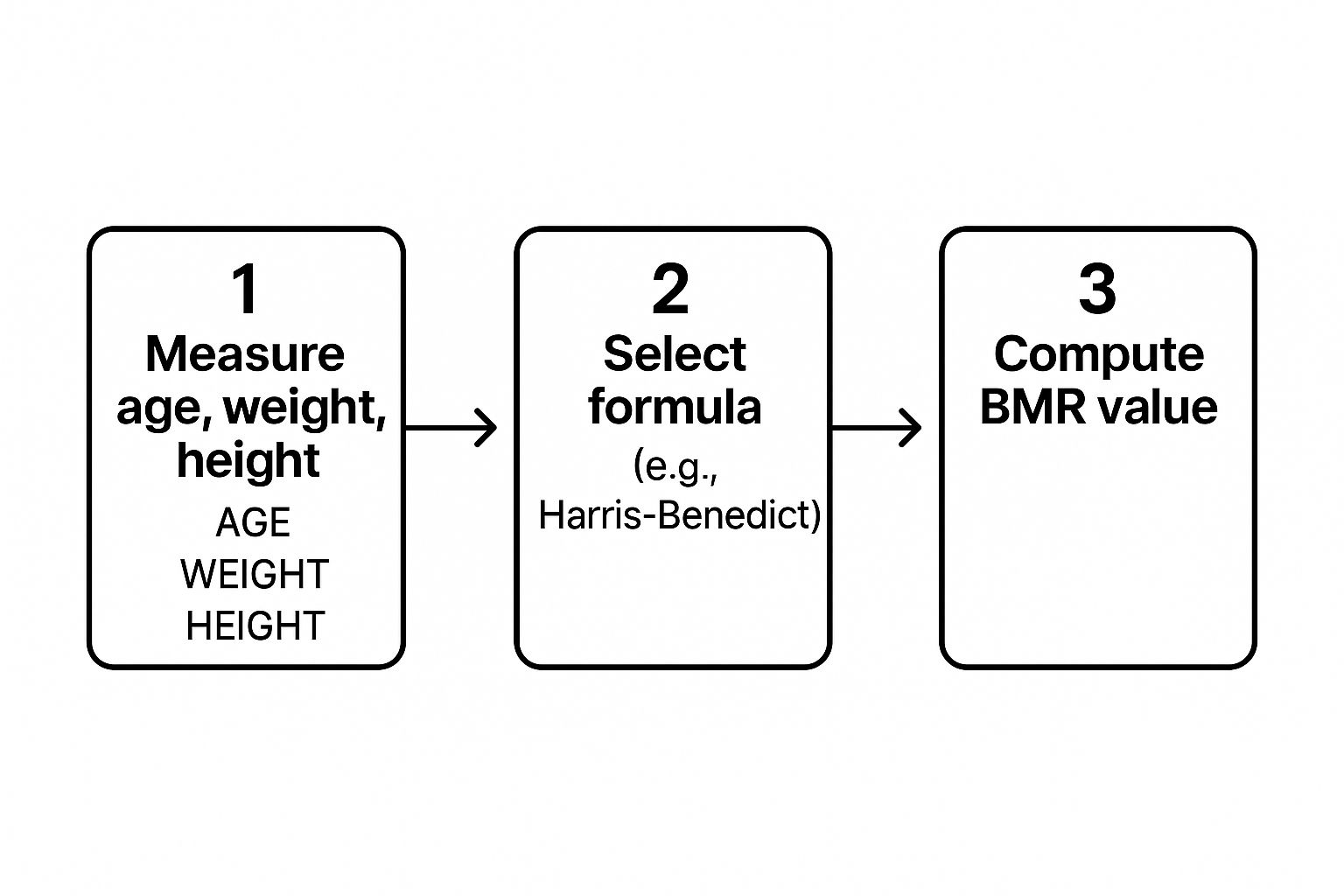
As you can see, the process starts with gathering your personal stats, choosing the right formula for you, and then running the numbers to get that baseline BMR.
Putting It All into Practice
Let’s run the numbers for two completely different people using the Mifflin-St Jeor formula to see how this plays out in the real world.
Scenario 1: The Sedentary Office Worker
- Meet Sarah: She's 35 years old, 5'6" (168 cm), and weighs 150 lbs (68 kg).
- Her BMR: ~1,438 calories/day.
- Her Activity: With a desk job and no regular exercise, we'll use the Sedentary Multiplier (1.2).
- Her Estimated TDEE: 1,438 x 1.2 = ~1,725 calories/day.
Scenario 2: The College Athlete
- Meet David: He's a 20-year-old athlete, standing at 6'0" (183 cm) and weighing 190 lbs (86 kg).
- His BMR: ~1,979 calories/day.
- His Activity: He’s training hard 5-6 days a week, so he gets a Very Active Multiplier (1.725).
- His Estimated TDEE: 1,979 x 1.725 = ~3,414 calories/day.
The Takeaway: Notice how the same formula gives dramatically different results? It all comes down to individual stats and lifestyle. This number isn't meant to be a strict rule but a personalized starting point to guide your nutrition.
If you’re not keen on doing the math yourself, plenty of online platforms offer various fitness tools that can run these calculations for you. Just remember, no matter how you get your number, treat it as a guide, not gospel.
Getting Daily Insights With Wearable Tech

Predictive equations give you a solid, if static, starting point for your energy needs. The problem is, they don't know when you took the stairs, chased your kid around the park, or pushed extra hard on that last set in the gym.
This is where wearable technology—your fitness tracker or smartwatch—really shines. It provides a dynamic, real-time look at how much you're actually moving throughout the day.
These gadgets use a combination of sensors, primarily accelerometers and heart rate monitors, to piece together a pretty detailed picture of your moment-to-moment energy burn.
How Your Watch Figures Out Your Calorie Burn
At the core of your tracker is an accelerometer, a tiny sensor that detects all kinds of movement. It counts your steps, can tell the difference between a walk and a run, and knows when you’ve been sitting still for too long.
This movement data gets crunched by an algorithm to estimate the energy cost, often expressed as calories burned or in Metabolic Equivalents (METs). While the formulas are validated in labs, their accuracy out in the real world can definitely vary depending on what you're doing.
Working alongside the accelerometer is an optical heart rate sensor. This is the tech that shines a light onto your wrist to measure changes in blood flow. By keeping tabs on your heart rate, your watch gets a much clearer picture of your effort level. An accelerometer might not see much difference between a fast walk and a slow jog, but your heart rate will tell the true story.
Just How Accurate Are These Things?
So, can you trust the numbers on your wrist? It’s complicated.
For steady, rhythmic cardio like running or cycling, today's wearables are remarkably accurate. The consistent motion is easy for the sensors to track and translate into a reliable calorie estimate.
Where they tend to stumble is with other types of activity.
- Strength Training: The classic stop-start nature of lifting weights is tough for trackers. There's a lot of muscular effort without much body movement, which often leads to a significant underestimation of the calories you're actually burning.
- High-Intensity Interval Training (HIIT): The quick bursts of all-out effort followed by recovery can cause a lag in heart rate tracking. The device often struggles to keep up with those rapid changes.
- Non-Exercise Activity: Things like carrying heavy groceries, vigorous cleaning, or gardening often get underreported, even though they absolutely add to your total daily energy expenditure.
Knowing these limitations is crucial. If you're really chasing precision, it’s worth checking out different devices and how they stack up in our guide on heart rate monitor accuracy.
My Two Cents: Think of the "calories burned" feature on your watch as a motivational tool and a way to spot trends. It’s perfect for seeing if you’re more active this month than last, but I wouldn't use it to calculate an exact calorie deficit down to the single digit.
Beyond everyday fitness trackers, there are also highly specialized sports sensors that offer incredibly detailed metrics. If you're a serious athlete, you might want to explore something like this ultimate guide to wearable football sensors to see how targeted tech can dial in on the specific energy demands of a sport.
Comparing Methods for Tracking Energy Burn
When it comes to tracking your energy expenditure, you've got options ranging from simple formulas to sophisticated lab equipment. Here’s a quick breakdown of how they compare in terms of accuracy, cost, and what they're best used for.
| Method | Accuracy Level | Accessibility & Cost | Best For |
|---|---|---|---|
| Predictive Equations | Low to Moderate | High (Free) | Getting a quick, general baseline of your daily needs. |
| Wearable Trackers | Moderate | Moderate (One-time cost) | Tracking daily activity trends and staying motivated. |
| Field Tests | Moderate to High | Low | Assessing fitness levels and estimating VO₂ max without a lab. |
| Instrument-Based | High to Very High | Low (Expensive) | Clinical research and elite athletic performance analysis. |
Ultimately, wearables are fantastic tools for building awareness and tracking your progress over time. Just remember to use them for what they're good at—trends and motivation—while understanding where they might fall short.
How Clinical Gold Standards Work
When you plug numbers into a formula or glance at your fitness tracker, you're getting a very educated guess. But where do the "real" numbers come from? How do we know how accurate those guesses are? The answer lies in clinical gold standards—the high-precision laboratory techniques that all other methods are measured against.
You probably won't be using these at home, but knowing how they work gives you a much better appreciation for the science of metabolism. It shows you why everything else is just an approximation and reveals the incredible detail behind these measurements. These are the benchmarks that set the standard.
Measuring What You Breathe: Indirect Calorimetry
One of the most common lab methods is Indirect Calorimetry. The name sounds technical, but the idea behind it is actually quite elegant: it figures out your metabolism by analyzing the air you breathe. It all comes down to a simple fact—when your body burns energy, it needs oxygen (O₂) and creates carbon dioxide (CO₂).
To measure this, a person simply relaxes and breathes into a specialized machine, often called a metabolic cart. This device precisely measures the amount of oxygen they consume and the carbon dioxide they exhale. By looking at the ratio of these gases, scientists can tell exactly what fuel your body is using (carbs vs. fats) and calculate your metabolic rate with incredible accuracy.
For a closer look at this process, check out our guide on how to measure resting metabolic rate.
The Ultimate Benchmark: Doubly Labeled Water
When it comes to measuring Total Energy Expenditure (TEE) out in the real world over several days or weeks, nothing comes close to the Doubly Labeled Water (DLW) method. It's the undisputed gold standard for capturing how many calories someone actually burns while living their normal life, not just sitting in a lab.
Here's how it works: a person drinks a small amount of special water that contains harmless, stable (non-radioactive) isotopes of hydrogen and oxygen. Think of these as "tagged" atoms. As their body burns energy and produces CO₂, these labeled atoms are slowly flushed out of the body through urine, sweat, and breath.
Researchers then collect urine samples over the next one to three weeks to see how quickly these isotopes are disappearing. The rate at which they vanish is directly linked to CO₂ production, which allows for an exceptionally precise calculation of TEE.
The Doubly Labeled Water method is so trusted that it has been the cornerstone of metabolic research since the 1980s. In the last four decades, it's been used to gather over 8,000 measurements in 37 countries, creating the foundation of our modern understanding of how humans use energy. You can learn more about this extensive data on IAEA.org.
These clinical methods are the bedrock of metabolic science. They provide the "ground truth" that allows researchers to create and fine-tune the more accessible tools we rely on every day, from simple equations to the smartwatch on your wrist.
Putting Your Numbers to Work
Alright, so you’ve done the math and now you have a number—your estimated Total Daily Energy Expenditure (TDEE). That's a great first step, but the number itself is just data. The real magic happens when you turn that data into a practical tool that helps you reach your goals. This is where we bridge the gap between theory and real-world results.
First things first, you need to match your measurement method to your objective. Not every situation requires a lab-grade calculation, and picking the right tool for the job from the get-go will save you a ton of hassle.
Choosing the Right Tool for the Job
Think honestly about what you're trying to achieve. Are you just dipping your toes into fitness, or are you a competitive athlete dialing in your performance? The answer dictates your approach.
For General Health & Wellness: If you're looking to improve your overall health or maybe drop a few pounds, a predictive equation like the Mifflin-St Jeor is perfect. It’s free, quick, and gives you a solid baseline to start from without getting bogged down in too much detail.
For Building Daily Habits: Find yourself motivated by daily feedback? A wearable fitness tracker is probably your best friend. It helps you see trends and keeps you engaged day-to-day, which is often more valuable than having a perfectly precise calorie count.
For Serious Athletes: When performance is the name of the game, I usually recommend a combined approach. Use a more advanced formula like Katch-McArdle for a sharper BMR estimate (assuming you know your body fat percentage), and layer that with data from a quality heart rate monitor during your training sessions.
Whichever path you take, it’s critical to treat the final number as a starting point, not a strict rule set in stone. Think of your TDEE calculation as your initial hypothesis. Now, it's time to test it in the real world.
Your TDEE Is a Starting Line, Not a Finish Line
Here's a dose of reality: your body isn't a simple calculator. How well you slept, your stress levels, and even hormonal shifts can all nudge your daily energy needs up or down in ways no formula can perfectly predict. That’s why the number you get is just the beginning of the conversation.
Over the long haul, the most accurate tool you have for gauging your energy needs is your own body's feedback. The scale, your energy levels, and how you feel in the gym will always paint a more honest picture than any single equation or device.
So, how do you listen to that feedback? You create a simple framework. Once you have your estimated TDEE, the plan is to eat at that calorie level consistently for a couple of weeks while keeping an eye on a few key metrics. This is your observation phase—and it’s where you collect the data that truly matters.
The Feedback Loop: How to Fine-Tune Your Approach
To make your plan truly yours, you need to track your body’s response and be ready to make small, smart adjustments. This creates a sustainable system that evolves right along with you.
Track these three things for 2-3 weeks:
Body Weight: Hop on the scale three or four times a week, always under the same conditions (like first thing in the morning after using the bathroom). Then, take the weekly average. This simple trick smooths out the daily noise from water retention and sodium intake.
Energy Levels: Just use a simple 1-5 scale. Were you feeling sharp and energetic, or were you dragging through your afternoons?
Performance: How did your workouts feel? Were you strong and hitting your marks, or did you feel like you were running on fumes?
After a couple of weeks, take a look at your data. If your average weight is holding steady and you feel great, your TDEE estimate was pretty much bang on. If you've lost a little weight, your actual TDEE is probably a bit higher than you calculated. Gained a little? It’s likely a bit lower.
Use this real-world feedback to make a small tweak—say, adding or subtracting 100-200 calories—and run the experiment again. This simple, iterative process is the secret to turning a generic calculation into a personalized plan that actually works.
Common Questions About Energy Expenditure
Once you start digging into energy expenditure, a few questions always pop up. It’s a confusing topic at first, so let's clear up some of the most common sticking points.
Getting these details straight helps you turn a bunch of numbers into a practical tool for your health goals. The idea is to feel confident in your approach, not get bogged down by the science.
How Often Should I Recalculate My Energy Expenditure?
You definitely don't need to do this every day or even every week. My advice is to only run the numbers again when something significant changes.
So, what counts as a "significant change"?
- A major shift in body weight: Think a loss or gain of 5-10% of your total weight.
- A new activity level: Maybe you started an intense marathon training plan or switched from an active job to a desk job.
- A routine check-in: It's smart to recalculate every 3-4 months anyway, just to account for smaller, gradual changes your body has made.
Treat your TDEE as a solid starting point, not a moving target you need to hit perfectly every day. Pay more attention to what your body is telling you—your energy levels, performance, and how your weight trends over several weeks. That real-world feedback is always more valuable than a formula.
Why Does My Fitness Tracker Show Different Numbers Than a Calculator?
This is probably the question I hear most often. The discrepancy comes down to the different methods they use. Predictive equations are based on a fixed formula using your stats (age, sex, height, weight) and a simple activity multiplier. They're a great, stable estimate.
Your fitness tracker, on the other hand, is trying to measure your calorie burn in real-time. It uses sensors like heart rate monitors and accelerometers to guess how much energy you're using minute by minute.
The truth is, neither one is 100% accurate.
The calculator can’t account for a surprisingly active day, and the tracker often gets confused by things like strength training or stress-induced heart rate spikes. The best approach is to use both: let the equation set your baseline and use the tracker to spot trends. The most important thing is to pick one method and stick with it for consistency.
Is It Possible to Increase My Metabolism?
Yes, absolutely. You have a good amount of control over your Basal Metabolic Rate (BMR), which accounts for the biggest chunk of your daily calorie burn. The single most effective way to give it a boost is to build more lean muscle.
Muscle is metabolically "expensive" tissue—it burns far more calories than fat, even when you're just sitting on the couch. This is precisely why strength training is your best long-term strategy for stoking your metabolic fire.
You can't change your age or genetics, but building and preserving muscle is something you can actively work on to crank up your body's engine.
At Cartwright Fitness, we focus on professional-grade equipment for accurate health and performance tracking. If you're looking for reliable tools to measure body composition or metabolic rate, check out our selection of validated instruments.


