

Are you trying to find the “most accurate” body fat test, or are you trying to answer a more useful question, such as whether an athlete is preserving lean mass, whether an employee needs further clinical assessment, or whether a rehabilitation programme is producing meaningful change?
Those questions don't have the same measurement requirements. Body fat measurement methods estimate different compartments, rely on different assumptions, and introduce different sources of error. A test that works well for repeated field monitoring may be unsuitable for individual diagnosis, while an imaging method that gives a stronger whole-body reference may be impractical for frequent team screening.
The right choice depends on the decision that follows the measurement. Total fat, visceral fat, regional fat, and change over time aren't interchangeable targets.
Table of Contents
- Why the Best Body Fat Test Depends on Your Question
- How Major Body Fat Measurement Methods Work
- Comparing Accuracy and Reliability Across Methods
- Understanding Error Margins and Misclassification Risks
- Choosing the Right Method for Your Setting
- Practical Implementation and Trend Monitoring Strategies
- Real-World Applications Across Professional Settings
Why the Best Body Fat Test Depends on Your Question
Define the decision threshold first, then choose your method. A sports science department may need a repeatable measure across a training block. An occupational health provider may need a practical screening tool that staff can administer consistently across a workforce. Clinical teams need a defensible estimate of fat mass, lean mass, or regional tissue distribution. Treating these needs as identical makes the test appear more precise than the decision process allows.
Whole-body fat mass and lean mass call for a different approach from regional tissue assessment. DXA is usually the closest practical reference method for whole-body estimates. MRI or CT can show visceral, subcutaneous, or intramuscular fat in greater regional detail than field methods. CT involves ionising radiation. MRI provides detailed soft-tissue assessment without that exposure, but both require specialised access and interpretation. This distinction is outlined in the recent review of body composition assessment methods.
Four questions that change the answer
- Do you need an absolute estimate? Clinical or research decisions require a method with strong reproducibility and a clear reference position.
- Do you need regional information? Waist circumference and skinfolds provide indirect information, while imaging can distinguish tissue compartments more directly.
- Do you need to track serial change? A consistent protocol on the same device often supports better monitoring than switching methods in pursuit of a theoretically stronger single reading.
- Do you need high throughput? A portable field method may be the only workable option for teams testing many people within a limited period.
The measurement target determines the acceptable error. A whole-body estimate can support group monitoring, while a borderline individual classification deserves more scrutiny before it drives clinical or occupational action.
Hydrostatic weighing became a historical benchmark because it estimates body density rather than directly counting fat tissue. Reviews describe it as a “gold standard” in the historical development of body composition assessment, while recognising that it remains a two-compartment model rather than a direct chemical measurement of fat mass (Physiological Reviews).
Practical rule: Define the decision threshold first. Then choose the method whose likely error will not undermine that decision.
For a fitness trainer, the useful question may be whether waist size and estimated fatness are moving in the intended direction while performance is maintained. For a clinician, a borderline classification warrants a more defensible reference method. For an occupational team, standardisation, privacy, throughput, and follow-up pathways can matter more than a highly detailed one-off scan.
How Major Body Fat Measurement Methods Work
Which body fat method fits the decision you need to make? The answer depends on the signal being measured, the assumptions used to interpret it, and the testing conditions that can shift the result.
Density and displacement methods
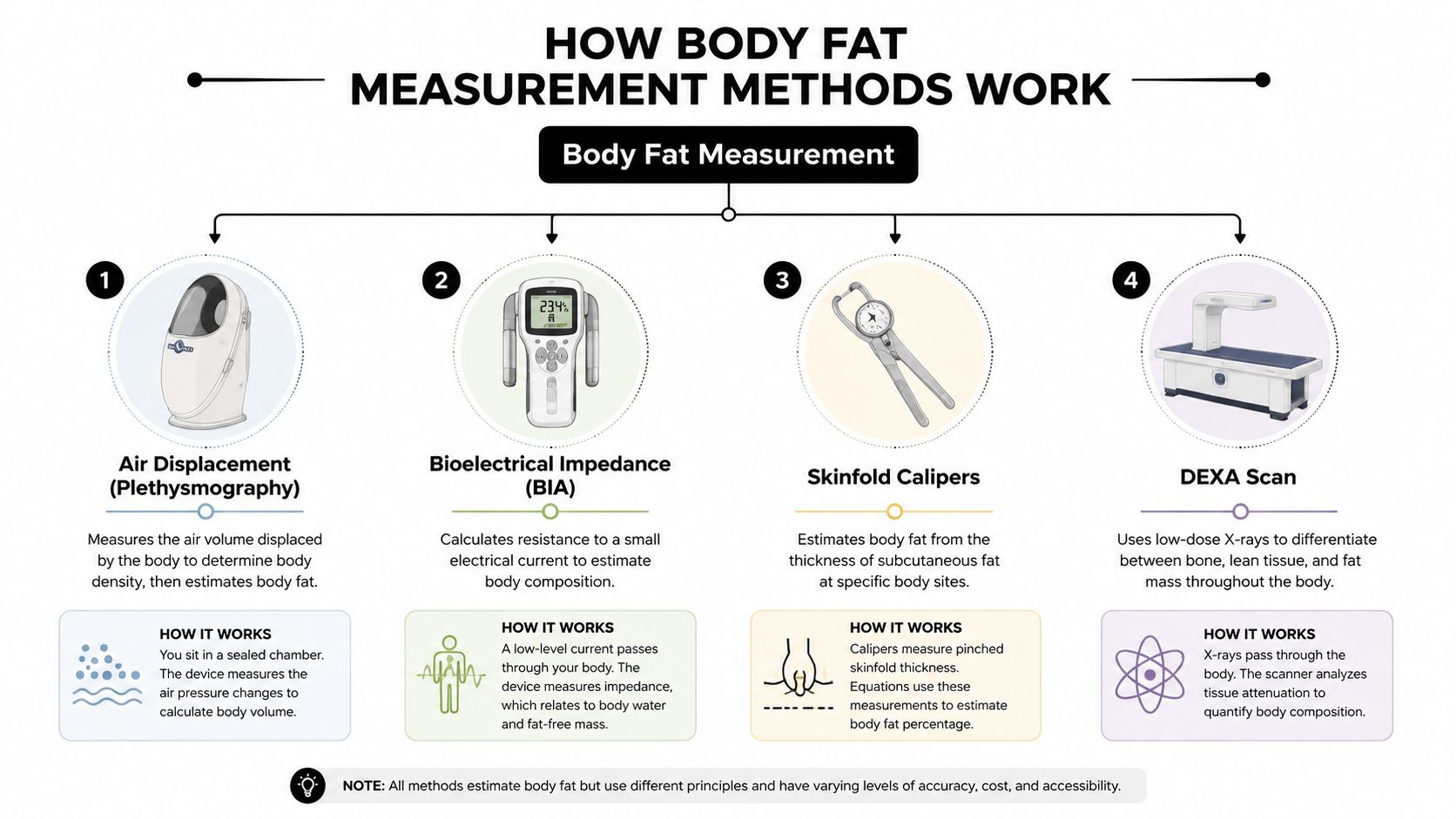
Hydrostatic weighing estimates body density from body mass in air and apparent mass underwater. The calculation then applies assumed densities for fat and fat-free mass. Residual lung volume, buoyancy, and participant technique can affect the estimate. Its long use established it as a reference for comparing newer methods, although it remains an indirect model (Physiological Reviews).
Air-displacement plethysmography, commonly associated with the Bod Pod, uses the same density principle with air instead of water. The person sits inside a chamber, and the system estimates body volume from air displacement before combining that value with body mass. Testing is quick and controlled. Clothing, hair, posture, and equipment calibration can still influence the reading.
Electrical, thickness, and imaging methods
Bioelectrical impedance analysis, or BIA, sends a small electrical current through the body and measures impedance. Water-rich tissues conduct electricity differently from fat tissue, so the device combines impedance with body mass, height, age, sex, and an equation developed for a particular population. Hydration, recent food or exercise, electrode contact, and equation choice can materially affect results. Guidance such as Is a BIA scale worth it is most useful when read alongside the device's testing protocol.
Skinfold calipers measure subcutaneous tissue thickness at selected anatomical sites. A practitioner enters those readings into an equation, often using a multi-site approach such as the Durnin and Womersley four-site method. The measurement is local, while the reported body fat percentage depends on assumptions about fat distribution and the relationship between subcutaneous and total body fat. Operator training and consistent site location therefore matter.
DXA, or dual-energy X-ray absorptiometry, uses two X-ray energies to distinguish bone mineral from soft tissue, then estimates fat mass and fat-free mass. It produces whole-body and regional results, which can suit clinical and performance questions requiring distribution as well as total mass. Results remain dependent on the instrument, analysis software, reference standard, and population.
For a plain-language explanation of the outputs, see what body composition analysis measures. The practical task is to trace the estimation chain from signal to reported result. A clear understanding of that estimation chain is more valuable than any league table of methods.
Comparing Accuracy and Reliability Across Methods
Which result do you need: a defensible baseline, a repeatable trend, or a decision about an individual's body-fat category? Accuracy describes closeness to a reference method. Reliability describes whether repeated tests under similar conditions produce consistent results. A method may correlate strongly with DXA across a group while disagreeing enough to misclassify one person.
The table summarises the principal methods without assigning one universal error value. Device model, equation, operator, population, and testing protocol can all change performance.
Body Fat Measurement Methods Comparison
| Method | Accuracy vs Reference | Reliability (CV) | Cost | Best For |
|---|---|---|---|---|
| Hydrostatic weighing | A historical reference method based on body density. One comparison found estimates statistically equivalent to DXA within a 10% equivalence interval, with absolute mean differences from reference methods ranging from 1.0% to 4.9% body fat | Depends on underwater technique, residual lung volume, and operator control | Specialist facility | Reference comparisons and controlled research |
| Skinfolds | Statistically equivalent to DXA within a 10% equivalence interval in one clinical comparison, although absolute values may differ substantially from DXA (SciELO review) | Operator-dependent, with field-method precision varying by protocol (PubMed comparison) | Low | Practical field monitoring with a trained assessor |
| BIA | Useful for field assessment, but studies report meaningful bias versus DXA and limited interchangeability for individual classification (PubMed study) | Device and hydration dependent. Precision varies by model and outcome | Low to moderate | Standardised trend monitoring |
| Air-displacement plethysmography | Density-based estimate with controlled testing, rather than a direct fat measurement | A technical review reported fat-mass CV of 2.13% | Specialist facility | Controlled laboratory or performance settings |
| DXA | A practical reference for reproducible whole-body fat-mass estimation. One comparison reported fat-mass CV of 1.17%, with DXA the only method meeting an 80% precision cut-point | High day-to-day reliability, with reported ICCs above 0.9 across methods in one laboratory comparison | Higher | Clinical, research, and detailed baseline assessment |
These categories answer different operational questions. Use DXA when regional distribution or a defensible baseline matters. Use skinfolds when a trained assessor can maintain site locations and technique. Use BIA for repeated monitoring only when the device, preparation, timing, and interpretation remain consistent. Select equipment based on agreement and repeatability metrics, not correlation alone.
Absolute values still require caution. One study reported male body fat at 19.0% by DXA versus 12.7% by skinfolds, while female body fat was 29.2% by DXA versus 17.8% by skinfolds (SciELO review). The practical implication is specific: skinfolds may show the direction of change while assigning a materially different absolute classification.
Hydrostatic weighing shows why historical benchmarks remain in use. In a volunteer study, mean body fat was 20.5% with hydrostatic weighing, 21.8% with skinfolds, and 20.8% with impedance, supporting its role in validating field methods (Physiological Reviews).
For teams reviewing BIA claims, BIA accuracy in body composition analysis keeps agreement, correlation, and repeatability separate. That distinction should guide procurement, protocol design, and the decision to use a result for classification or trend monitoring.
Understanding Error Margins and Misclassification Risks
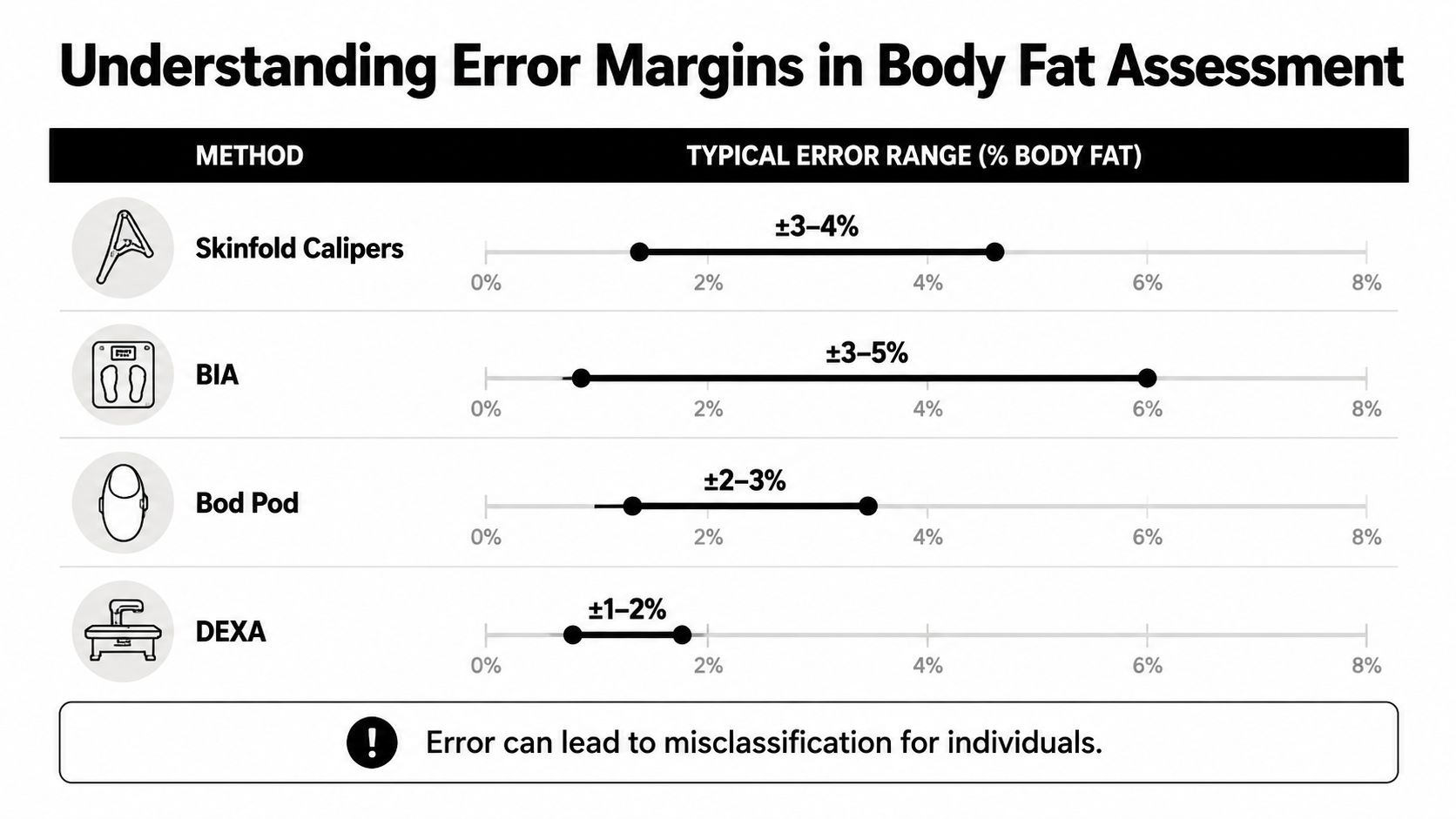
Could a result be precise enough for a trend, yet too uncertain for an individual decision? That is the practical question behind error margins. Two devices producing different readings is only part of the problem. Risk increases when a team treats those readings as interchangeable and makes a decision the measurement cannot support.
BIA and skinfolds may support monitoring within one stable protocol, while differing materially from DXA in the same person. A study of young adults found that BIA underestimated body fat versus DXA by about 6.5 percentage points at baseline, while skinfolds underestimated it by about 1.7 percentage points. Neither field method detected the small training-related changes identified by DXA in that study.
Why individual error grows
A prediction equation is trained on a population. The person being tested may differ from that population in body size, age, ethnicity, muscularity, fat distribution, hydration, or training status. BIA readings also respond to fluid shifts, recent food intake, skin temperature, and the path taken by the electrical current. With skinfolds, site location and tissue compression can change the result between assessors.
A strong BIA correlation with DXA across a group describes ranking at group level. It does not make the two results interchangeable in an individual report. Recent review evidence describes strong correlations for some BIA outcomes alongside wide limits of agreement and weaker performance for skeletal muscle mass and people with higher adiposity (Frontiers review).
Trend monitoring tolerates consistent bias. Diagnostic claims do not.
Calibrate the decision to the error
Use a field method when the decision concerns direction, adherence, or programme response, provided the protocol stays stable. A single unconfirmed BIA or skinfold result should not determine whether someone is labelled “healthy,” “unhealthy,” or fit for a consequential role. If the result conflicts with waist measures, BMI, physical function, clinical history, or the person's presentation, investigate the discrepancy rather than forcing the number to fit.
Borderline individual decisions warrant DXA or another suitable reference assessment for confirmation. Questions about visceral or ectopic fat require regional tissue assessment, not a whole-body percentage used as a substitute. Error tolerance belongs to the decision, not to the device brochure.
Choosing the Right Method for Your Setting
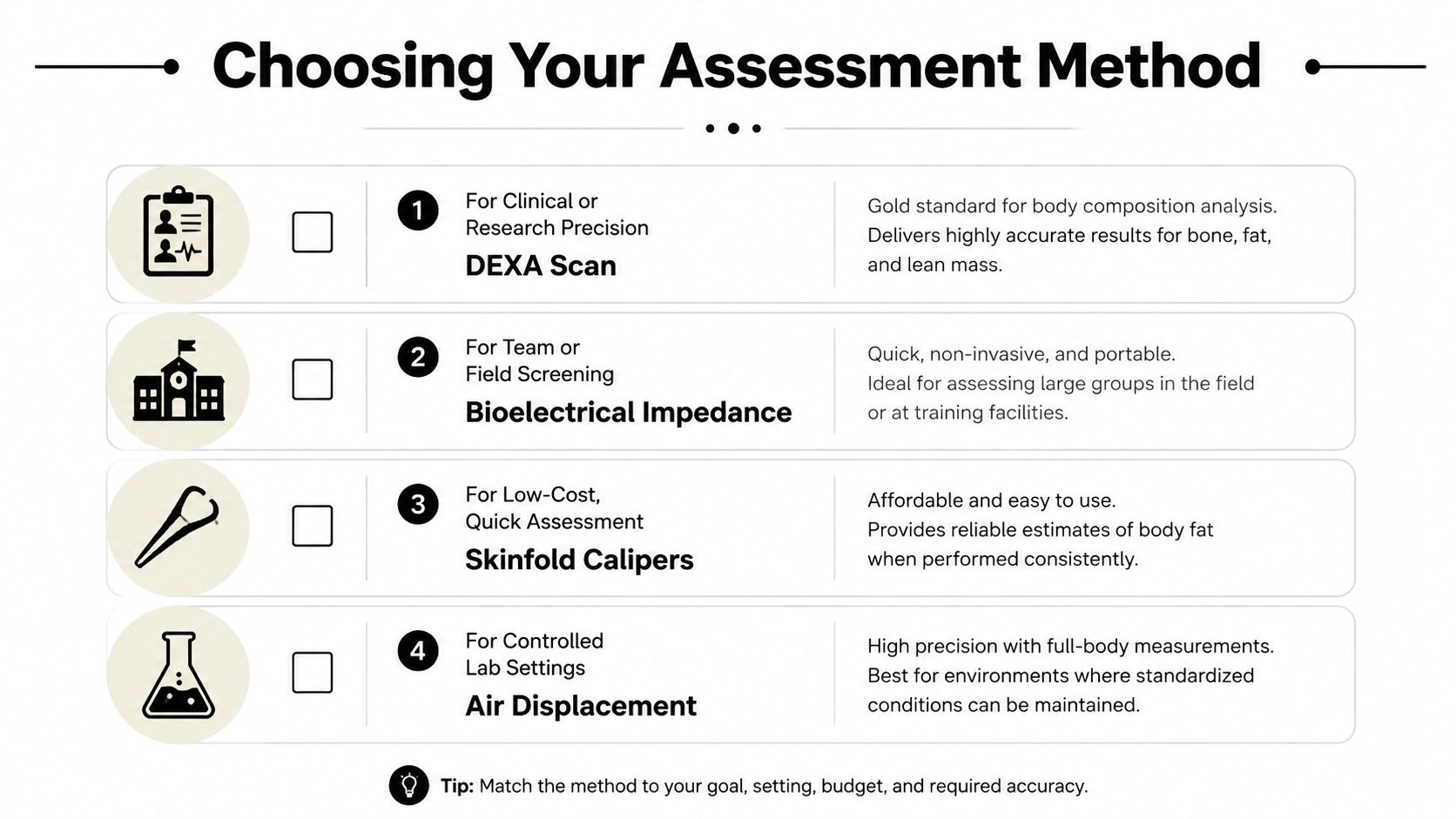
Which decision must the measurement support, and how much error can that decision tolerate? Start with the question, then assess the required precision, available time, operator skill, and consequences of a wrong classification. Radiation exposure and access to clinical imaging also influence repeated-testing plans.
Occupational health
Occupational health teams need a defensible process, not an isolated body fat estimate. BIA or skinfolds suit structured screening when trained staff follow a fixed protocol. A single estimate should not determine fitness for duty. If a result carries medical or employment consequences, refer the person for appropriate clinical assessment.
Privacy affects data quality and participation. Explain what the method measures, who can access the result, and what action may follow. An advanced test provides little value if employees distrust the process or decline repeat assessments.
Clinical and rehabilitation services
Choose DXA when reproducible whole-body fat mass and lean mass answer the clinical question, especially when treatment decisions or meaningful changes require confirmation. MRI or CT is more appropriate for regional fat, muscle quality, or organ-associated fat. CT selection requires careful consideration of radiation exposure.
Rehabilitation teams should interpret repeated body composition observations alongside strength, function, circumference, and clinical status. A field method is suitable for routine tracking under a consistent protocol. Unexpected or conflicting findings warrant a more rigorous assessment before treatment conclusions are made.
Sports performance
Sports scientists usually need repeatable testing across training phases, low athlete burden, and efficient squad assessment. Skinfolds remain practical because they are portable and inexpensive, and they are widely used in sports settings (SciELO review). BIA produces reliable results when hydration and pre-test conditions are standardised. Record those conditions, because a technically consistent device still produces misleading trends when testing follows different meals, training sessions, or fluid states.
Use DXA for a stronger reference baseline or more detailed regional information. The added precision matters when the staff must verify a small change, examine fat distribution, or resolve disagreement between field measures and performance data.
Fitness and corporate wellness
A standardised BIA device or trained skinfold assessor gives trainers and wellness teams useful feedback without treating every assessment as a medical event. Keep the method unchanged between visits, and interpret results with waist circumference, performance, and programme adherence.
Cartwright Fitness supplies professional testing equipment and related systems, including skinfold tools, BIA guidance, and the Seca 525 mBCA for measuring fat mass and fat-free mass. The appropriate choice remains determined by the team's protocol, training, and decision requirements, rather than by the product category alone.
Practical Implementation and Trend Monitoring Strategies
A modest method used consistently often beats an impressive method used inconsistently. Before collecting the first baseline, write the protocol down. Specify the device, assessor, anatomical sites or electrode position, clothing, time of testing, pre-test restrictions, calibration checks, and how results will be reported.
BIA requires particular attention to hydration and recent activity because fluid distribution can alter impedance. Skinfolds require site marking, assessor training, and repeatability checks. DXA requires consistent positioning and awareness that scanner settings, analysis software, and technician decisions can influence the output.
Build a usable baseline
Record more than body fat percentage. Capture body mass, relevant circumferences, the method and device used, assessor identity, unusual pre-test conditions, and a small set of functional or performance markers. A change in estimated fat percentage means more when it aligns with waist change, training performance, and the expected programme timeline.
Don't switch from a BIA analyser to skinfolds and call the difference progress. A method change creates a new measurement series. If a reference assessment is available, use it to understand the scale and direction of the local bias, then continue with one protocol for trend monitoring.
Use control charts, not emotional reactions
Teams should look for a pattern across repeated observations rather than reacting to one reading. Flag an unexpected result for repeat testing when the participant arrived dehydrated, had trained immediately before assessment, changed equipment, or had a different assessor. The person may have changed, or the protocol may have changed.
The same principle applies to individual clients. Tracking fitness progress with consistent measures is more informative than chasing a new device each time a reading disappoints. A field method becomes valuable when it helps the practitioner decide whether to continue, adjust, or escalate the programme.
Quality-control principle: Standardise the measurement before you interpret the trend.
Real-World Applications Across Professional Settings
An occupational health provider screening a physically demanding workforce might use a trained skinfold assessor or validated BIA protocol for routine monitoring, then refer ambiguous cases for clinical assessment. The team would keep body fat estimates separate from the actual fitness-for-duty decision, which should include job-specific function and relevant health information.
A university sports science department could use skinfolds or BIA for repeated squad monitoring and reserve DXA for a baseline or research protocol. The department would report within-method changes, not compare a skinfold percentage directly with a later DXA percentage.
A rehabilitation service may pair a practical field method with circumference, strength, mobility, and functional testing. If the clinical question concerns regional muscle or visceral fat, the service would need imaging rather than treating a whole-body estimate as an answer.
A corporate wellness team should favour a low-burden protocol that participants understand and will repeat, with careful handling of privacy and individual interpretation. Across all four settings, the strongest implementation decision is the same: match the method to the decision, standardise the conditions, and escalate when the error could change the outcome.
Cartwright Fitness provides professional equipment for skinfold assessment, BIA, body composition analysis, and related performance testing, helping teams build consistent protocols around the tools they select. Visit Cartwright Fitness to review suitable assessment equipment and speak with a product team about matching your testing setup to clinical, athletic, or occupational requirements.