

A technician arrives for an occupational fitness review after a handheld BIA device flags him as having high body fat. The reading was taken mid-shift, in work clothing, after normal food and fluid intake. A later DEXA assessment produces a materially different result, and the referral decision has to be reconsidered. The problem wasn't a lack of technical knowledge. It was a failure to control the measurement.
Body composition fitness testing only supports a clinical, occupational or performance decision when the instrument, operator protocol and decision threshold are aligned. A number can look precise while carrying more uncertainty than the decision allows. The practical task is therefore not to find a universally superior method, but to identify which source of error is acceptable for the question being asked.
Table of Contents
- Why Body Composition Results Go Wrong in Practice
- What Body Composition Testing Actually Measures
- Comparing BIA, Skinfolds, Ultrasound and DEXA
- Accuracy, Bias and What UK Validation Studies Show
- Preparing the Subject and Controlling the Reading
- How Often to Retest and What Change Is Real
- Choosing Professional Equipment That Fits the Decision
Why Body Composition Results Go Wrong in Practice
The reading is only as useful as its conditions
A single handheld BIA result can be distorted by hydration, food, clothing, skin temperature, recent exercise and electrode contact. Consumer-grade scales add another problem, because their equations may not match the population being assessed or the purpose of the test. A mid-shift screening result shouldn't be treated as interchangeable with a controlled clinical measurement.
That distinction matters in occupational health. A body composition result may influence referral, rehabilitation planning, workplace risk management or fitness-for-duty discussion. Those decisions need a defensible trail showing how the subject was prepared, how the device was operated and why the chosen threshold was appropriate.
UK practice already treats body composition as broader than scale weight. The NHS adult BMI guidance defines BMI as weight in kilograms divided by height in metres squared, with 18.5 to 24.9 classified as healthy weight, 25 to 29.9 as overweight and 30 or above as obese. Waist measurement adds information about central adiposity, with low-risk thresholds under 80 cm for women and under 94 cm for men, higher risk from 80 to 88 cm for women and 94 to 102 cm for men, and very high risk above those levels.
Practical rule: A result shouldn't trigger a consequential decision until the team can explain the method, conditions, uncertainty and action threshold.
Common failures are procedural
Several failure modes recur across gyms, clinics and workplace assessments:
- BIA equipment is used without a controlled protocol. Hydrated, clothed subjects tested at different times can produce readings that look like physiological change.
- Skinfold sums are paired with unsuitable equations. A technically competent set of sites can still produce a poor estimate if the equation doesn't suit the subject or the intended comparison.
- Ultrasound operators learn the device but not the anatomy. Training on phantom tissue doesn't automatically prepare staff to locate sites consistently across dense muscle or different body shapes.
- DEXA printouts are accepted without review. Region-of-interest placement, software processing and segmentation can affect interpretation, so a report shouldn't be reduced to one headline percentage.
For general orientation, a plain-language resource such as the Venus Health Co. body composition test guide can help explain why several measures may be used. Professional teams need to go further by documenting the method and controlling repeat testing.
The underlying physiology hasn't suddenly changed because a number changed. Usually, the measurement system changed. The rest of this guide treats body composition fitness testing as a decision problem, with each technique judged by whether its bias and repeatability are acceptable for the outcome that follows.
What Body Composition Testing Actually Measures
Before choosing a device, the team needs a workable model of what is being estimated. Think of the body as a warehouse stocked with three pallets: fat mass, fat-free mass and total body water. Fat mass represents lipid stores in adipose and other tissues. Fat-free mass includes muscle, bone, organs and connective tissue, while total body water is divided into intracellular and extracellular compartments.
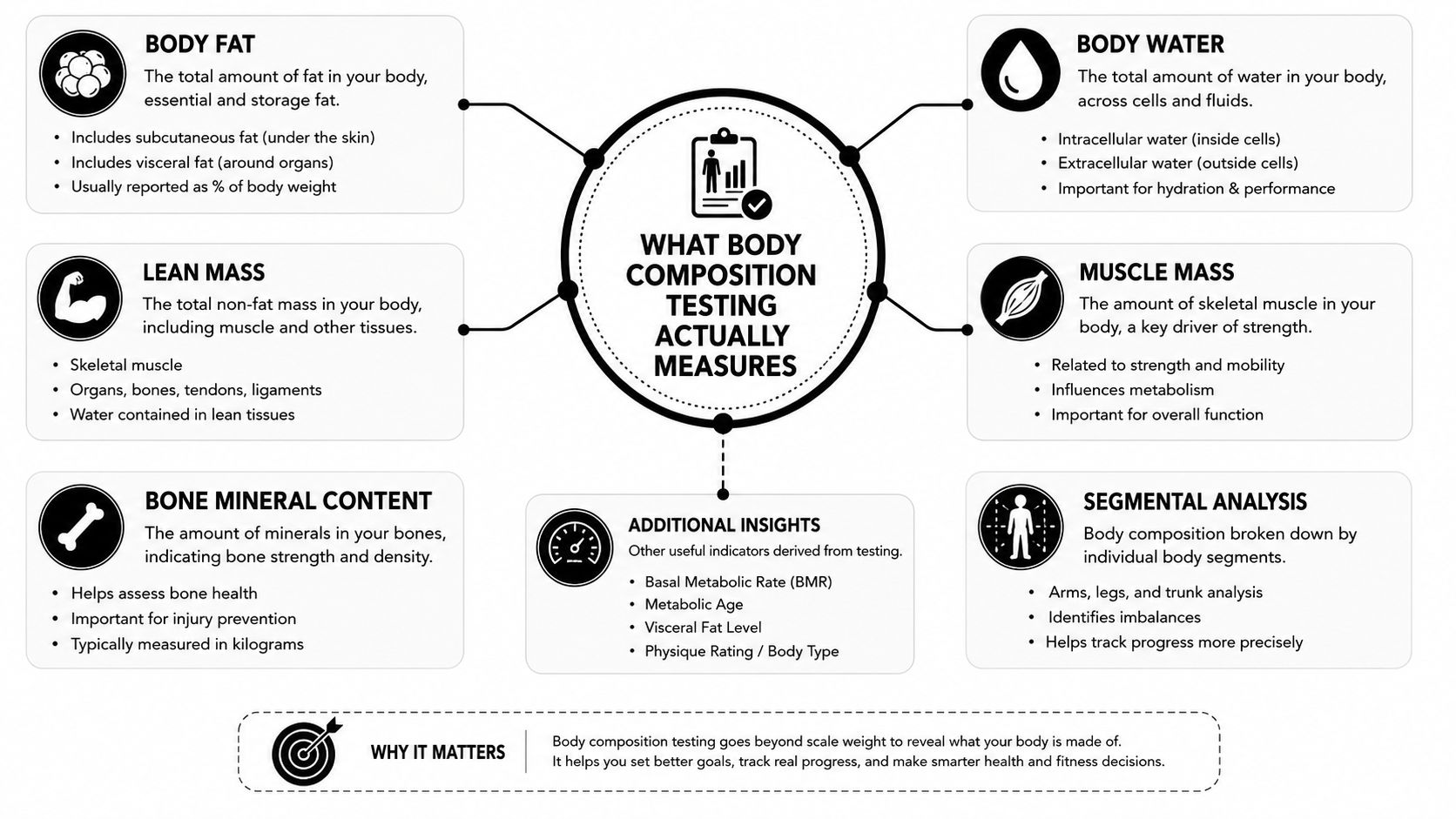
Every method estimates these compartments from a different physical signal. BIA uses electrical impedance, skinfolds use tissue thickness, DEXA uses differences in X-ray attenuation, and ultrasound uses reflected sound waves. None of these signals directly weighs fat cells or counts muscle fibres. Each applies assumptions, equations and operator decisions to convert a physical response into a body-composition estimate.
Why simple scales disagree
A single-frequency consumer scale generally collapses the model into a two-compartment estimate, fat mass and fat-free mass. It does this by applying population-average assumptions about hydration within fat-free mass. When the subject's hydration state differs from that assumption, the device may assign some of the resulting impedance change to fat or lean tissue.
That collapse explains many disagreements between devices. Two instruments can receive the same body weight and produce different estimates because they use different electrode paths, frequencies, algorithms, reference populations or segmental models. A more advanced device may report total body water and separate extracellular from intracellular water, but the output still needs a controlled protocol and appropriate validation.
Metrics that support real decisions
Professional interpretation should focus on the metric connected to the outcome:
- Percent body fat expresses fat mass relative to total body mass. It can support monitoring, but a small difference isn't automatically a real change.
- Fat mass index relates fat mass to height, which can help compare people of different stature more appropriately than absolute fat mass alone.
- Lean soft tissue mass excludes bone mineral content and focuses on non-bone, non-fat tissue.
- Appendicular lean mass describes lean tissue in the limbs, which is relevant when assessing regional muscle status.
- Visceral adipose volume estimates fat around internal organs and is more decision-specific than a whole-body fat percentage.
The practical choice is therefore not “Which test is most advanced?” It is “Which compartment estimate carries the least unacceptable error for this decision?” A waist measure may be adequate for central adiposity screening, while regional lean tissue may require imaging. A field BIA trend may support service monitoring, but it shouldn't automatically determine an individual clinical classification.
Comparing BIA, Skinfolds, Ultrasound and DEXA
A worker needs a defensible fitness classification, while an athlete may need a repeatable trend in regional muscle. Those decisions do not require the same instrument. The four methods estimate overlapping compartments, but their cost, footprint, operator burden, radiation status and error profile differ. Choose the method whose bias and repeatability are acceptable for the decision, not the method with the most impressive report.
BIA passes a low electrical current through the body and estimates composition from impedance. Handheld single-frequency units are quick and portable. Multi-frequency and segmental systems model water and tissue distribution in greater detail, but hydration assumptions can still shift the result. The UK Biobank validation study found mean bias under 2% for total fat mass and total lean mass from anthropometry and 50 kHz segmental BIA, while leg and visceral fat mass bias exceeded 10% in both sexes. Total-body monitoring may therefore be defensible, whereas regional interpretation is less secure (UK Biobank BIA validation).
Skinfold assessment measures subcutaneous tissue thickness at standardised anatomical sites with callipers. ISAK seven- or eight-site protocols suit sports science and field work because equipment costs are low and there is no radiation. The measurement is only as consistent as the technician's site marking, grasp, calliper placement and selected equation. Experienced staff can obtain useful repeatability, but poor handling can overwhelm the value of the calculation.
B-mode ultrasound estimates tissue thickness from reflected sound at tissue boundaries. Sites may include the rectus femoris, abdominal region and posterior thigh. Portable equipment avoids radiation, yet probe pressure, compression, gel application and placement can change the image. Staff need anatomical training and consistent image-acquisition practice, not just software familiarity.
DEXA uses two X-ray energy levels to distinguish bone mineral, lean tissue and fat across the whole body and regions. It supplies more compartments than field methods, but requires a controlled facility, trained interpretation and radiation governance. UK government guidance recommends sports-performance DEXA within a recognised programme, using morning, fasted, minimally clothed conditions and, where possible, the same scanner for longitudinal testing (COMARE radiation guidance).
| Method | Physical principle | Repeatability constraint | Dominant error source | Operational burden |
|---|---|---|---|---|
| BIA | Electrical impedance | Device and protocol dependent | Hydration and algorithm assumptions | Low |
| Skinfolds | Subcutaneous tissue thickness | Operator and site dependent | Site location and tissue handling | Low to moderate |
| Ultrasound | Reflected sound waves | Operator and site dependent | Compression and probe pressure | Moderate |
| DEXA | Dual-energy X-ray attenuation | Scanner and analysis dependent | Software version and region-of-interest drawing | Moderate to high |
Published coefficient-of-variation values vary by instrument, protocol, subject and operator. Procurement teams should request method-specific validation and define the decision threshold before selecting a device. A comparison of body-fat measurement methods offers useful orientation. A medical BIA system such as the Seca 525 mBCA Medical Body Composition Analyser reports fat and fat-free mass, total body water, extracellular and intracellular water, and skeletal muscle mass. Supplied product information states that results are available in 17 seconds.
The practical question is simple: can this method detect a meaningful change, or support the classification being made, under the service's actual conditions? If not, a richer report does not improve the decision.
Accuracy, Bias and What UK Validation Studies Show
A worker is referred after a body-composition reading crosses an internal threshold. The result may be repeatable, yet still be wrong for that individual. That scenario makes accuracy too broad to guide a service. Separate repeatability, the degree to which the same method produces similar results under the same conditions, from agreement, the degree to which it matches a reference model. A method can have low test-retest variation and remain consistently biased.
Validation findings also show why the intended decision matters. As noted earlier, UK work on BIA found that total fat mass and total lean mass performed better than regional estimates. Mean bias remained under 2% for those total-body measures, while leg and visceral fat mass bias exceeded 10% in both sexes. Population tracking may tolerate that pattern when the objective is group-level comparison. An occupational-health clinician deciding whether one person needs further assessment may not.
The UK surveillance framework uses defined thresholds. The NHS Health Survey for England 2022 collected adult waist measurements alongside BMI to monitor central obesity, while NHS England uses BMI 30 kg/m² or higher to define obesity and 40 kg/m² or higher to define morbid obesity (Health Survey for England 2022). Near a referral boundary, individual scatter matters. A small apparent difference can change the action without representing a meaningful physiological shift.
A decision table for validation work
| Method | Reported bias vs 4C | Typical LoA (BF%) | Test-retest CV | Best use case |
|---|---|---|---|---|
| Consumer BIA | Device dependent | Device dependent | Protocol dependent | Basic trend monitoring with strict standardisation |
| Segmental clinical BIA | Low for some total-body measures, higher for some regional measures | Population and device dependent | Protocol dependent | Whole-body tracking and structured service assessment |
| Skinfolds | Equation and operator dependent | Subject and site dependent | Operator dependent | Field assessment with trained staff |
| Ultrasound | Site and operator dependent | Validation dependent | Operator dependent | Regional tissue monitoring with image-quality control |
| DEXA | Reference-method dependent | Scanner and analysis dependent | Same-scanner protocol dependent | Regional assessment and longitudinal research |
Bias can vary by ethnicity, age band and BMI stratum. Devices may encode these assumptions in firmware or equations, then display the output as though it were a direct observation. Before adopting a threshold, the service should check whether the validation population resembles its own client mix.
Use the body fat measurement accuracy resource to frame the measurement problem, then review the manufacturer's validation papers, the device protocol and local repeatability checks. A high correlation across a cohort does not guarantee agreement for an individual.
Set the acceptable error budget before testing begins. The method is suitable only if its bias and repeatability fit the clinical, occupational or sports decision that follows. A more detailed report cannot compensate for an error range that makes the decision unstable.
Preparing the Subject and Controlling the Reading
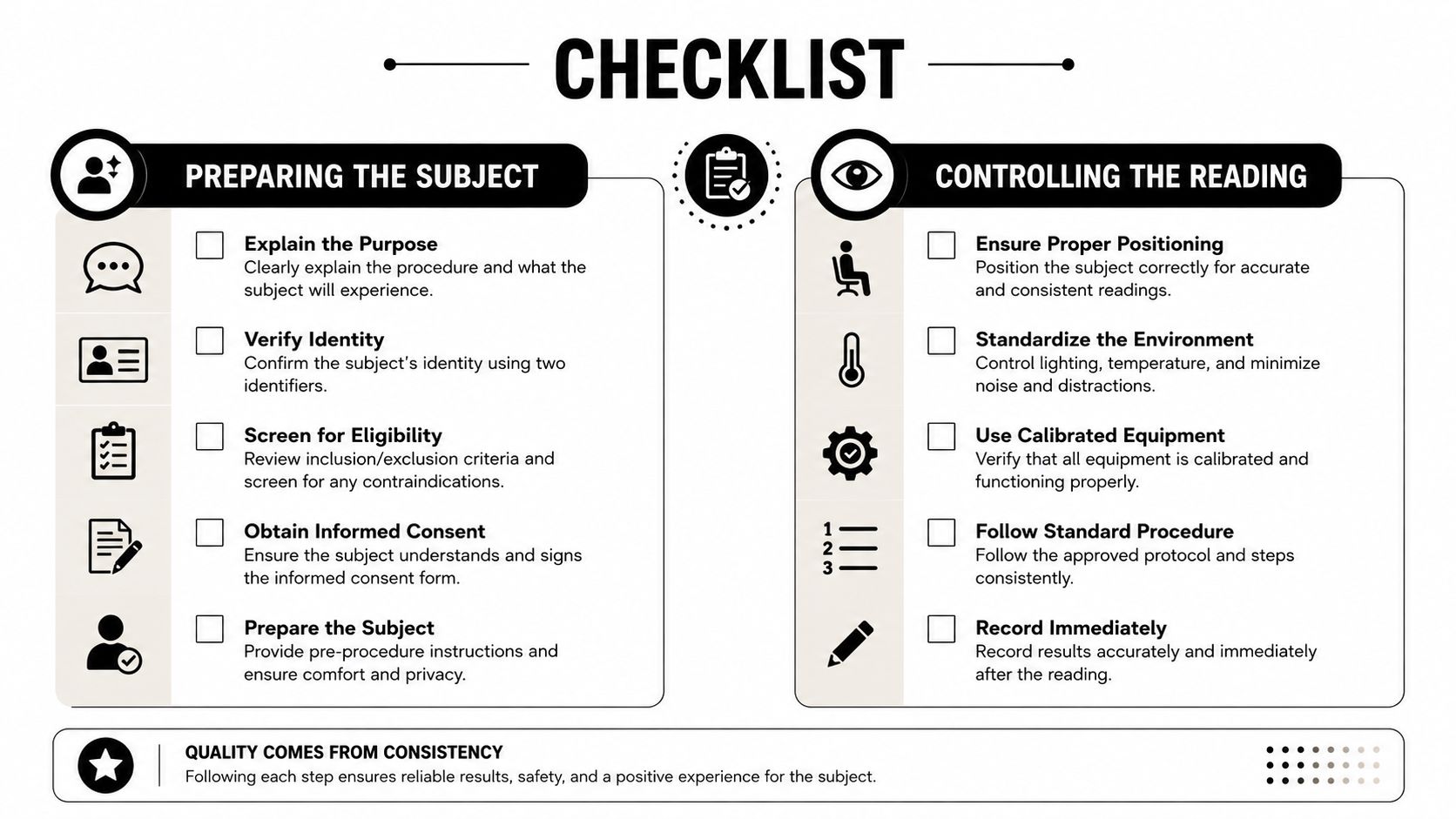
Pre-test preparation isn't a courtesy checklist. It is part of the instrument. BIA responds to fluid distribution, skin contact and recent activity, so inconsistent preparation can create a false trend even when the subject's tissue compartments haven't meaningfully changed.
A defensible service protocol should specify the following conditions:
- Fast for 10 to 12 hours. Food and fluid intake can alter gastrointestinal contents and impedance conditions.
- Avoid alcohol for 24 hours. Alcohol can disturb normal hydration and recovery conditions.
- Avoid vigorous exercise for the preceding 12 hours. Exercise changes fluid distribution and skin temperature.
- Void within 30 minutes of testing. This removes a controllable source of variation in body mass and fluid distribution.
- Keep hydration consistent. A service may standardise intake at 35 mL/kg body mass over the prior 24 hours, provided that the protocol is clinically appropriate and safely applied.
- Control the room. A target of 22 to 26°C helps reduce environmental variation.
- Allow at least 4 hours since caffeine. Caffeine intake should be recorded and held consistent between visits.
These figures must be treated as a service protocol, not universal medical advice. The assessor should adapt preparation for clinical status, medication, fluid restriction, pregnancy, acute illness and safeguarding considerations.
Why timing changes the output
A 500 mL water bolus can shift BIA impedance within minutes and alter the reported fat-mass estimate. A resistance-training session can raise extracellular fluid for 24 to 48 hours, while glycogen depletion after a low-carbohydrate day can reduce total body water and lower BIA-reported lean mass by 0.8 to 1.2 kg overnight. These effects are measurement confounders, not evidence of rapid tissue loss or gain.
The operator should also record clothing, posture, electrode contact, device identity, software version and time of day. UK anthropometry procedures emphasise basic setup controls such as placing scales on a level floor and keeping nearby objects from interfering with testing conditions (UCL adult anthropometry procedures).
Skinfold and ultrasound work needs a separate control layer. The operator should mark anatomical sites consistently, define the order of measurements, control skin compression and document probe placement. A BIA checklist cannot be copied across to a calliper or ultrasound session.
How Often to Retest and What Change Is Real
Weekly weigh-ins and weekly BIA scans can create a false sense of control. The more frequently a noisy method is used, the more opportunities the service has to mistake hydration, glycogen, food mass or recent exercise for tissue change.
A change should exceed 2.77 times the typical measurement standard error before it is treated as a change with 95% confidence. The supplied UK-relevant guidance indicates that this commonly supports intervals of roughly 4 to 6 weeks for standard BIA, 6 to 8 weeks for skinfolds and 8 to 12 weeks for DEXA, unless deliberate overfeeding or pharmacological intervention changes the expected rate of adaptation (UK BIA reliability research).
The interval should match the process being monitored. Fluid management may justify frequent BIA readings in a clinical setting, while fat-mass change during a structured programme usually needs a longer observation window. A DEXA service page may describe annual monitoring as typical, but the correct interval remains a clinical decision based on method, risk and purpose.
| Method | Minimum interval (general) | Minimum interval (intervention-driven) | Smallest detectable change (BF%) |
|---|---|---|---|
| Standard BIA | 4 to 6 weeks | Shorter only with a defined fluid or intervention purpose | Must exceed 2.77 × typical standard error |
| Skinfolds | 6 to 8 weeks | Shorter only with strong operator and protocol control | Must exceed 2.77 × typical standard error |
| DEXA | 8 to 12 weeks | Shorter only when the intervention warrants it | Must exceed 2.77 × typical standard error |
Two consecutive tests can also produce regression-to-the-mean artefacts, particularly when the first reading was unusually high or low. Serial plotting is safer than comparing isolated points. Each plot should show the method, preparation conditions, standard error and any event likely to influence the result.
Before acting, a clinician should demand a minimum data series that includes repeated measurements under the same protocol, device and operator where possible, plus the decision threshold and uncertainty around the observed change. If those fields aren't available, the result may be useful as a prompt for review, but it isn't a strong basis for a consequential classification.
Choosing Professional Equipment That Fits the Decision
Procurement should begin with one question: What decision will this reading feed into, and what error margin can that decision tolerate? A field screening programme, a rehabilitation service, a research protocol and a fitness-for-duty assessment don't need identical equipment.
Multi-frequency clinical BIA may suit a service that needs rapid compartment estimates and repeatable workflow. Candidate systems can include the Seca mBCA 554 and InBody 770, subject to review of validation populations, software outputs and local protocol performance. Research-grade ultrasound, such as BodyMetrix BX-2000 or GE LOGIQ systems, may be appropriate when regional tissue imaging is the primary question and trained operators are available. Harpenden and Slim Guide calliper kits remain practical for field assessment when staff can maintain anatomical marking and measurement technique.
DEXA referral is more appropriate when regional fat, lean tissue or bone-related information carries greater decision value than portability. The same method shouldn't be forced into every setting merely because it produces more variables.
Procurement criteria that survive daily use
A serious equipment review should cover:
- Reference-method validation: Look for published comparison against an appropriate reference, not only manufacturer correlation.
- Population fit: Check whether validation includes the ages, body sizes, sexes, ethnicities and clinical conditions found in the service.
- UK support: Confirm calibration, servicing, training and technical support arrangements.
- Data handling: Require software export that fits clinical records, longitudinal plotting and audit requirements.
- Total cost: Model five-year ownership, including training, servicing, consumables, software and referral costs, rather than comparing purchase prices alone.
| Tier | Use Case | Representative Equipment | Acceptable Error | 5-Year Cost Band |
|---|---|---|---|---|
| Entry clinical | Structured screening and trend monitoring | Clinical BIA or validated calliper protocol | Suitable for screening, not high-stakes regional classification | Obtain a supplier-specific total-cost quote |
| Mid-tier multi-disciplinary | Occupational health, rehabilitation and performance services | Multi-frequency BIA or trained ultrasound | Defined locally against the decision threshold | Compare equipment, service and software costs |
| Research-grade | Regional phenotyping and longitudinal research | DEXA referral pathway or research ultrasound | Tightest decision-specific error budget | Include governance, scanning and analysis costs |
Cartwright Fitness supplies professional assessment equipment and software for occupational health, healthcare, universities, sports science, rehabilitation and emergency-service settings. Its relevant portfolio includes body-composition and anthropometry solutions alongside wider assessment equipment, while Cartwright Assess is being developed to standardise testing, calculate and interpret results, maintain assessment histories and generate professional reports.
Visit Cartwright Fitness to review professional body-composition and physical-assessment equipment, software and support options. Match the instrument and protocol to the decision, then build a repeatable assessment pathway that your clinical, occupational or performance team can defend.


