

When you step on a regular bathroom scale, it tells you a number. But what does that number really mean? It’s just your total weight—a single, often misleading figure that lumps everything together. It doesn't tell you the most important part of the story.
A scale simply can't distinguish between a pound of dense, powerful muscle and a pound of fluffy, energy-storing fat. Focusing only on that number is like trying to judge a car's performance by its paint color while completely ignoring the engine.
Why Body Composition Matters More Than Weight
Think about this: two people can be the same height and weigh the exact same amount. One might be a dedicated athlete with very little body fat and a lot of muscle, while the other could lead a more sedentary life with the opposite body makeup. On the scale, they look identical. In reality, their health, metabolism, and fitness levels are worlds apart.
This is where understanding your body composition becomes a game-changer. It's about looking beyond the scale to see what you're really made of.
This visual breaks down the main components that make up your total body mass.
As you can see, your body is a complex mix of different tissues. Just measuring the grand total gives you an incomplete, and often frustrating, picture of your health.
Shifting Your Health Perspective
For most of us, the real goal isn't just to "lose weight" but to improve our body composition—to fine-tune the ratio of lean tissue to fat. Achieving a healthier composition brings a whole host of benefits that go way beyond just looking better.
Improving your body composition, rather than just lowering your weight, is directly linked to a faster metabolism, increased strength, better hormonal balance, and a reduced risk of chronic diseases like type 2 diabetes and cardiovascular conditions.
This shift in focus can free you from the frustrating cycle of chasing a number on the scale. Instead, you can concentrate on building real strength, feeling more energetic, and truly enhancing your well-being. Getting a handle on your body composition is the first step toward a more empowered and sustainable health journey. If you're looking for more general wellness content, exploring a variety of resources can provide even more insight.
To help you get started, we've put together a quick guide to the most common methods out there.
Quick Guide to Body Composition Methods
This table offers a snapshot of the different tools available, what they measure, and who they're best suited for.
| Method | Principle | Best For |
|---|---|---|
| DEXA Scan | Uses low-dose X-rays to measure bone, fat, and lean mass. | Clinical accuracy; tracking small changes in bone density and body fat. |
| Hydrostatic Weighing | Measures body density based on water displacement (Archimedes' principle). | Gold-standard accuracy, but less common and requires submersion in water. |
| BIA (Bioelectrical Impedance) | Sends a weak electrical current through the body to estimate water and fat levels. | At-home tracking, convenience, and monitoring general trends over time. |
| Skinfold Calipers | Measures the thickness of subcutaneous fat at specific body sites. | Affordable and portable method for tracking fat loss, but highly dependent on the user's skill. |
| 3D Body Scanners | Uses infrared sensors to create a 3D model of your body and estimate measurements. | Visual tracking and precise circumference measurements; great for motivation. |
Each of these methods has its place, from gold-standard lab techniques to practical tools you can use at home. This guide will walk you through the primary body composition assessment methods in detail. By the end, you’ll have a clear understanding of how each one works and feel confident choosing the right tool to track your progress effectively.
The Scientific Journey of Measuring Our Bodies
The tools we use to measure our bodies today didn't just appear out of nowhere. They aren't the latest fitness fads. Instead, they’re the product of a fascinating scientific quest that spans more than a century, with each discovery building on the one before it. This journey was a slow, deliberate march that has completely reshaped our understanding of human health.
It all started with a series of foundational discoveries that, at the time, seemed to have nothing to do with fitness. Think about it: Roentgen’s discovery of X-rays in 1895, Becquerel’s work on radioactivity in 1896, Urey finding the stable isotope deuterium in 1931, and Rabi’s breakthrough with nuclear magnetic resonance in 1938. These weren’t just lab experiments; they were the essential building blocks that gave scientists brand-new ways to see inside the body. This groundwork paved the way for the different body composition assessment methods we have today. You can get a deeper appreciation for this evolution by exploring the extensive history of these scientific advancements.
What we often see as "new" technology is really standing on the shoulders of giants. These tools began as academic curiosities and slowly evolved into the powerful clinical instruments we rely on.
The First Wave: A Focus on Adiposity
For a long time, body composition was a pretty niche field of study. But that all changed in the 1970s as the world started to wake up to a growing obesity epidemic. All of a sudden, measuring body fat—or adiposity—wasn't just for researchers in a lab. It became a critical public health issue.
This lit a fire under the scientific community, kicking off the first big wave of intensive body composition research. The mission was clear and urgent:
- Figure out how to accurately measure body fat.
- Understand the link between excess fat and chronic diseases like diabetes and heart conditions.
- Create reliable tools for doctors and for large-scale health studies.
This new focus pushed methods like hydrostatic weighing and early bioelectrical impedance devices to the forefront. Researchers were in a race to find better ways to track the health risks tied to body fat.
The shift in the 1970s transformed body composition analysis from a lab-based curiosity into a critical tool for understanding and combating widespread chronic disease.
The Second Wave: The Importance of Muscle
Just as the world was zeroing in on fat, a second, equally important realization was dawning. In 1989, Dr. Irwin Rosenberg published a landmark report on sarcopenia—the natural loss of muscle mass and strength that comes with age. His work was a game-changer. It ignited a second wave of research, turning the spotlight onto the other side of the body composition coin: our skeletal muscle.
It became clear that muscle wasn't just for lifting things. It’s a vital metabolic organ, absolutely essential for healthy aging, overall strength, and our ability to bounce back from illness or injury. This new priority drove the refinement of technologies like DEXA, which could precisely measure not just fat, but also lean muscle and bone density. All around the world, specialized labs and international conferences dedicated to body composition started popping up, cementing its place as a cornerstone of modern health and medicine.
Understanding the Gold Standard Lab Methods
When you absolutely need the most precise numbers possible, you turn to the "gold standards" of body composition assessment. These are the lab-grade methods that researchers and elite clinicians trust. Think of them as the bedrock of body composition science; they're the benchmarks all other methods, like smart scales and calipers, are measured against.
While you probably won't use these methods for your weekly check-in, understanding how they work is incredibly revealing. They show us what's truly possible when it comes to analyzing what our bodies are made of. The big three are Dual-Energy X-ray Absorptiometry (DEXA), Hydrostatic Weighing, and Air Displacement Plethysmography (which you probably know as the Bod Pod). Each one uses a different scientific approach to achieve remarkable accuracy.
DEXA: The Body's Blueprint
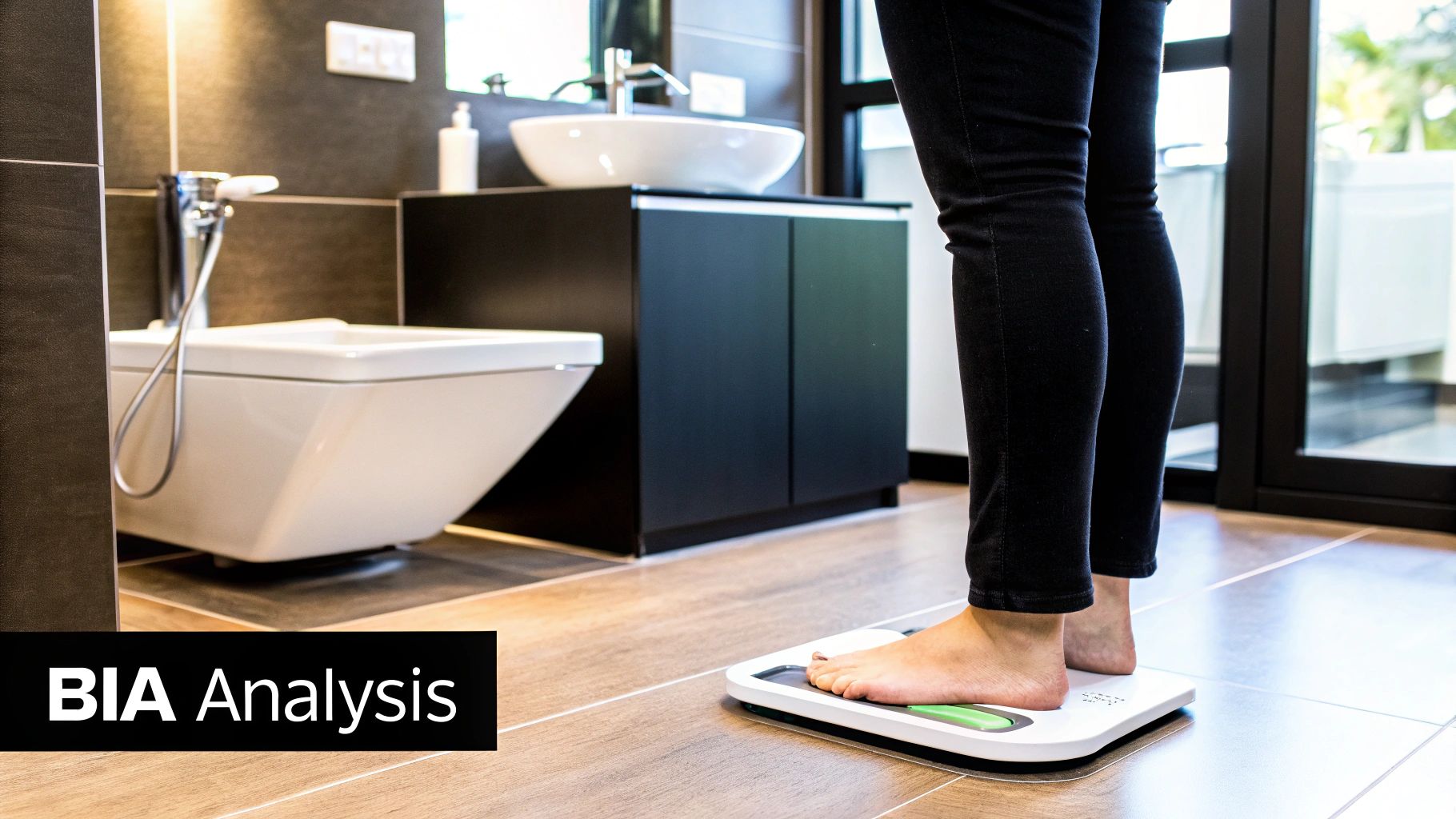
Dual-Energy X-ray Absorptiometry, or DEXA, is pretty much the top of the mountain for body composition testing. The best way to think of it is as a machine that creates a highly detailed blueprint of your body. The process is simple for you: just lie still on a table for a few minutes while a mechanical arm glides over you, sending two very low-dose X-ray beams through your body.
Here's the clever part. Those two beams have different energy levels. Bone, fat, and lean tissue all absorb these X-rays in their own unique way. The DEXA software can read these differences and generate a precise map of your body. It doesn't just spit out a single body fat percentage; it gives you a regional breakdown, telling you exactly how much fat and muscle you're carrying in your arms, legs, and torso.
This level of detail is something most other methods can't even touch. DEXA is also one of the few techniques that can directly measure bone mineral density, making it a critical tool for monitoring osteoporosis risk. It even distinguishes between the fat just under your skin (subcutaneous) and the dangerous fat packed around your organs (visceral), which is a huge indicator of metabolic health.
A DEXA scan provides a three-compartment model analysis, separating the body into bone mass, fat mass, and fat-free mass. This comprehensive breakdown is why it's a cornerstone of clinical research and elite athletic programs.
Of course, this kind of precision doesn't come cheap. DEXA scans are expensive and not widely available, since they require dedicated medical equipment and trained staff. They aren't practical for frequent tracking, but for establishing an incredibly accurate baseline to measure long-term progress, they are unmatched.
Hydrostatic Weighing: The Classic Displacement Test
Hydrostatic weighing, often just called underwater weighing, is one of the original gold standard methods. It’s a real-world application of a physics principle figured out by the ancient Greek mathematician Archimedes. The concept is refreshingly simple: dense things sink more.
Since fat is less dense than muscle and bone, a person with more body fat will be more buoyant and weigh less underwater. A leaner person, on the other hand, will be denser and weigh more underwater.
Getting it done involves a few specific steps:
- Dry Weight: First, you're weighed on a normal, high-precision scale.
- Submersion: Next, you sit on a special chair and are lowered completely into a large tank of water.
- Exhalation: Here’s the tricky part. You have to blow out all the air from your lungs and hold it for a few seconds while your underwater weight is recorded.
By comparing your weight on land to your weight in the water and correcting for the water's density, technicians can calculate your body's overall density. From there, a well-established formula gives them your body fat percentage. It’s highly accurate, but the experience can be pretty uncomfortable, especially for anyone anxious about being underwater. The sheer size of the required equipment also means you won't find these setups just anywhere.
Bod Pod: The Air-Based Alternative
For anyone who’d rather not get dunked in a tank of water, Air Displacement Plethysmography (ADP) is a fantastic, dry alternative. The most well-known machine for this is the Bod Pod. It operates on the exact same density principle as underwater weighing but uses air instead of water.
You simply sit inside a futuristic, egg-shaped chamber for a couple of minutes, wearing minimal clothing like compression shorts and a swim cap. The machine measures tiny changes in air pressure inside the sealed pod to determine precisely how much volume your body takes up—or, how much air you displace.
Once it knows your body's volume and your mass (which it gets from a connected scale), the system calculates your density and then your body fat and lean mass percentages. The whole process is fast, completely non-invasive, and very reliable. This has made it a favorite in university research labs and professional sports facilities. But just like a DEXA scan, the Bod Pod is an expensive piece of equipment, which limits how easy it is to find one.
Diving Into Practical Methods for Everyday Tracking
While the gold-standard lab methods give us incredible accuracy, let's be realistic—they aren't something you can do every week. For regular progress tracking in gyms, clinics, or even at home, we need more accessible "field methods." These tools are built for convenience and are perfect for watching your body composition trends over time.
The two most common body composition assessment methods you'll run into are Bioelectrical Impedance Analysis (BIA) and Skinfold Calipers. They're far more affordable and user-friendly than lab equipment, but this convenience comes with a trade-off in precision. Knowing how they work is the key to using them right.
Demystifying Bioelectrical Impedance Analysis (BIA)
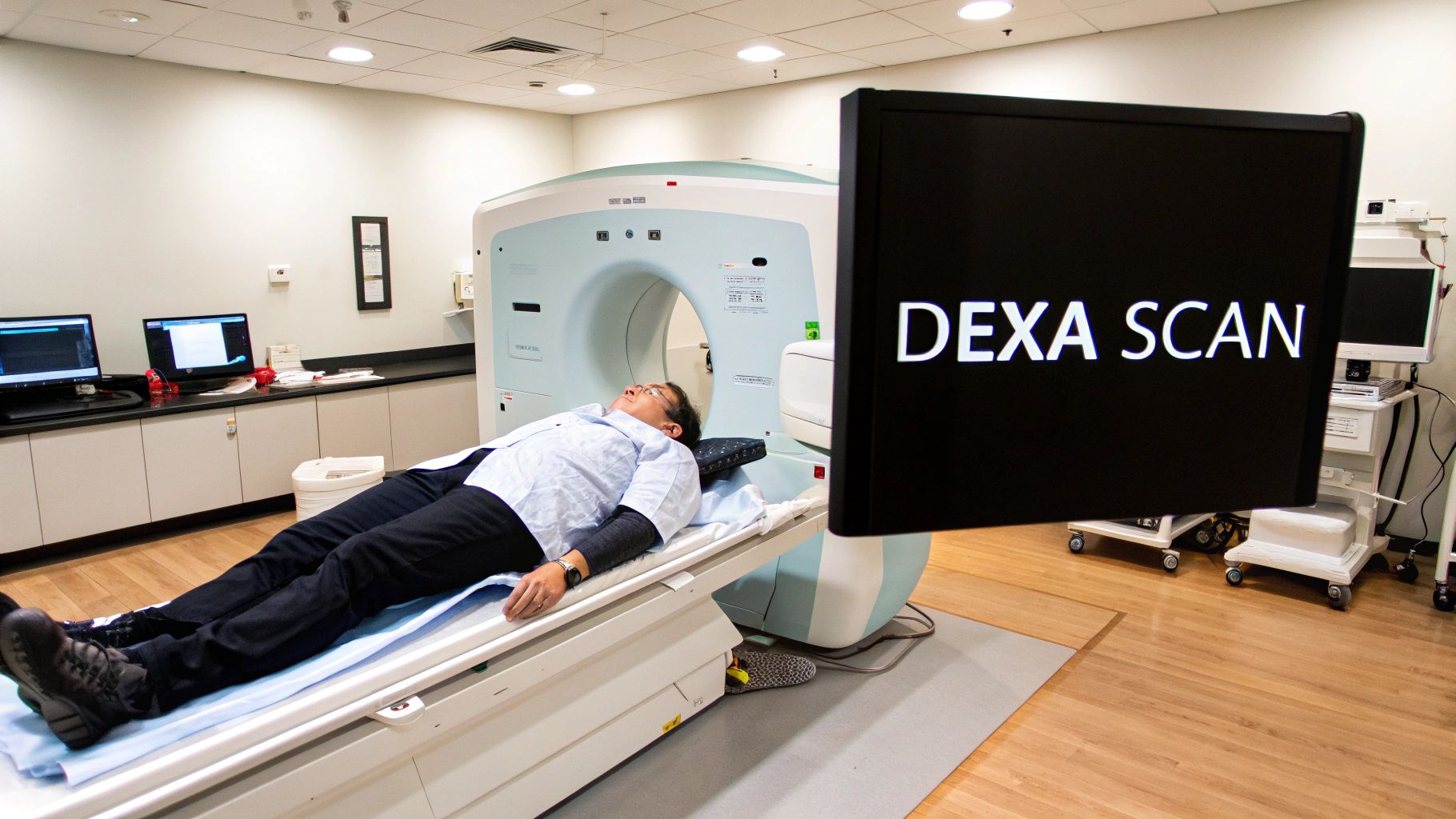
Bioelectrical Impedance Analysis, or BIA, is the tech powering most of those smart scales and handheld body fat analyzers. The process itself is simple and completely painless. You just stand on some metal footplates or hold onto electrodes, and the device sends a tiny, perfectly safe electrical current through your body.
Think of it this way: your lean tissue (muscle, organs) is full of water and electrolytes, making it a great conductor. It's like a wide, clear river where the current flows easily with low resistance. Fat tissue, on the other hand, contains very little water. It acts like a dam, impeding the current and creating high resistance.
By measuring the speed and strength of this current—its impedance—the BIA device plugs that data into built-in equations to estimate your body water. From there, it calculates your lean mass and, ultimately, your body fat percentage.
The Hands-On Approach with Skinfold Calipers
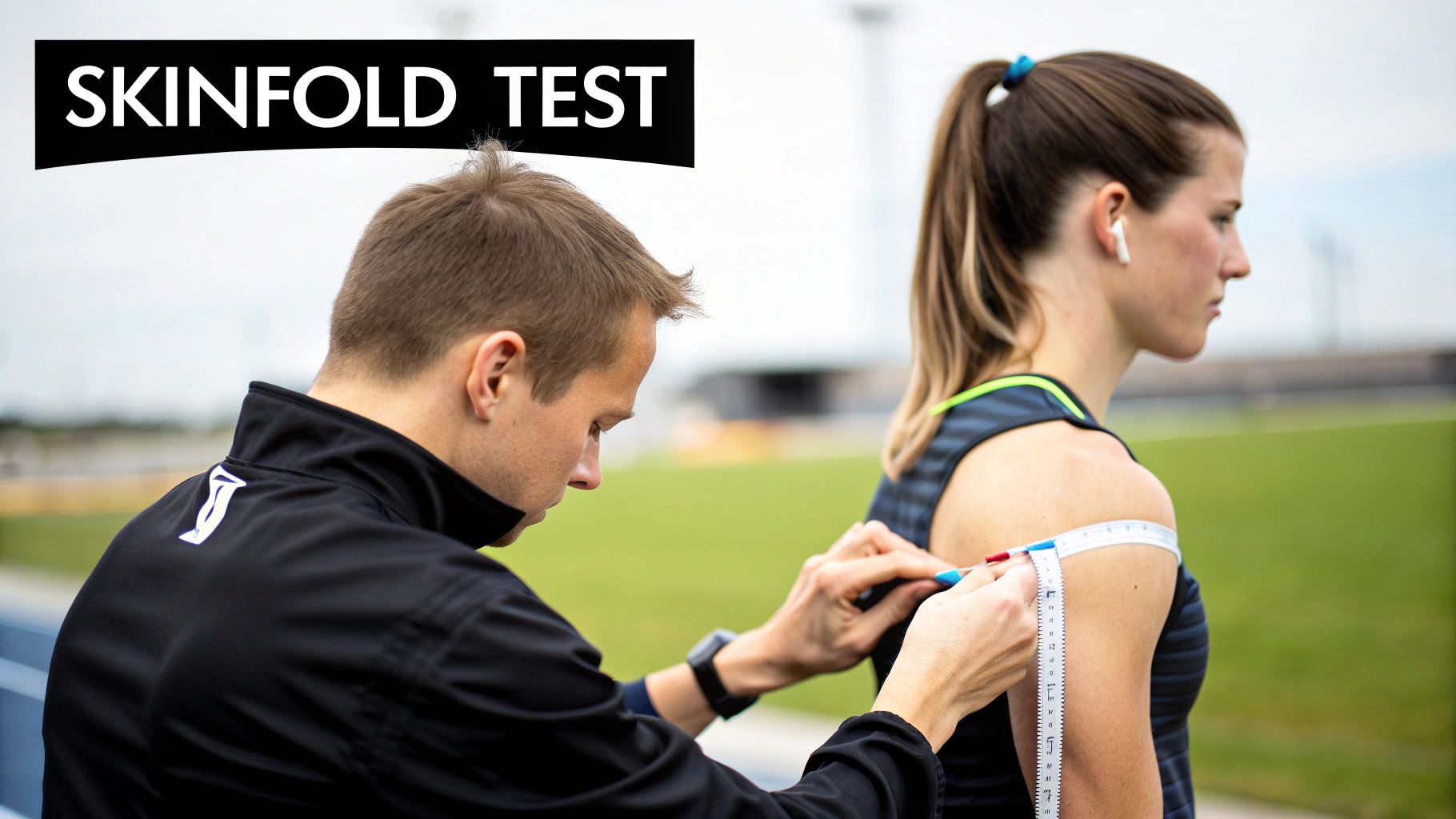
Skinfold testing is a much more direct, hands-on method. It involves using a tool called a caliper to gently pinch and measure the thickness of your subcutaneous fat—the fat sitting just beneath the skin—at several specific spots on the body.
You'll commonly see measurements taken at sites like the:
- Triceps: On the back of your upper arm.
- Subscapular: Just below your shoulder blade.
- Abdominal: To the side of your navel.
- Thigh: On the front of your upper leg.
After taking these measurements (usually from 3 to 7 sites), the numbers are plugged into a special formula. This formula estimates your total body density, which is then converted into a body fat percentage. It’s a classic technique that, when done right, can give you a reliable snapshot of your body fat.
The core idea behind skinfold testing is that the amount of fat you can pinch is directly proportional to your total body fat. While this is generally true, the real trick is having the skill to get a consistent, accurate pinch every single time.
Why Consistency Is Everything
Both BIA and skinfold calipers are incredibly useful for tracking progress, but they're also highly sensitive to outside factors. This is their biggest limitation, but it's also where you can take control. Their accuracy hinges almost entirely on strict protocol adherence.
When done correctly, field methods like skinfolds and BIA can get you within 3% of the gold-standard lab results. The problem is, their accuracy is fragile. The equations they use often assume a "reference" body type, which can throw off the numbers for people of different ages or ethnicities. You can read more about the limitations of these methods in athletic populations.
BIA is especially vulnerable to changes in your hydration, while skinfold accuracy lives and dies by the technician's skill. This makes getting reliable results a real challenge.
For BIA, things like your hydration level, when you last ate, or if you just worked out can dramatically swing the results. For skinfolds, the skill of the person taking the measurement is everything—a tiny shift in location or pressure can change the reading.
Because of this, the single number you get from one test isn't nearly as important as the trend over time. By measuring under the exact same conditions every time—same time of day, same hydration status, same technician—you can reliably track whether your hard work is truly paying off.
How to Choose the Right Assessment Method for You
With so many ways to measure body composition, picking the right one can feel like a shot in the dark. But here’s the secret: the "best" method isn't about finding the single most accurate tool on the planet. It’s about finding the one that fits your goals, your budget, and what you actually plan to do with the results.
Think of it like choosing a vehicle for a trip. You wouldn't take a high-strung race car on a family road trip, and you wouldn't enter a minivan in the Monaco Grand Prix. In the same way, your reason for measuring—whether it's for peak athletic performance, tracking your fitness progress, or just general health—should be the main driver of your decision.
First, Define Your Primary Goal
Before you get lost in the details, take a moment to clarify what you're trying to accomplish. Are you looking for a single, ultra-precise baseline measurement? Or are you more interested in tracking small changes week over week? Your answer will immediately point you in the right direction.
For Maximum Precision and Detail: If you're a competitive athlete, a bodybuilder dialing in for a show, or someone who needs to monitor specific health data like bone density, then accuracy is your top priority. For you, the gold-standard methods like a DEXA scan or hydrostatic weighing are worth it. They deliver the most reliable and granular data available.
For Tracking Progress and Trends: Maybe you're a dedicated gym-goer who wants to see if your hard work is paying off. In this case, consistency trumps perfect accuracy. Methods like BIA (smart scales) or skinfold calipers are fantastic for this. They allow you to spot trends over time, which is exactly what you need to know if your program is working.
For General Health and Motivation: If you're just starting out on your health journey, the goal is to build momentum and stay motivated. A simple, user-friendly tool like a BIA smart scale or even a 3D body scan can provide that encouraging feedback loop. They help you build good habits without getting overwhelmed by a mountain of complex numbers.
This visual guide can help you think through which method makes sense based on your situation.
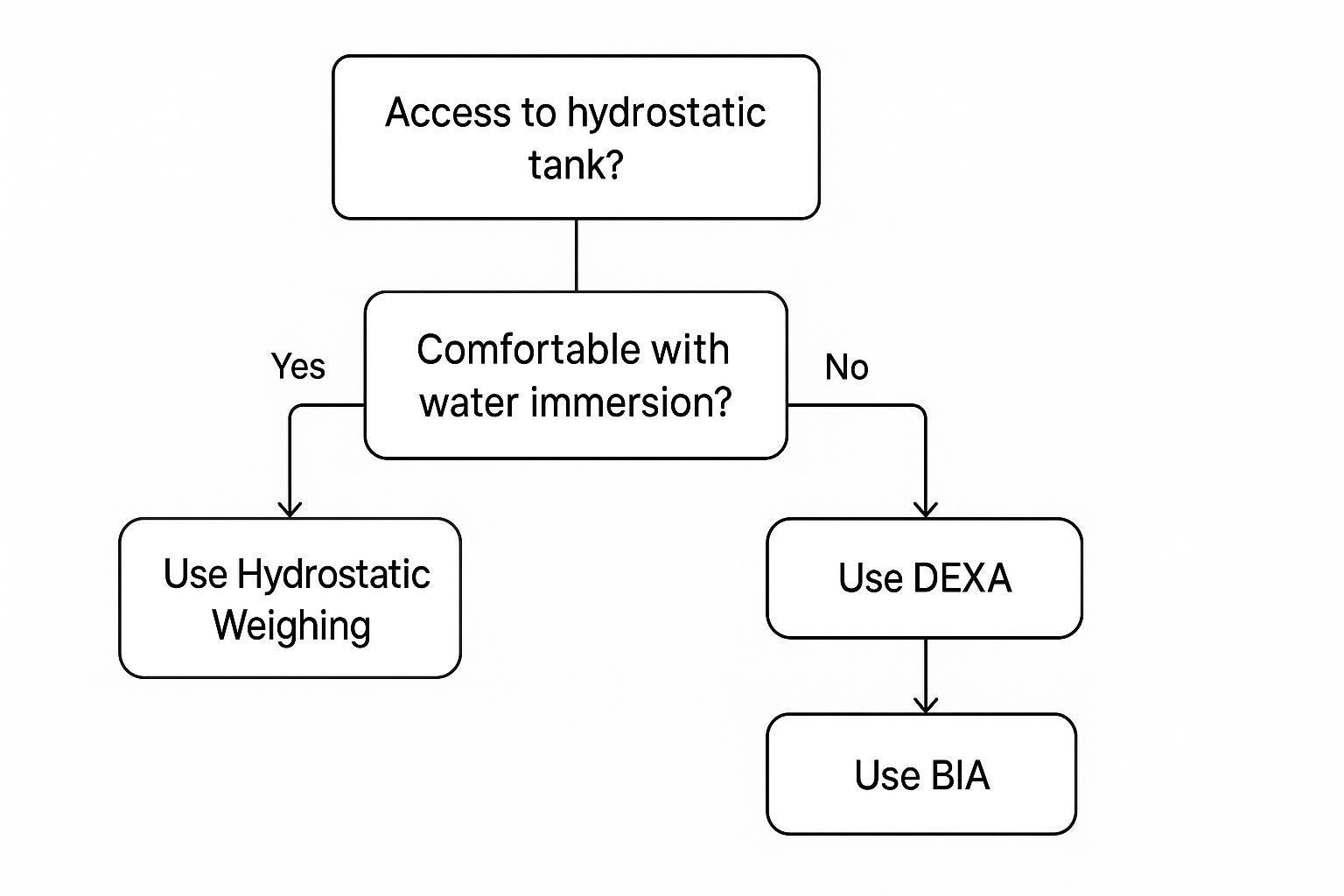
As you can see, sometimes the choice comes down to simple logistics—like what you have access to or your comfort level with being submerged in water.
Comparing Your Options Side-by-Side
To make a truly informed choice, it’s helpful to see how the main methods stack up against each other. Let's compare them based on what usually matters most: accuracy, cost, accessibility, and the kind of information they give you. After all, what works for a university research lab is probably impractical for a personal trainer, and what a trainer uses might be overkill for someone at home.
Choosing the right method is an investment in your health journey. Weighing the trade-offs between cost, convenience, and data detail ensures you get the most value and insight from your efforts.
To help you sort through it all, I've put together a table comparing the most common body composition assessment methods.
Comparing Body Composition Assessment Methods
This table breaks down the pros and cons of each major method, helping you match a tool to your specific needs.
| Method | Accuracy | Typical Cost | Accessibility | Key Data Provided |
|---|---|---|---|---|
| DEXA Scan | Very High | $100 – $250+ per scan | Low (medical facilities) | Regional fat/muscle, bone density, visceral fat |
| Hydrostatic Weighing | High | $50 – $150 per test | Very Low (specialized labs) | Total body density, body fat percentage |
| Bod Pod (ADP) | High | $50 – $150 per test | Low (universities, high-end gyms) | Body density, fat and lean mass percentages |
| Skinfold Calipers | Moderate to High | $10 – $50 (calipers) + technician fee | Moderate (gyms, trainers) | Subcutaneous fat thickness, body fat percentage |
| BIA (Smart Scales) | Low to Moderate | $30 – $150 (one-time device cost) | Very High (at-home use) | Body fat %, muscle mass %, body water |
At the end of the day, the best method is the one you'll actually use consistently. A "less accurate" BIA scale that you use correctly every week will give you far more actionable insight than a single, ultra-precise DEXA scan you only get once a year. When you align your choice with your goals and resources, you’re setting yourself up with the right information to succeed.
Frequently Asked Questions About Body Composition
Even after you get a handle on the different ways to measure body composition, you're bound to have some practical questions. Let's walk through some of the most common ones that come up as people start tracking their progress.
How Often Should I Measure My Body Composition?
This really comes down to your specific goals and the tool you're using. Trying to measure every single day is a recipe for frustration, since our bodies fluctuate constantly.
For most people using accessible tools like a BIA scale or skinfold calipers, checking in every 4 to 8 weeks is a great pace. That gives your body enough time to make real changes, letting you see genuine trends in fat loss or muscle gain without getting bogged down by daily noise. If you're using a gold-standard method like DEXA, a scan every 6 to 12 months is plenty for tracking major shifts unless you're a competitive athlete on a strict regimen.
Are At-Home Smart Scales Accurate for Body Composition?
Think of your at-home smart scale as a trend-tracker, not a source of absolute truth. The number it gives you is more of a directional guide. Their BIA technology is easily thrown off by things like your hydration level, if you've eaten recently, or if you just finished a workout.
The real value isn't in the exact number, but in its consistency over time. If you use the scale under the same conditions every time—like right after you wake up and use the restroom—it can paint a surprisingly reliable picture of your progress. It’s a great tool for telling you if you're moving in the right direction.
Why Do Different Methods Give Me Different Results?
It’s definitely confusing when your BIA scale says you're at 22% body fat, but a DEXA scan says 25%. This happens because each method is based on a completely different way of estimating what’s going on inside your body.
- DEXA is very direct. It uses low-dose X-rays to get a clear picture of your fat, muscle, and bone mass.
- BIA is more indirect. It sends a tiny electrical current through your body and estimates your body fat based on how much water it thinks you have.
- Skinfolds only measure the subcutaneous fat you can pinch just under the skin.
It’s not that one method is "right" and the others are "wrong"—they’re just measuring different things in different ways. It’s like comparing apples and oranges.
The most important thing you can do is pick one method and stick with it. Consistency is what allows you to accurately see how your body is changing over time, no matter which tool you're using.
What Is a Healthy Body Fat Percentage?
There's no magic number that's perfect for everyone. What's considered healthy depends on a bunch of factors, including your age, sex, genetics, and how active you are. The American Council on Exercise provides some general guidelines that work for most people.
For men, a healthy range is often cited as 10-20%. For women, who naturally require more essential body fat for hormonal health, a healthy range is typically 20-30%. Elite athletes might have percentages well below these, but for most of us, the goal should be what's healthy and sustainable for our own bodies—not chasing a number we saw on social media. It's always a good idea to chat with a healthcare or fitness professional to figure out a target that’s right for you.
At Cartwright Fitness, we specialize in providing validated, high-precision testing equipment for health professionals and facilities seeking reliable data. Explore our professional-grade solutions for body composition analysis at https://www.cartwrightfitness.co.uk.