

Body composition analysis tools are designed to give you the full story, not just the headline. While a regular scale tells you your total weight, these devices break it down, measuring the exact proportions of fat, muscle, bone, and water in your body. It’s the difference between knowing the total weight of a building and having the actual blueprint.
Going Beyond the Scale with Body Composition
For years, we’ve relied on the bathroom scale and the Body Mass Index (BMI) chart to tell us if we’re healthy. But that’s like judging a car's performance purely by how much it weighs. It tells you nothing about the engine, the frame, or how it actually drives. A Formula 1 car and a delivery truck might weigh the same, but you wouldn't say they're built the same.
The same idea holds true for our bodies. Two people can have the exact same number on the scale but live in completely different health realities. One might be packed with lean muscle and have very little body fat, while the other is the opposite, putting them at a higher risk for health problems even with a so-called "normal" weight.
The Limits of Traditional Metrics
This is where old-school metrics like BMI really fall short—they can't tell the difference between fat and muscle. A highly-trained athlete could easily be flagged as "overweight" or "obese" on a BMI chart, while a less active person with low muscle mass and high body fat might get a "healthy" label. This is exactly why modern body composition analysis tools are so critical.
With detailed data, you can finally:
- Track what really matters: See if a client is losing fat while building muscle—a huge win that a scale would completely miss.
- Spot hidden health risks: Identify dangerous visceral fat coiled around the internal organs, which you can't see from the outside.
- Create truly personal plans: Design nutrition and exercise programs based on what someone's body is actually made of.
A Growing Need for Deeper Insights
The blind spots of older methods have sparked a major shift in the health and wellness world. Professionals are no longer satisfied with surface-level numbers; they need precise data to guide their clients effectively.
This isn't just a small trend. The global market for body composition monitors is expected to hit $1.4 billion by 2035, doubling from around $700 million in 2025. This explosion shows that everyone—from trainers to clinicians—is moving toward a more data-driven approach to health. You can read the full research on this market growth to see just how big this shift is.
By moving beyond a single number on a scale, fitness and clinical professionals can offer truly personalized guidance. Body composition data transforms the conversation from "How much do you weigh?" to "What is your body made of and how is it changing for the better?"
Ultimately, these advanced tools provide the kind of actionable insights that lead to real, lasting health improvements. They’re setting a whole new standard for how we track progress and care for clients.
A Look Under the Hood: How Body Composition Tools Work
When you step on a scale, you only get one number: total weight. Body composition tools, on the other hand, give you the full story by breaking that number down into fat, muscle, bone, and water. Each method uses a different scientific approach to peek inside the body.
Bioelectrical Impedance Analysis (BIA)
Think of Bioelectrical Impedance Analysis (BIA) as a smart, gentle electrical current on a mission. When the signal travels through your body, it moves quickly through water-rich tissues like muscle but slows down when it hits fat, which contains very little water. The device measures this resistance—or impedance—to figure out your body composition.
It’s an incredibly popular technology for good reason. In fact, BIA is expected to hold a 45.8% market share by 2025, largely because it's non-invasive, affordable, and easy to find everywhere from gyms to home scales. You can learn more about these findings in the North America body composition analyzers market report.
However, its biggest strength is also its biggest weakness. Because BIA relies on water, your hydration level can really swing the results. A well-hydrated client will test differently than a dehydrated one, which is why consistent pre-test routines are so important.
Professional-grade BIA analyzers take this a step further by using multiple frequencies. This allows them to differentiate between water inside your cells and water outside, giving a much more accurate picture for athletes or in clinical settings.
DEXA (Dual-Energy X-ray Absorptiometry)
Often called the "gold standard," DEXA uses two very low-dose X-ray beams to create a highly detailed map of your body. It doesn't just tell you how much fat and muscle you have; it shows you exactly where it is.
This is where DEXA really shines. It can pinpoint dangerous visceral fat around your organs or reveal a muscle imbalance between your left and right legs with incredible precision. It’s less of an estimate and more of a blueprint.
DEXA provides clinicians with a near-perfect 'blueprint' of body composition, combining bone, fat, and muscle data in one scan.
For a clearer picture of how these common methods stack up, let's look at a quick comparison.
At-a-Glance Comparison of Body Composition Analysis Methods
This table provides a high-level comparison of the most common body composition analysis technologies, focusing on their core principles, typical use cases, and key differentiators.
| Method | Core Principle | Primary Use Case | Key Feature |
|---|---|---|---|
| BIA | Electrical impedance through tissue | Quick home or gym assessments | Portable, non-invasive testing |
| DEXA | Low-dose X-ray absorption differences | Clinical bone and body composition evaluations | High-precision regional mapping |
| ADP | Air volume displacement measurement | Research labs and specialized clinics | Accurate whole-body volume data |
As you can see, the right tool really depends on what you're trying to measure and in what setting.
Air Displacement Plethysmography (ADP)
Air Displacement Plethysmography (ADP) sounds complicated, but the concept is simple. You know how placing an object in a full tub of water makes some water spill out? ADP does the same thing, but with air.
A person sits inside a sealed chamber (often called a Bod Pod), and the machine measures how much their body volume displaces the air inside. From there, it calculates body density to determine body composition.
While it's highly accurate, ADP isn't something you'll find at your local gym. It requires specialized, bulky equipment and a controlled environment, making it a go-to for research labs and high-performance clinics.
The Trade-Offs: What Professionals Need to Know
Every method comes with its own set of pros and cons, and understanding them is key to choosing the right tool for the job.
- BIA: Its main advantages are speed, portability, and ease of use. The downside? Its accuracy is heavily influenced by hydration.
- DEXA: You get unbeatable precision in mapping fat, muscle, and bone. But this comes with much higher equipment costs and the need for a certified technician.
- ADP: It delivers highly accurate density measurements. The trade-off is limited accessibility, as the equipment is expensive and not portable.
So, how does this play out in the real world?
A sports scientist monitoring a team's hydration and muscle mass during a grueling training camp would probably choose a multi-frequency BIA device for quick, daily check-ins. On the other hand, a clinical dietitian assessing an elderly patient's osteoporosis risk would rely on a DEXA scan to get an accurate bone density reading. Meanwhile, university researchers might use an ADP chamber for a study where exact body volume is the most critical variable.
Practical Takeaways for Professionals
Knowing the science is one thing, but applying it is what truly matters. Your expertise transforms a simple number into a meaningful insight for your client. To get the most reliable data, consistency is everything.
- Standardize your protocol. Always test clients under the same conditions—for example, first thing in the morning, before a workout, and after using the restroom.
- Get the setup right. Whether it's proper electrode placement for a BIA test or correct positioning for a DEXA scan, small details make a big difference.
- Maintain your equipment. Regular calibration and following the manufacturer's guidelines are non-negotiable for accurate readings.
Ultimately, a solid grasp of how BIA, DEXA, and ADP work allows you to match the method to the client's goal, interpret the results with confidence, and elevate the quality of your assessments.
Comparing the Top Professional Analysis Tools
Knowing how the technology works is one thing, but picking the right professional-grade body composition analysis tool is a whole different ball game. What works perfectly for a university research lab will likely be a terrible fit for a bustling personal training studio. Ultimately, the decision comes down to a practical trade-off between precision, speed, cost, and the overall client experience.
Let's break down the leading professional options—DEXA, ADP (the Bod Pod), and multi-frequency BIA—across the factors that actually matter to your business. This will help you see why one tool might be the perfect choice for a clinical setting, while another is built to thrive in a high-volume fitness environment.
The Clinical Gold Standard: DEXA
When you need pinpoint accuracy and there's simply no room for error, DEXA is the undisputed champion. It gives you a granular, three-component breakdown of bone, fat, and lean mass, not just for the whole body but for specific arms and legs. This is how professionals spot muscle imbalances, track changes in bone density, and measure dangerous visceral fat with true medical-grade precision.
Of course, that level of detail comes with a hefty price tag. A DEXA machine represents a massive capital investment, often running into the tens of thousands of dollars. It also needs its own dedicated room and a licensed technician to run it, which adds significant ongoing operational costs.
- Accuracy: Considered a gold standard. It delivers exceptionally high precision and provides crucial regional data.
- Cost: The initial investment is very high, and so are the ongoing operational expenses.
- Client Experience: The scan itself is quick and non-invasive. However, it usually requires a physician's referral and a trip to a clinical facility, making it impractical for regular fitness tracking.
- Portability: Zero. The machine is huge, heavy, and permanently installed.
A DEXA scan is the right call when the goal is diagnostic. For instance, a clinician monitoring a patient with osteoporosis needs the exact Bone Mineral Density (BMD) score that only DEXA can deliver. A sports medicine doctor might also use it to meticulously track an athlete's recovery from a major injury by comparing the muscle mass between their limbs.
The Research Powerhouse: ADP (Bod Pod)
Much like DEXA, Air Displacement Plethysmography (ADP)—better known as the Bod Pod—is another highly accurate tool you'll find in top-tier clinical and research settings. It's fantastic at measuring whole-body density, which it then uses to calculate body fat percentage. Its accuracy is right up there with underwater weighing, but the client experience is worlds better—and much faster.
The Bod Pod is quicker than a DEXA scan and involves no radiation, which is a definite plus for some clients. But it also shares many of DEXA’s practical downsides. The equipment is expensive, bulky, and completely stationary. And while it gives you a precise snapshot of total body composition, it can't provide that valuable regional breakdown you get from DEXA.
The Bod Pod hits a sweet spot with its blend of high accuracy and a non-invasive, radiation-free experience. This has made it a go-to tool in academic research and elite performance centers where reliable whole-body data is the top priority.
Imagine a university's sports science department studying how a new training regimen affects athletes' body composition. The Bod Pod gives them the reliable, repeatable data they need to publish a formal study.
The Gym Floor Champion: Multi-Frequency BIA
For the vast majority of fitness centers, personal trainers, and wellness clinics, multi-frequency Bioelectrical Impedance Analysis (BIA) devices from brands like InBody and Tanita strike the perfect balance. These professional-grade machines are a giant leap forward from the simple scales people have at home. By using multiple electrical frequencies, they provide a segmental analysis of each arm, leg, and the trunk.
This is a game-changer. You can finally show a client concrete proof that they’ve gained muscle in their legs while losing fat from their midsection—a powerful motivator that a simple number on a scale would completely miss. The test itself is incredibly fast, often taking less than 60 seconds, and the results are printed on an easy-to-read sheet that clients can take home.
- Accuracy: Very good for tracking changes over time, especially when pre-test protocols are kept consistent. It may not match DEXA's precision in a single snapshot, but its reliability makes it fantastic for monitoring progress.
- Cost: Dramatically more affordable than DEXA or the Bod Pod, with different models available to fit a range of professional budgets.
- Client Experience: Top-notch. The process is quick, non-invasive, and provides instant, visually engaging feedback that sparks conversation.
- Portability: Many professional models are portable, which is great for trainers who work at multiple locations or run corporate wellness events.
The true power of multi-frequency BIA lies in its ability to track progress. As Dr. Anuruddh Kumar Misra, a medical director at Premise Health, puts it, the technology is "very fast, it’s non-invasive…and it gives you very specific data points where you can immediately give feedback." This makes it an incredible tool for keeping clients engaged and motivated. While hydration levels can affect the numbers, maintaining a consistent pre-test routine easily solves this for tracking purposes.
Making the Right Choice for Your Practice
At the end of the day, choosing between these body composition analysis tools is about matching the technology to your business model.
A high-end wellness clinic that offers premium diagnostic services might justify the cost of a DEXA machine to attract a medical-focused clientele. On the other hand, a gym that thrives on membership volume and client motivation needs a tool that is fast, affordable, and delivers recurring value. For them, a professional BIA analyzer is the clear winner, turning a simple weigh-in into a meaningful coaching session.
How to Choose the Right Body Composition Analyzer
Picking the right body composition analysis tool isn't just a technical decision; it's a business one. The "best" device isn't always the most expensive or the most precise. It’s the one that fits your business, your clients, and your day-to-day workflow like a glove.
Answering a few straightforward questions can cut through the noise and make the choice clear.
First, what's your main goal? Are you a clinician diagnosing health conditions, or a personal trainer tracking a client's fitness journey? A medical practice might need the diagnostic power of a DEXA scan to check bone density. A gym, on the other hand, just needs a reliable BIA device to show a client they've packed on muscle and lost fat, keeping them motivated.
Then you have to think about the practical side. What’s your budget for the machine itself, plus any ongoing costs like software or disposable supplies? A top-of-the-line device with amazing features is a bad investment if it gathers dust because it’s too expensive to run.
Defining Your Core Needs
To start narrowing things down, think about how you'll actually use the tool. The needs of a personal trainer working out of their car are worlds apart from a large, high-end wellness clinic.
Let's walk through a few real-world examples:
- The Mobile Trainer: A portable, multi-frequency BIA device is the perfect companion. It lets them run assessments right in a client's home or at different gyms, offering immediate feedback without needing a dedicated office.
- The High-Volume Gym: For a fitness center focused on getting new members started and keeping them engaged, a stationary professional BIA analyzer is a fantastic asset. A test takes less than a minute, and the simple reports are gold for trainers during onboarding or monthly check-ins.
- The Premium Wellness Clinic: A clinic that offers executive health packages might go all-in on a DEXA machine. It immediately positions them as a top-tier provider and helps justify a higher price point by delivering clinical-grade data on things like visceral fat and bone health.
This infographic lays out the constant balancing act between accuracy, cost, and speed that every professional faces.
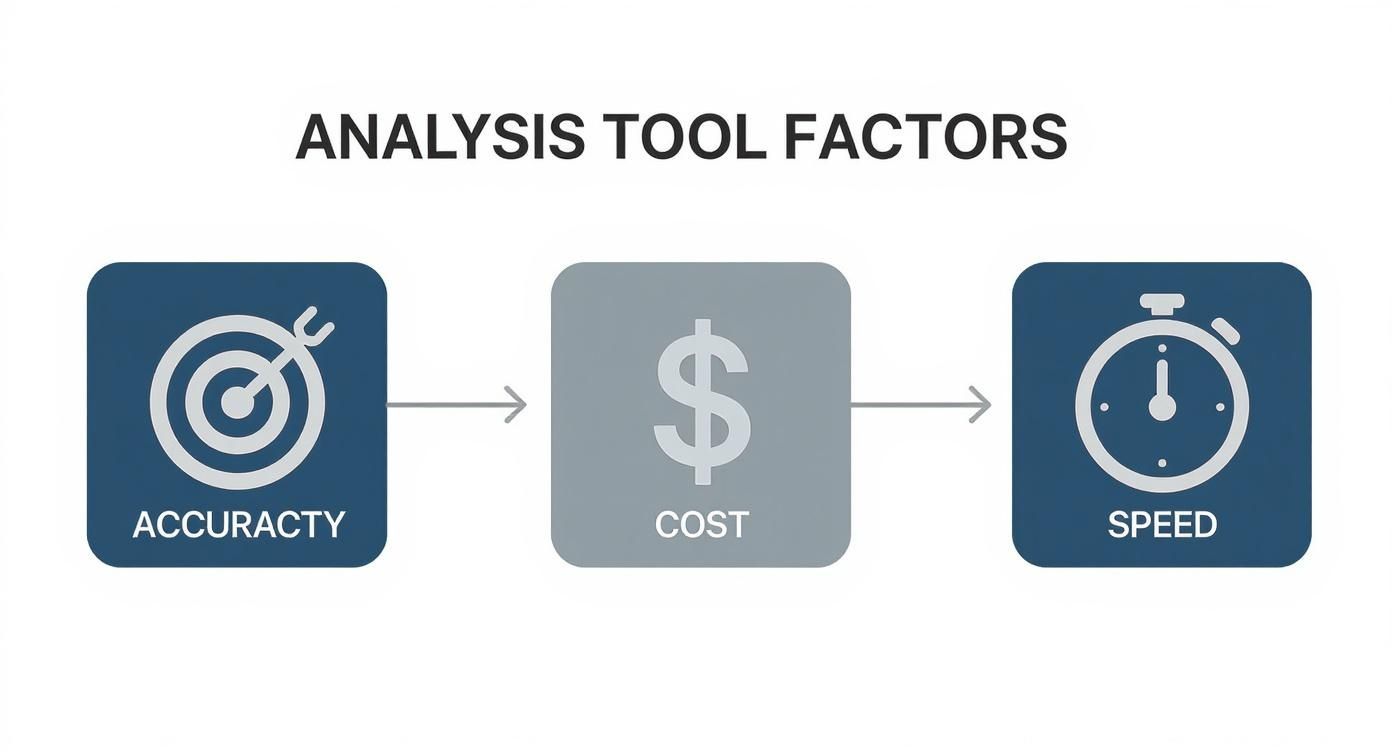
As you can see, there's a fundamental trade-off. The most accurate tools often come with a bigger price tag and a slower process, while the quicker, more affordable options might sacrifice a bit of precision.
Key Questions for Your Checklist
Before you pull the trigger, run through this simple checklist. It ensures you’ve covered all your bases and are picking a tool that will actually help your business grow.
- Who are my clients? Are they elite athletes who nerd out on granular data, or everyday people who just need a motivational boost? The report should be easy for them to understand.
- What is the client experience like? The whole process needs to be simple, comfortable, and fast. If the test is a huge, intimidating ordeal, clients won't want to do it regularly.
- How will I use the data? Are you adjusting training plans, tweaking nutrition, or screening for health risks? Make sure the device gives you the specific numbers you need to do your job well.
- What are the operational requirements? Does it need a special room, a dedicated power outlet, or a certified technician to run it? These things add up and affect the true cost of ownership.
Investing in a body composition analyzer is about more than just buying a piece of equipment. It's an investment in your ability to deliver incredible, data-driven results for your clients. The right tool backs up your expertise and builds client trust.
The demand for these devices is skyrocketing, which shows just how vital they've become. Globally, the body composition analyzer market was valued at around $856.36 million in 2024 and is expected to blow past $1.86 billion by 2032. This boom is all about people becoming more health-conscious and wanting personalized data. You can discover more insights about the body composition analyzer market and see where things are headed.
Ultimately, by carefully weighing your needs against the features, costs, and practicalities of each option, you can make a smart, strategic investment. That decision will empower you to give better guidance, keep your clients fired up, and build a more successful practice.
Putting Your Analysis Tool Into Practice
Owning one of the best body composition analysis tools is only half the battle. The real value comes when you turn those raw numbers into a story your clients can relate to—and act on.
A sheet filled with data can feel intimidating. But with your expertise, each metric becomes a milestone in your client’s journey.
Standardizing Your Testing Protocol
Before you track change, you need confidence in your measurements. Inconsistent testing is like comparing apples to oranges—especially when methods like BIA are so sensitive to hydration. Think of it as running the same lab experiment under identical conditions each time.
To make your protocol bulletproof, set clear rules for every session:
- Consistent Timing: Test at the same hour each day—ideally first thing in the morning, post-restroom but pre-breakfast.
- Pre-Test Conditions: Ask clients to skip exercise, caffeine, and alcohol for at least 12 hours beforehand.
- Hydration Status: Encourage regular hydration the day prior, but avoid large fluid intake immediately before scanning.
By controlling these variables, you ensure the shifts you observe reflect true changes in muscle and fat—not just water weight fluctuations.
The goal of consistent testing is an “apples to apples” comparison. With a solid protocol, you can confidently tell a client, “You’ve built muscle—your hard work is paying off,” backed by real data.
Communicating Results For Maximum Impact
Numbers alone won’t inspire anyone. Your role is translator—turning technical metrics into clear, motivating takeaways.
Instead of handing over a printout, sit down with your client. Highlight specific wins. For example, even if the scale hasn’t budged, you might celebrate a 2% drop in body fat percentage alongside a boost in lean mass. That’s proof their plan is working.
This is where trust forms. You’re not just the person who pressed “start” on a machine. You’re the expert who interprets the results and crafts the next steps.
From Data To Actionable Plans
Detailed reports from professional body composition analysis tools are the springboard for personalized programming. They move you past one-size-fits-all advice and into bespoke solutions.
Here’s how to put the data to work:
- Identify Imbalances: A segmental analysis might reveal less muscle on one side. You can then introduce single-leg presses or lunges to even things out and minimize injury risk.
- Target Visceral Fat: If visceral adipose tissue (VAT) is high, explain its health implications and design a plan centered around HIIT and nutrition tweaks proven to reduce internal fat.
- Set Realistic Goals: Use the initial scan as your baseline. Then aim for targets like “gain three pounds of lean mass in two months” or “shave off 1% body fat each month.”
By tying every recommendation back to their personal data, you deliver a level of customization that keeps clients engaged. This approach not only drives better physical outcomes but also strengthens retention—proving your guidance is an investment in their long-term health.
Of course. Here is the rewritten section with a more natural, human-written tone.
Common Questions About Body Composition Analysis
Even after you've got a solid grasp of the different technologies, a few questions always seem to pop up from clients and even other pros. Getting these sorted out from the start is key to building trust, setting realistic expectations, and making sure the data actually helps people, rather than confuses them. Let's tackle some of the most common ones I hear.
How Accurate Are These Tools, Really?
This is the big one, and the honest answer is: it depends. Accuracy isn't a simple yes or no; it's a spectrum. The real goal isn't to find some mythical, perfect number but to pick the tool with the right level of precision for what you're trying to achieve.
Think of DEXA scans as the gold standard in a clinical setting. They give you an incredibly precise breakdown of fat, muscle, and even bone density. The Bod Pod (Air Displacement Plethysmography) is right up there, too, which is why you see it so often in research.
For fitness professionals, a good multi-frequency BIA device is fantastic. Its real power isn't in a single, one-off reading—which can be swayed by how much water you've had to drink—but in its consistency over time. If you test under the same conditions, it's brilliant for showing progress. The BIA scales you buy for home use? They're the least precise, but they can still give someone a general sense of the trend.
Remember, the most powerful insight comes from the trend line, not a single dot on the graph. Consistent measurements with the same device are what truly show if a client is moving in the right direction.
How Often Should Someone Get Measured?
For tracking changes from a new fitness plan or diet, I've found that testing every four to eight weeks is the sweet spot. It gives the body enough time for real physiological changes—like building new muscle or losing body fat—to actually show up in the numbers.
Testing too often, like every single week, can be a recipe for frustration. Normal, daily shifts in water weight can easily hide real progress and leave a client feeling defeated when they shouldn't be.
Consistency is everything. If you want data you can actually rely on, you need a strict protocol:
- Same Time of Day: Morning is usually best, before the day's activities throw things off.
- Similar Conditions: This means testing after a fast and making sure hydration is consistent with any pre-test instructions.
- Standardized Routine: Always test before a workout and after a trip to the restroom. This creates a stable baseline.
Sticking to a routine like this means you can confidently compare this month's results to last month's and get a true picture of their journey.
Is There Anyone Who Shouldn't Use These Tools?
Absolutely. While these tools are safe for most people, they aren't for everyone. It's our job as professionals to screen clients properly before hooking them up to any machine.
The biggest red flag is for Bioelectrical Impedance Analysis (BIA). It should never be used on anyone with an implanted electronic medical device. This includes things like pacemakers or implantable cardioverter-defibrillators (ICDs). The very low electrical current that BIA uses could potentially interfere with these life-saving devices. It's a risk you just don't take.
Pregnant women are also generally advised to steer clear of both BIA and DEXA scans. While the radiation from a DEXA scan is tiny—even less than a dental X-ray—the standard medical advice is to avoid any unnecessary radiation exposure during pregnancy. When in doubt, always have the client check with their doctor first.
At Cartwright Fitness, we focus on providing validated, high-precision health and fitness testing equipment so professionals can deliver assessments they can stand behind. You can explore our selection of professional-grade tools for performance testing and body composition analysis on our official website.