

In the UK, body composition analysis costs roughly £35 to £200 for self-pay scans, with non-imaging operator-led tests around £35 to £70, DXA around £60 to £200, and combined packages reaching £250 to £562 depending on report depth and clinician review. A quote at the lower end can buy a quick estimate, while a higher fee may buy repeatable measurements, segmental data and an interpretation that supports a clinical or performance decision.
A clinic manager often sees two apparently similar quotations arrive on the same day. One provider offers a body composition assessment for £65. Another quotes £189 for a DXA scan, or considerably more for a package including consultation and follow-up. The mistake is to treat those prices as competing versions of the same product.
They aren't. The first may provide a fast operator-led measurement and a printed result. The second may include imaging, quality controls, detailed reporting and professional interpretation. For occupational health, rehabilitation, university research and sports performance, the important figure is cost per decision, not cost per scan.
Table of Contents
- What body composition analysis actually costs in the UK today
- Why body composition pricing varies so widely
- Comparing DXA, BodPod, BIA, ultrasound and skinfolds on cost and value
- Matching the method to the setting
- What a professional quote should include beyond the scan fee
- Operator skill and protocol as the real cost driver
- Budgeting body composition for an organisation
- Which method to choose for your use case
What body composition analysis actually costs in the UK today
The UK self-pay market has a broad price structure because “body composition analysis” covers several different services. University and clinical exercise facilities publish lower-cost options such as £35 for an InBody analysis with report, £40 for a body composition assessment, £65 for BodPod analysis and £70 for a TANITA-based monitor session. Published private DEXA pricing starts at £115 at a London imaging provider and £125 through a UK-wide booking platform, while specialist clinics quote around £179 to £189. More packages can reach £225 to £562 when 3D imaging, repeat sessions or other extras are included. These examples are collated in UK body composition analysis pricing.
The practical interpretation is straightforward. Non-imaging operator-led tests generally occupy the £35 to £70 range, while clinical BIA and InBody services often sit higher. DXA is the premium self-pay benchmark, although the actual fee depends on location, reporting and whether the service is sold as a stand-alone scan or a broader health assessment.
| Method | Typical UK price band | Notes |
|---|---|---|
| Operator-led non-imaging assessment | £35 to £70 | Skinfolds, BodPod and other academic or performance services |
| Clinical BIA or InBody package | £60 to £120 | Cost changes with analysis depth and consultation |
| DXA body composition | £60 to £200 | Imaging-grade output, with higher fees in some locations |
| Combined or clinician-reviewed package | £250 to £562 | May include bone data, 3D imaging, repeat sessions or follow-up |
The price alone says little about usefulness. A raw body fat estimate may be sufficient for a broad screening exercise, but it isn't equivalent to a report showing fat mass, fat-free mass, body water, skeletal muscle mass, segmental distribution and change from a previous assessment. Professionals evaluating body composition and muscle preservation should therefore ask what the result will inform before selecting a test.
Practical rule: Buy the smallest assessment that can answer the decision safely, then pay for interpretation when the result will change treatment, training or work-capacity planning.
The remainder of a written quotation matters as much as the headline. Scan region, operator qualification, report content, repeatability controls and review time determine whether the output can support a defensible decision.
Why body composition pricing varies so widely
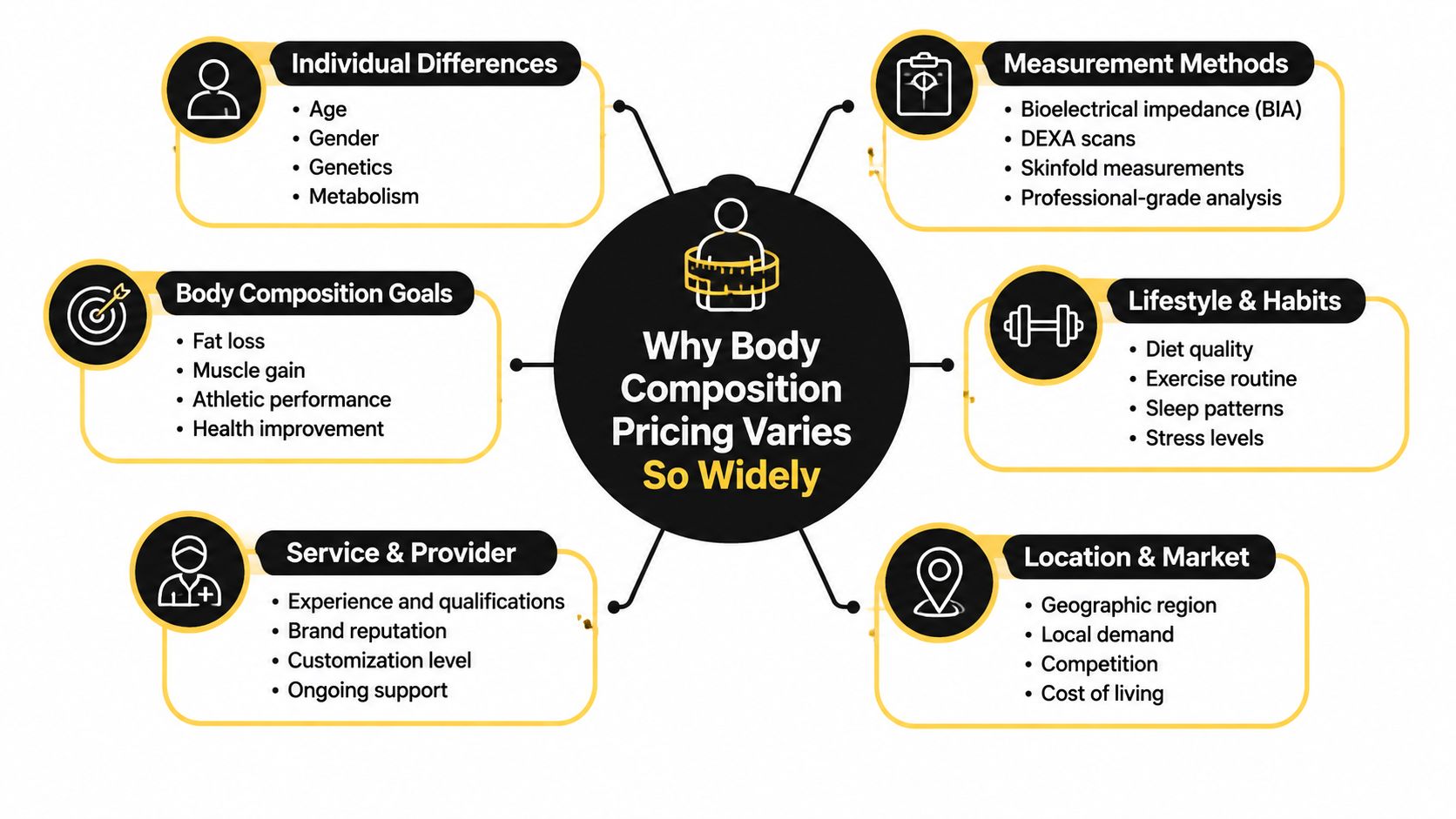
The scanner is only one part of the service. Five variables usually explain most of the difference between a lower-cost assessment and a premium package.
Hardware sets the starting point
A simple BIA device has very different capital, room and maintenance demands from a DXA or BodPod system. A provider recovering the cost of imaging equipment, dedicated space, compliance procedures and trained staff can't price every appointment like a short standing measurement. The hardware also determines the type of output available, although a capable device still needs an appropriate protocol and competent operator.
The Seca mBCA 515 Medical Body Composition Analyzer illustrates the distinction between a basic weight reading and a medical body composition system. It breaks weight into fat mass, fat-free mass, body water, extracellular and intracellular water, and skeletal muscle mass.
Staff time changes the quote
A short BIA appointment can be delivered at high throughput. Imaging requires positioning, safety checks and equipment operation, while a detailed anthropometric assessment requires measurement points, preparation and recording. More staff time increases the cost even when the measurement itself appears quick.
Reporting separates a number from evidence
A basic printout may contain headline values only. A professional report can add raw measurements, compartment data, segmental findings, comparisons with previous tests, reference context and a narrative interpretation. That work takes time and requires someone able to distinguish a meaningful change from measurement noise.
Review and repeatability add value
Clinician or physiologist review is a separate professional input, not a decorative extra. Repeatability controls, standardised preparation and documented quality assurance make serial results more useful. A lower fee can be appropriate when the purpose is simple screening, but it becomes false economy when poor control forces repeat assessments.
Location and service model affect the final price
Published UK guidance places body-composition DXA around £60 to £200 nationally, with examples around £100 to £200 in London and £60 to £120 in Edinburgh. A university facility may keep costs down through an academic or performance model, while a private clinic may include consultation, reporting and follow-up in its fee. That is why two providers can quote different prices for a nominally similar scan without either quotation being misleading.
Comparing DXA, BodPod, BIA, ultrasound and skinfolds on cost and value
No method wins every buying decision. The correct comparison considers the evidence base relevant to the purpose, appointment throughput, repeatability under a fixed protocol, price and setting.
| Method | Evidence base | Throughput | Repeatability (CV) | Typical UK price | Best-fit setting |
|---|---|---|---|---|---|
| DXA | Imaging-based compartment assessment | Moderate | Provider and protocol dependent | £60 to £200 | Clinical, research and detailed performance assessment |
| BodPod | Air-displacement densitometry | High | Provider and protocol dependent | Around £65 to £150 | University and performance laboratories |
| Multi-frequency BIA | Device-specific impedance models | Very high | Strongly protocol dependent | £60 to £120 for clinical systems | Occupational health and serial monitoring |
| Ultrasound | Regional tissue-depth assessment | Moderate | Operator dependent | £40 to £90 | Clinical and regional assessment |
| Skinfolds | Practitioner-led anthropometry | Moderate | Operator dependent | £35 to £70 | Sport, education and community services |
DXA offers the strongest case where segmental fat and lean mass, bone data or detailed distribution are central to the decision. UK self-pay body-composition DXA commonly falls within £60 to £200, but the value depends on whether the report is interpreted and whether the same positioning and analysis approach will be used at repeat visits. It suits a university study or specialist clinic better than a high-volume screening line.
BodPod provides a density-based assessment without imaging and is established in university and performance environments. Published UK examples include £65 at Coventry University and £69 in university service pricing, while a broader service can charge more when consultation is included. It offers attractive throughput for a laboratory that needs consistent testing, although it doesn't provide the same segmental output as DXA.
BIA has the widest practical range. A medical system can produce multiple compartments and support serial monitoring, while a consumer device may offer only a modelled estimate. BIA is a sensible choice for occupational health or team monitoring when preparation, hydration, time of day and device use are tightly controlled. It becomes a poor choice when staff treat every reading as directly comparable despite inconsistent conditions.
Ultrasound can be useful when regional fat depth or muscle thickness is the specific question. The method is operator dependent, so training and standardised sites matter more than a low equipment price. Organisations evaluating procurement should understand the wider clinical equipment market, including public sector ultrasound tenders, before assuming that a device purchase alone defines service quality.
Skinfolds remain the most economical option when an ISAK-qualified practitioner performs the assessment consistently. The University of Northampton lists an ISAK-qualified eight-skinfold assessment at £60, while the wider academic benchmark for operator-led non-imaging services is roughly £40 to £65. For an academy or S&C environment, the method can deliver strong decision value if the operator is skilled and the protocol is fixed.
A professional overview of body composition fitness testing should therefore be read as a measurement-design question, not a shopping list. The cheapest method is valuable only when it answers the question reliably.
Matching the method to the setting
University clinic
A university sports science department running doctoral research may need segmental data, documented procedures and a stable measurement platform. DXA makes sense when the research question depends on regional fat and lean mass or bone-related information. If participant flow becomes the limiting factor, BodPod may offer a more practical density-based route, particularly when the study doesn't require segmental imaging.
The purchase decision should follow the protocol and analysis plan. A lower appointment price isn't useful if researchers later need to repeat measurements because the first output lacks the required variables.
Occupational health provider
An OH provider usually values throughput, consistency and defensible reporting across many employees. A validated BIA system can work well when staff standardise preparation and record relevant contextual factors. The service should define when a result triggers referral, further assessment or a broader functional test rather than presenting body composition as a diagnosis in isolation.
The best cost model is often the one that keeps operator time low while preserving a clear audit trail. That may favour a professional BIA workflow over an imaging service for routine screening.
Private health clinic
A private clinic charging a premium fee needs to deliver more than machine access. A DXA package priced above £200 can be justified when it includes a structured report, clinician review, relevant comparison and a consultation that links the findings to the client's clinical or performance question. The fee is difficult to defend when the client receives only an unannotated printout.
The clinic should make the inclusions visible before booking. Clear scope protects trust and lets the purchaser compare total service value rather than equipment labels.
Strength and conditioning gym
An S&C facility often needs frequent, low-friction monitoring rather than an imaging baseline for every athlete. An ISAK-qualified practitioner using skinfolds can produce a useful trend at a modest cost, provided the athlete is measured at consistent sites and under consistent conditions. The gym should reserve DXA or BodPod for cases where the extra information will change programming, selection or medical referral.
A cost-per-decision framework becomes most useful. A repeatable, practical method that coaches understand can be more valuable than a technically richer test that appears only occasionally.
What a professional quote should include beyond the scan fee
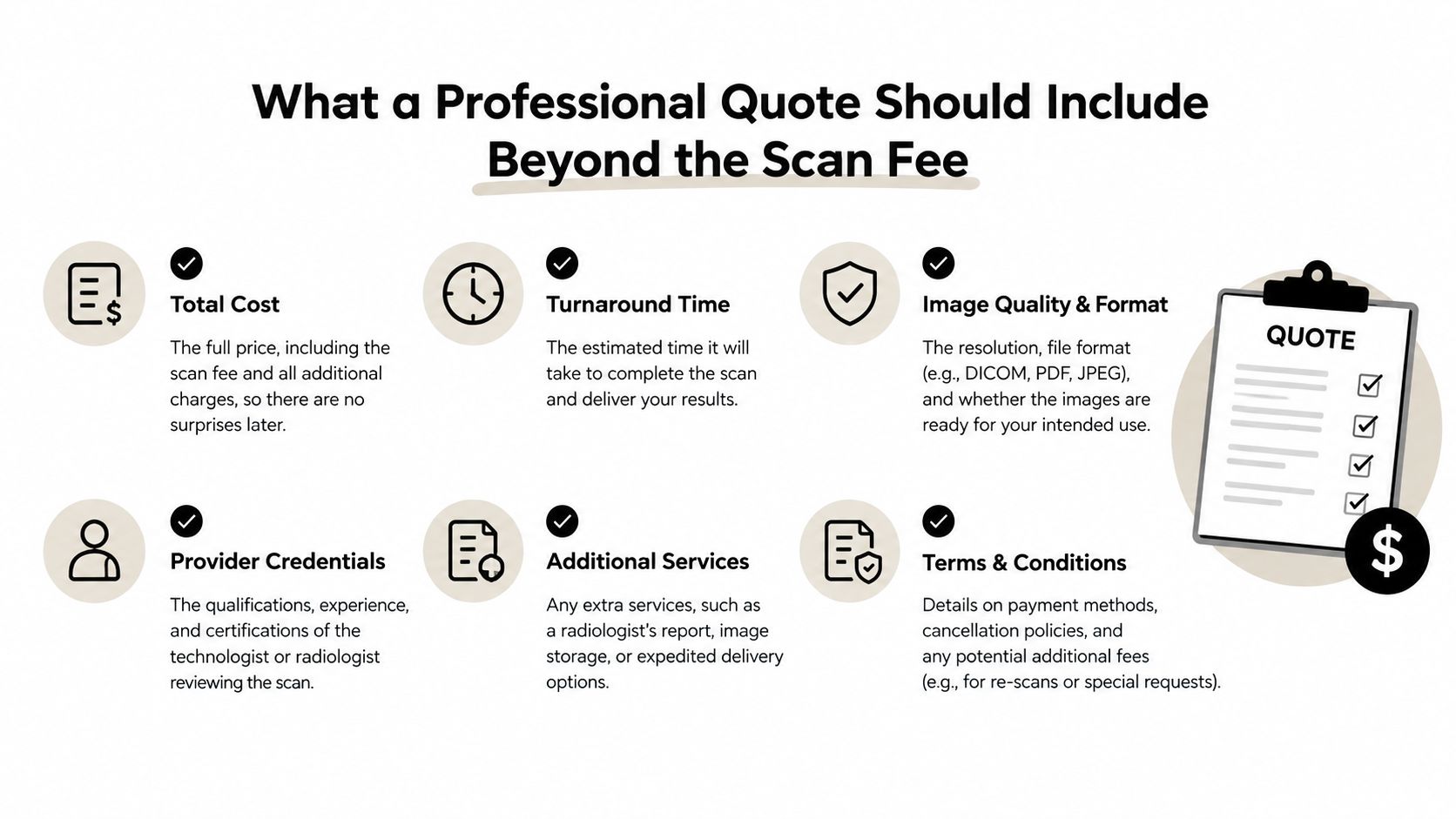
A credible quotation should allow a buyer to reconstruct the service. “Body composition scan” isn't enough because it leaves the measurement region, output and professional responsibility undefined.
The essential line items
- Method and scan region: The quote should identify DXA, BodPod, BIA, ultrasound or skinfolds, and state whether the assessment is whole-body, regional or site-specific.
- Operator qualification: Buyers should know whether a radiographer, clinician, physiologist or trained anthropometrist performs the test.
- Raw versus interpreted output: A report containing values alone isn't equivalent to a narrative explaining the findings and their limitations.
- Segmental information: The provider should specify whether arms, legs, trunk or other relevant regions are included.
- Comparison with prior tests: Serial monitoring requires a defined comparison process, not two reports placed side by side.
- Software and export: Organisations should check whether data can be retained, exported and tracked within an approved system.
- Professional review: The quotation should identify whether clinician or physiologist interpretation is included, optional or unavailable.
A provider should also state VAT treatment, cancellation terms, repeat-scan pricing, report delivery arrangements and any travel or setup charge for on-site work. These omissions make low headline prices difficult to compare with fuller packages. Published UK pricing demonstrates the scale of the gap, with university BodPod services around £65 to £69, private DEXA packages commonly beginning around £120 to £189, and combined body and bone packages reaching roughly £250 to £349. Those prices reflect different deliverables, not merely different tills.
A defensible quote answers one question: what professional output will the organisation receive, and can that output support the decision being made?
For two quotations placed side by side, the buyer should confirm:
- The measurement method and exact region.
- Preparation instructions and rescheduling rules.
- Operator credentials and quality assurance process.
- Included data fields, interpretation and comparison.
- Report delivery, software access and follow-up.
- VAT, cancellation, travel and repeat-assessment terms.
Operator skill and protocol as the real cost driver
Two identical systems can produce different practical value when operators use different preparation rules, positioning and reporting standards. The device may be expensive, but the measurement process determines whether a repeat result reflects a physiological change or a changed testing condition.
BIA services should control factors such as hydration, recent food and drink, exercise, clothing and bladder state. DXA requires consistent positioning, appropriate clothing and careful handling of artefacts. Skinfolds depend heavily on site identification, calliper technique and the operator's ability to reproduce the same measurement locations.
The same principle applies across body composition, grip strength, back and leg strength, functional assessment and aerobic testing. A professional service needs a written protocol, staff training, standard preparation instructions and a process for recording deviations.
Repeatability reduces total cost
A poorly controlled test can create an apparent change that has nothing to do with the intervention. That can trigger unnecessary programme changes, repeat scans or clinician time. The financial loss isn't limited to the original fee. It includes staff time, participant inconvenience and the risk of making a decision from unreliable data.
The relevant buying question is therefore not which scanner a provider owns. It is which operator and protocol come with the service. Resources on body fat measurement accuracy are useful when organisations are writing procedures or evaluating supplier claims.
A disciplined operator can reduce the need for repeat assessments and make longitudinal data easier to interpret. That compresses the total cost of ownership, even if the initial appointment isn't the cheapest available.
Budgeting body composition for an organisation
A clinic or university should budget body composition as a service line, not as a single equipment invoice. Capital expenditure is visible, but training, software, calibration, reporting and quality assurance determine whether the equipment produces defensible data.
The following categories belong in a procurement model:
- Hardware: DXA, BodPod, professional BIA or anthropometry equipment.
- Calibration and consumables: Equipment checks, reference phantoms and replacement items.
- Operator training: ISAK or ISAK-aligned training for skinfold work, plus method-specific competency.
- Reporting time: Physiologist, clinician or sports scientist time for interpretation.
- Software: Segmental export, longitudinal records and professional report generation.
- Quality assurance: Drift checks, audit records and protocol reviews.
- Facility overhead: Room requirements, insurance, servicing and governance.
Indicative UK professional equipment bands include £45,000 to £95,000 installed for DXA, £28,000 to £40,000 for BodPod, £1,200 to £6,500 for multi-frequency BIA, and £300 to £900 for skinfold kits. These are capital planning ranges, not complete ownership costs, and the equipment figures should be validated with suppliers before approval.
| Method | Hardware (capital) | Consumables / year | Operator training (one-off) | 5-year indicative range |
|---|---|---|---|---|
| DXA | £45,000 to £95,000 installed | Provider and service dependent | Provider and method dependent | Must include servicing, room and governance costs |
| BodPod | £28,000 to £40,000 | Replacement and service dependent | Provider and method dependent | Must include calibration and specialist maintenance |
| Multi-frequency BIA | £1,200 to £6,500 | Low to moderate, device dependent | Method and protocol training | Must include software and QA provision |
| Skinfold kit | £300 to £900 | Low, equipment dependent | ISAK or aligned training | Must include competency maintenance and audit |
A five-year model should separate fixed and variable costs. DXA and BodPod require room planning, servicing and reference checks. BIA requires disciplined preparation and software governance. Skinfolds require operator development and periodic competency checks.
A lower capital price doesn't guarantee a lower assessment cost. If staff can't standardise the method, the organisation may spend more on repeats and interpretation than it saved at purchase.
Which method to choose for your use case
Choose DXA when clinical-grade segmental data, bone information or fat distribution will directly affect a decision. A self-pay assessment commonly sits around £60 to £200, and the higher end is easier to justify when the service includes a proper report and professional review.
Choose BodPod for a performance or research laboratory that needs density-based assessment and efficient throughput but doesn't require the same segmental output as DXA. It suits an organised laboratory workflow where preparation and quality control are already embedded.
Choose multi-frequency BIA for serial monitoring of athletes, employees or patients when the same operator can control hydration, time of day and preparation. The method is particularly practical when the team needs regular measurements and can keep the protocol stable.
Choose ultrasound when the question concerns regional fat or muscle thickness and a trained clinician can reproduce the measurement sites. It is a targeted tool, not a substitute for every other form of body composition assessment.
Choose skinfolds when budget is the binding constraint and an ISAK-qualified operator is available. Academy sport, school physical education and community services can gain useful information from a disciplined low-cost method, provided the organisation doesn't overstate what the result can establish.
The strongest procurement decision starts with the action that follows the test. If the result only records a broad baseline, an operator-led method may be sufficient. If it changes clinical management, research conclusions or occupational fitness decisions, the quote should fund the reporting, protocol and review needed to make that decision defensible.
Cartwright Fitness supplies professional assessment equipment, software and solutions for body composition and anthropometry, alongside tools for VO₂ assessment, the Chester Step Test, grip strength, dynamometry, functional fitness and occupational assessment. Organisations comparing body composition analysis cost can visit Cartwright Fitness to review equipment and professional assessment resources matched to their testing environment.