

A blood lactate test kit is a handheld device that lets athletes and coaches measure lactate concentration right from a tiny drop of blood. It’s a simple test that delivers powerful, real-time feedback on how your body is actually handling the stress of exercise. Think of it like a tachometer for your body’s engine, showing you precisely how hard you're working on a metabolic level.
What Is a Blood Lactate Test Kit and Why Use One?
For any serious athlete, the line between peak performance and overtraining is razor-thin. You have to push your limits to get better, but pushing too hard for too long is a fast track to burnout, illness, and injury. This is where a blood lactate test kit becomes one of the most powerful tools in your training toolkit. It helps you move past generic heart rate zones and vague feelings of "effort" and into the world of objective, biological data that’s unique to you.
It’s the difference between navigating with a rough sketch of a map and using a high-precision GPS. Both might get you to your destination, but one gives you the accuracy and real-time feedback to make smart adjustments along the way, ensuring you get there faster and more efficiently.
From Guesswork to Precision Training
Using a lactate meter is all about training smarter, not just harder. The data it gives you lets you pinpoint exactly how your body responds metabolically to different levels of exertion. This is a game-changer for a few key reasons:
- Define Your Personal Training Zones: You can find your true aerobic and anaerobic thresholds (often called LT1 and LT2). These aren't just estimates based on age; they are your personal metabolic signposts that tell you exactly how to structure your endurance, tempo, and high-intensity interval workouts for the best results.
- Prevent Overtraining: Monitoring your lactate levels shows you when your body is creating more metabolic stress than it can handle. This is a clear, biological warning sign that it's time to back off the intensity or build in more recovery, stopping the chronic fatigue that kills progress.
- Track Your Fitness Progression: As you get fitter, your body gets much better at clearing and using lactate as fuel. You’ll start to see lower lactate numbers at the same speeds or power outputs, giving you concrete proof that your hard work is paying off.
By measuring lactate, you take control of your training story. The numbers don't lie—they tell a clear story of your body's adaptation, efficiency, and readiness to perform, empowering you to make evidence-based decisions that lead to real-world performance gains.
A typical blood lactate test kit comes with everything you need to get an accurate reading in just a few minutes, whether you're at the track, by the pool, or in the gym. Let's break down the components to see how straightforward the process really is.
Core Components of a Test Kit
Here’s a quick look at what comes in a standard kit. Each part has a specific job to ensure you get a reliable measurement every single time.
Blood Lactate Test Kit at a Glance
| Component/Aspect | Description | Primary Benefit |
|---|---|---|
| Lactate Analyzer | A handheld digital meter that analyzes the blood sample and displays the lactate concentration, usually in millimoles per liter (mmol/L). | Provides an immediate, quantitative result for on-the-spot analysis and training adjustments. |
| Test Strips | Single-use strips coated with a reagent that reacts with lactate in the blood. The meter reads this chemical reaction. | Ensures a sterile and accurate test for each measurement, preventing cross-contamination. |
| Lancing Device & Lancets | A spring-loaded device and sterile needles (lancets) used to create a small, quick puncture on the fingertip or earlobe. | Allows for a fast, minimally invasive, and consistent way to obtain the necessary small blood sample. |
As you can see, the system is designed to be simple and self-contained, putting lab-grade data directly into your hands when and where you need it most.
Understanding Lactate: Your Body's High-Performance Fuel
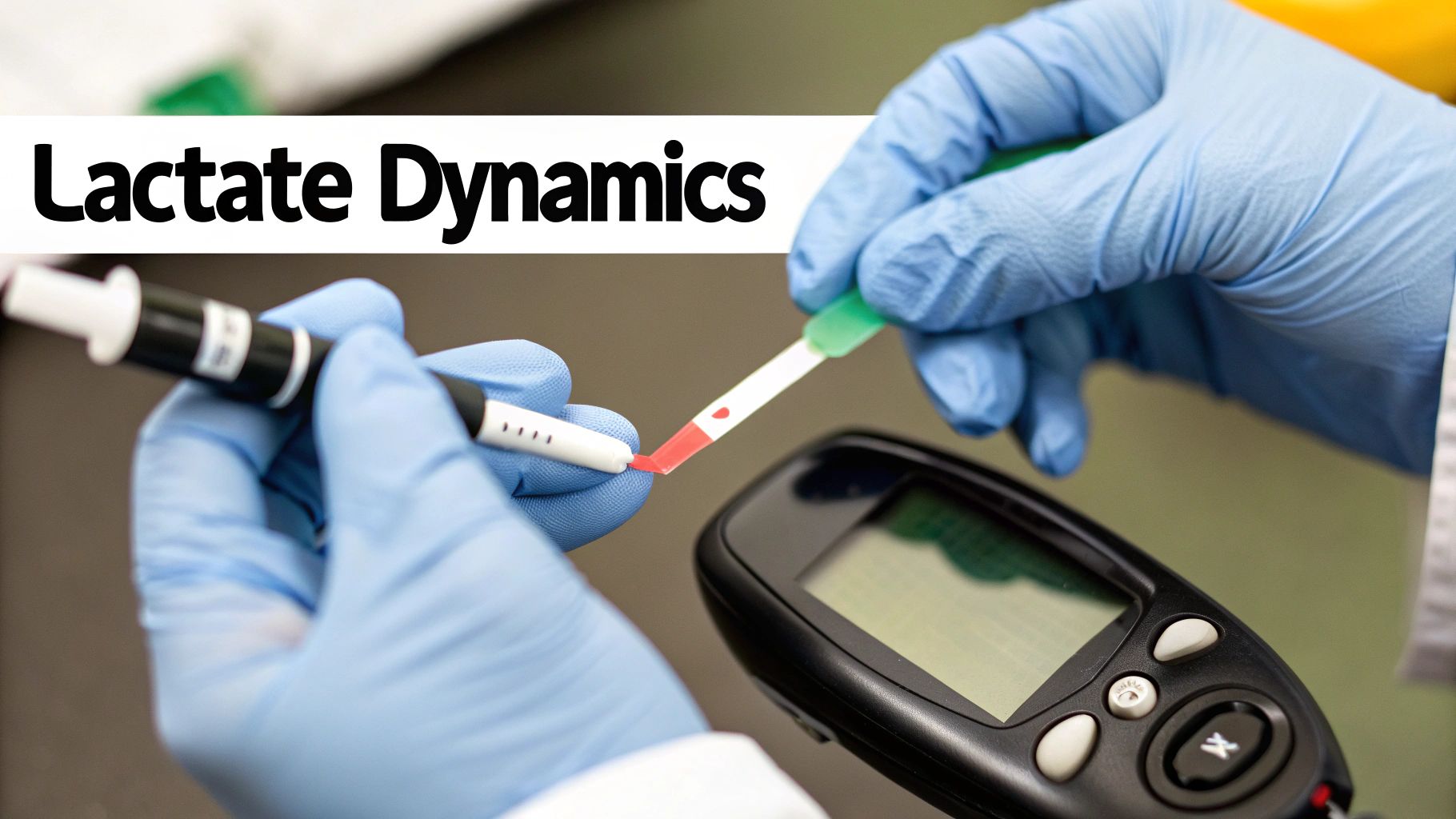
For decades, lactate has been unfairly blamed for just about everything that goes wrong during a hard workout. It’s been painted as the villain, a useless waste product that causes muscle burn, fatigue, and that dreaded feeling of hitting the wall. But that's an old, outdated story.
It’s time we see lactate for what it truly is: a premium, high-octane fuel and a vital messenger molecule that helps your body perform at its peak.
Think of your body like a high-end restaurant kitchen during a chaotic dinner service. Glucose from the carbs you eat is like the raw ingredients arriving at the back door—it has potential, but it needs to be processed. During intense exercise, your body starts rapidly breaking down that glucose into lactate.
Don't think of this lactate as food scraps. Instead, picture it as perfectly prepped ingredients—vegetables chopped, steaks seasoned, sauces simmering, all ready for the chef to use immediately. This ready-to-go fuel is quickly sent to wherever it's needed most. Your muscles, heart, and even your brain can grab this lactate and use it as a fast-acting energy source to keep you pushing when things get tough.
The Lactate Shuttle: A High-Speed Delivery System
This brilliant metabolic process is called the lactate shuttle. It's your body's incredibly efficient courier service for moving this valuable fuel from cells that are making it to cells that can burn it. When you're going all out, like during a sprint or a heavy lift, your fast-twitch muscle fibers crank out a ton of lactate.
But instead of just building up and causing problems, this lactate gets shuttled to other areas that are hungry for energy:
- Neighboring Muscle Fibers: Your slow-twitch (endurance) muscle fibers are fantastic at taking up lactate and using it for aerobic energy.
- The Heart: Your heart muscle absolutely loves lactate and can use it as a primary fuel source to keep beating powerfully.
- The Liver: It can take lactate and convert it back into glucose, creating a neat, sustainable energy loop.
- The Brain: When you're pushing hard, your brain can also use lactate to support focus and cognitive function.
This intricate network ensures the energy produced during intense effort isn't wasted but is cleverly recycled and redistributed to sustain your performance. That burning sensation you feel? It’s not the lactate. It's the build-up of hydrogen ions, which are a separate byproduct of energy metabolism.
If you want to get into the nitty-gritty of the biology, you can learn more about what lactate is in the blood and how it functions.
Lactate isn't the enemy of performance; it’s the signature of high-intensity work and a vital energy source.
Grasping this concept is the key to understanding why a blood lactate test kit is such an incredibly powerful tool for any serious athlete. You’re not measuring waste; you're measuring your body's ability to produce and use a critical performance fuel.
Why Measuring This Fuel Matters
When you test your blood lactate, you're getting a direct, real-time snapshot of this dynamic energy system at work. The number on the screen tells you exactly how much of this "prepped fuel" is circulating in your bloodstream at that specific moment, offering profound insights into your metabolic state.
Seeing a high lactate number isn't automatically a bad thing. It often just means your body is producing this fuel faster than it can clear and use it at that particular intensity.
As you get fitter, your body becomes a master of this process. Your lactate shuttle gets faster and more efficient. This allows you to hold much higher speeds or power outputs before lactate starts to accumulate significantly, which is the very definition of improved endurance.
This growing understanding is why the global market for blood lactate analyzers is booming. It was valued at around USD 1.2 billion and is projected to skyrocket to approximately USD 2.5 billion by 2033. This surge isn't just in sports science; it's also happening in medical settings where lactate is a key indicator of metabolic health.
How to Choose the Right Blood Lactate Test Kit
Picking the right blood lactate test kit can seem like a tough decision, but it really comes down to one thing: knowing what you need it for. It's not about finding the single "best" device on the market, but about finding the best one for you. A solo marathon runner, a researcher in a lab, and a coach managing an entire team all have very different requirements.
I like to think of lactate analyzers like cameras. A professional photographer needs a camera with manual controls, incredible resolution, and a bag full of lenses for every possible shot. On the other hand, someone just wanting to capture family memories needs a simple, portable camera that takes great pictures without any fuss. The features on a lactate kit work the same way—what's essential for one person is just a nice-to-have for another.
Let's break down the key features so you can look at any product spec sheet and know exactly what you're getting.
Accuracy and Reliability
This is non-negotiable. An inaccurate lactate meter isn't just useless; it's actively harmful because it leads you to make the wrong training decisions. You want a device with a proven track record, ideally one that has been validated in scientific studies or is trusted by professional sports institutes.
A reliable kit gives you consistent readings every single time. This is critical for tracking progress, where you're looking for small but significant drops in lactate levels at a specific intensity.
The whole point is precision. You have to be able to trust that a reading of 3.5 mmol/L is actually 3.5 mmol/L, not just a random guess. That trust is the foundation of any good data-driven training program.
Analysis Time and Sample Size
These two features are all about practicality, especially when you're trying to test in the middle of a workout.
Analysis Time: This is how long it takes to get your result after applying the blood sample. Times range from a lightning-fast 5 seconds to over a minute. For a coach trying to test a squad of swimmers between laps, those 5-15 second results are a game-changer. For a cyclist testing at home after a ride, a 60-second wait is no big deal.
Sample Size: This is the tiny drop of blood needed for a test, measured in microliters (µL). A smaller sample size (think 0.2-0.5 µL) means a less invasive, less painful finger prick. That’s a huge plus when you’re doing multiple tests in one session.
Your testing environment will dictate what’s best. Quick results from tiny samples are perfect for getting feedback on the fly, while slower devices might offer other perks, like a lower cost.
Comparing Key Features of Blood Lactate Analyzers
To make a smart choice, you need to see how each feature lines up with what you'll be doing day-to-day. The table below breaks down what these specs actually mean for you and who they benefit the most, helping you decide which analyzer is the right fit.
| Feature | What It Means for You | Ideal for… |
|---|---|---|
| Data Memory & Connectivity | Determines how many test results the device can store and if it can export data (via Bluetooth or USB) to an app or computer for deeper analysis. | Coaches, researchers, and serious athletes who want to track performance trends over the long term. |
| Portability & Durability | A small, lightweight, and tough device is easy to toss in a bag and take to the track, pool, or field. A larger, stationary unit might be better for a lab. | Field-based athletes and coaches who need to test in different training environments. |
| Cost Per Test | This isn't just the price of the meter; it's the ongoing cost of test strips and lancets. Some meters are cheap upfront, but their proprietary strips are expensive. | Anyone planning to test frequently, like teams or clinics, where the long-term budget is a major consideration. |
| Calibration | Some meters need manual calibration with a code or chip for each new box of test strips. Others do it automatically. | Automatic calibration is far more convenient and slashes the risk of user error. It’s a great feature for everyone, especially those new to lactate testing. |
By carefully weighing these factors against your specific needs—whether you prioritize speed, cost, or data analysis—you can confidently pick a blood lactate test kit that will become a powerful partner in hitting your goals. This way, you’re not just buying a piece of equipment; you're investing in a system that gives you real, actionable insights.
A Step-by-Step Guide to Accurate Lactate Testing
Using a blood lactate test kit might sound a little intimidating, but it's a straightforward process once you get the hang of it. The whole point is to get a clean, uncontaminated blood sample so the number on your meter is a true reflection of what's happening in your body. With a little practice, you’ll be testing quickly and confidently, whether you're at the track, in the gym, or at home.
Think of yourself as your own personal lab tech. A scientist follows a strict protocol for reliable results, and you need to do the same. Consistency is everything—performing the test the same way every time is what makes your results comparable from one session to the next.
Preparing for the Test
Before you even think about pricking your finger, proper setup is key. The first thing to do is get all your gear ready and within easy reach. This saves you from fumbling around with a bleeding finger later.
Here’s a quick pre-test checklist:
- Your lactate analyzer
- A fresh test strip
- A lancing device with a new, sterile lancet
- An alcohol wipe
- Clean tissue or gauze
- A sharps container for safe disposal
Once you have your supplies, wash your hands thoroughly with warm soap and water. This cleans the area and also helps get the blood flowing to your fingertips, making it much easier to get a good sample. Just be sure your hands are completely dry before moving on.
Executing the Test Accurately
With everything laid out, you're ready to collect your sample. The most common spots are the side of a fingertip or an earlobe, since these areas have good blood flow and are less calloused. For the sake of consistency, it's a good idea to stick to the same site for every test within a single training session.
- Prepare the Site: Take an alcohol wipe and clean your chosen area (like the side of your middle or ring finger). Let it air dry completely—don't blow on it, as that can introduce germs.
- Lance the Skin: Set your lancing device to a depth that's just enough to produce a small, round drop of blood. Press it firmly against your skin and click the button for a quick, clean puncture.
- Wipe Away the First Drop: This is a crucial step that many people skip. The first bit of blood can be mixed with skin oils or alcohol residue, which will skew your reading. Gently wipe it away with a clean tissue.
- Collect the Sample: Lightly squeeze your finger a little distance from the puncture to help form a fresh, well-formed droplet. Do not "milk" the finger right at the tip! This forces out other fluids that will dilute the blood and give you an artificially low number.
- Apply to the Test Strip: Pop the test strip into your meter. When the meter signals it's ready, just touch the very tip of the strip to the blood droplet. Capillary action will automatically pull the perfect amount of blood into the strip.
- Wait for the Result: The meter gets to work analyzing the sample. You’ll usually see your result pop up on the screen in just 5 to 15 seconds.
This image breaks down the essential flow of using your kit correctly.
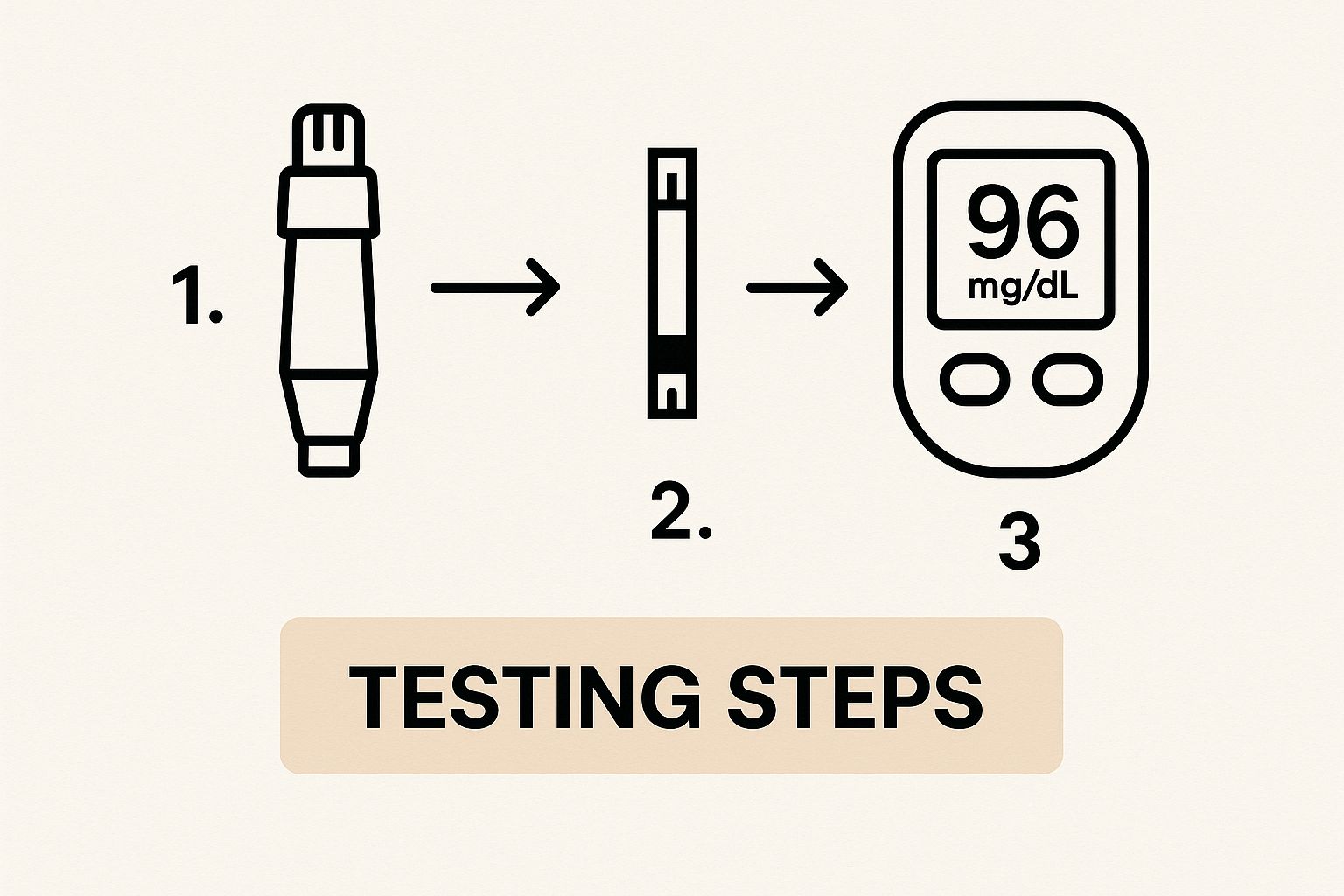
As you can see, following a clean, sequential process is what gives you data you can actually trust.
Safety and Disposal
Handling your used testing materials properly is just as important as the test itself. This is about protecting your health and the safety of others.
Safety isn't an afterthought; it's a core part of the testing process. Never reuse a lancet or test strip, and always dispose of sharp objects responsibly to prevent accidental injury and infection.
Right after you're done, place the used lancet into a dedicated sharps container. If you don’t have one, a hard, puncture-proof plastic bottle with a secure lid (like one from laundry detergent) can serve as a temporary solution. Once it's full, seal it up and follow your local guidelines for disposing of medical sharps. The used test strip and any bloody tissues can go into your regular trash.
How to Apply Lactate Data to Your Training Plan
So, you've got your blood lactate test kit. Collecting the data is one thing, but the real breakthrough comes when you use those numbers to build a truly intelligent training plan. This is where you stop just working hard and start working smart.
Think of it like tuning a high-performance engine. You wouldn't just guess at the fuel mix; you'd use precise instruments to dial everything in perfectly. Your lactate data is that instrument, giving you objective feedback to fine-tune your training intensity for the biggest gains without running yourself into the ground.
The whole process hinges on finding your unique metabolic turning points, commonly known as lactate thresholds. These aren't just abstract concepts—they are specific, measurable points where your body’s energy systems shift gears.
Finding Your Lactate Thresholds with a Step Test
The most effective way to map out your personal metabolic profile is with a lactate step test. This is simply a structured workout where you gradually ramp up the intensity in stages, or "steps," and take a quick blood sample at the end of each one. The goal is to see exactly how your lactate levels respond as you push harder.
You’re looking for two key thresholds:
- Lactate Threshold 1 (LT1): This is your aerobic threshold. It marks the point where lactate begins to tick up just above your resting levels. Training at or below LT1 is your bread and butter for building a deep aerobic base and endurance with very little stress.
- Lactate Threshold 2 (LT2): Often called the anaerobic threshold or maximal lactate steady state (MLSS), this is the tipping point where your body starts producing lactate faster than it can clear it. Training right around LT2 is the "sweet spot" for pushing your performance ceiling higher.
By plotting your lactate numbers against your effort (like your pace, heart rate, or power output), you can draw your personal lactate curve. This curve is your unique physiological fingerprint, showing you exactly where your LT1 and LT2 lie.
Your lactate curve is the ultimate guide to personalized training zones. It cuts through the noise, replacing generic, age-based formulas with hard data about your own body, right now.
This is exactly why sports institutes and performance clinics are embracing these tools. The global market for lactate monitoring was valued at USD 150.73 million and is projected to hit USD 325.88 million by 2033, a surge driven by the demand for this kind of precise, data-backed training. You can dig into these market trends and see how lactate analysis is shaping athletics on Grandview Research.
Case Study: A Cyclist's Journey to a New Personal Best
Let’s see how this plays out in the real world. Meet Sarah, a dedicated amateur cyclist training for a tough 100-mile Gran Fondo. For months, she was grinding away using heart rate zones and perceived effort, but she’d hit a stubborn plateau. Her endurance felt capped, and her high-intensity intervals left her wiped out without making her any faster.
Frustrated, she got a blood lactate test kit and performed a step test on her indoor trainer.
Sarah's Step Test Protocol:
- Warm-up: 15 minutes of easy spinning.
- Steps: Started at 100 watts, increasing power by 20 watts every 4 minutes.
- Testing: Took a blood lactate sample at the end of each 4-minute step.
The results were a lightbulb moment. She discovered her LT1 was at 135 watts—much lower than what she considered her "easy" pace. Her LT2 landed at 210 watts. It turned out she was doing most of her endurance rides in a metabolic gray zone, working too hard for true aerobic development but not hard enough to actually improve her threshold.
Armed with this data, Sarah completely rebuilt her training week:
- Zone 2 (Endurance): On her long rides, she kept her power strictly below 135 watts (her LT1). At first, it felt almost too easy, but she was finally building a massive aerobic engine without accumulating junk fatigue.
- Threshold Intervals: Her key workouts became intervals spent hovering right around 200-210 watts (her LT2). These sessions were demanding but targeted the exact intensity she needed to raise her sustainable power.
- VO2 Max Work: For her toughest days, she pushed well above her LT2, knowing these short, punchy efforts were building top-end power.
If you want to get into the nitty-gritty of testing protocols, you can check out our guide on the lactate threshold test for a deeper dive.
Tracking Progress and Making Adjustments
The final piece of the puzzle is re-testing to track progress. Every six weeks, Sarah would repeat her step test. After the first training block, the change was dramatic. Her LT2 had shifted up to 225 watts. Even better, her lactate reading at her old threshold of 210 watts had dropped from 4.0 mmol/L down to just 2.8 mmol/L.
This rightward shift in her lactate curve was undeniable proof that she was getting fitter. Her body had become far more efficient at clearing lactate, which meant she could sustain a higher power output before fatigue set in.
The result? On race day, she crushed the Gran Fondo, finishing 20 minutes faster than her previous personal best and feeling strong all the way to the finish line.
More Than Sports: Medical Applications for Lactate Testing

While athletes use a blood lactate test kit to gain a competitive edge, the technology's most profound impact is found far from the running track—in the high-stakes world of clinical medicine. In emergency rooms and intensive care units (ICUs), measuring lactate isn't about fine-tuning performance. It's about saving lives.
The same metabolic stress signals that guide an athlete's training become a critical early warning system in patients.
Think of lactate as the body's universal alarm bell for cellular distress. When a patient is battling a condition like severe infection (sepsis), trauma, or heart failure, their circulatory system can't always deliver enough oxygen to the body's tissues. This state, known as tissue hypoperfusion, forces cells to revert to anaerobic metabolism, which pumps out lactate as a byproduct.
A rising lactate level is often one of the first and most reliable signs that a patient is in serious trouble, sometimes well before other vital signs like blood pressure even begin to drop.
In a clinical setting, an elevated lactate level is a red flag signaling a "silent" crisis at the cellular level. It prompts immediate medical intervention to restore oxygen delivery and prevent irreversible organ damage or failure.
A Crucial Tool in Critical Care
For medical professionals, a portable lactate analyzer provides immediate, actionable data right at the patient's bedside. In a field where every minute matters, this speed is a game-changer.
- Sepsis Management: Sepsis is a life-threatening overreaction to infection that can cause rapid tissue damage and organ failure. A lactate level above 2.0 mmol/L is a key diagnostic marker, telling doctors to start aggressive treatments like fluids and antibiotics without delay.
- Trauma and Shock Assessment: After a major injury, lactate levels help medics quickly gauge the severity of internal bleeding and shock. Monitoring these levels also shows them whether resuscitation efforts are succeeding.
- Heart Failure Monitoring: For patients with acute heart failure, lactate testing helps determine how effectively the heart is pumping and perfusing the body, directly informing treatment decisions.
Expanding into Veterinary Medicine
The science behind lactate testing is just as relevant for animal care. Veterinarians are now widely using handheld lactate meters to assess critically ill animals, from cats and dogs in emergency clinics to horses suffering from colic. Just like in humans, elevated lactate gives a quick, objective measure of how sick an animal is and what its prognosis might be.
This field is growing fast. The veterinary blood lactate test meter market was valued at around US$ 141.1 million and is projected to reach US$ 234.3 million by 2033. Handheld devices are particularly popular, making up nearly 49.7% of this market because they're so easy to use in various settings. You can find more details on the expanding role of lactate testing in animal health.
These clinical and veterinary applications prove that a blood lactate test kit is much more than a fitness gadget. It's a serious, scientifically validated diagnostic tool grounded in the fundamental principles of how our cells work.
Common Questions About Blood Lactate Testing
Even after you get the science behind blood lactate, you'll probably still have some practical questions. That's completely normal. Let's walk through some of the most common things people ask before they start using a blood lactate test kit, so you can feel confident you have the whole picture.
Is a Blood Lactate Test Painful?
Honestly, not really. The test just needs a quick prick on your fingertip or earlobe with a tiny, sterile lancet. If you've ever seen someone with diabetes test their blood sugar, it's the exact same idea.
Most people say it feels like a brief, sharp pinch that’s over in a second. Because you only need a minuscule drop of blood, it's far from being a painful procedure, and any slight discomfort vanishes almost instantly.
How Often Should I Test My Lactate Levels?
This is a great question, and the answer is definitely not every day. For most athletes, the sweet spot for doing a full "step test" to find your lactate threshold and set your training zones is about every 4 to 8 weeks. This frequency is enough to see how your fitness is improving without getting bogged down in constant testing.
You can also do occasional spot-checks during important workouts. For example, testing once during a long tempo run can be a great way to verify you’re truly holding the right intensity. The key is to avoid over-testing; it's just not necessary for smart, data-driven training. Our in-depth guide to lactate threshold testing goes into much more detail on how to structure these tests.
Key Takeaway: There's no such thing as a universally 'good' lactate number. Your levels are unique to you. The real power comes from understanding what your numbers mean at different effort levels and seeing them improve over time.
Can I Use a Fitness Kit for Medical Diagnosis?
This is a critical point: absolutely not. Lactate analyzers built for sports are incredibly accurate for what they do—guiding your training and measuring fitness. However, they are not medical devices and should never, ever be used to diagnose a health problem.
If you're experiencing symptoms like unexplained fatigue or breathing difficulties and think high lactate might be a factor, you must see a doctor. Medical decisions should always be made by a qualified professional using clinical-grade equipment.
Ready to stop guessing and start training with precision? At Cartwright Fitness, we offer a curated selection of professional-grade blood lactate test kits and analyzers to give you the data you need for peak performance. Explore our lactate testing solutions and take the first step toward smarter training today.