

A bioimpedance analysis test is a quick and non-invasive way to get a look under the hood and see what your body is truly made of. It works by sending a completely safe, low-level electrical current through your body. This allows the device to tell the difference between fat, muscle, and water, giving you a detailed health snapshot that a regular bathroom scale could never provide.
How Does a Bioimpedance Analysis Test Actually Work?
So, how can a simple electrical signal reveal so much about your body? The science behind a bioimpedance analysis (BIA) test is based on a straightforward principle: different types of body tissue have different levels of electrical conductivity.
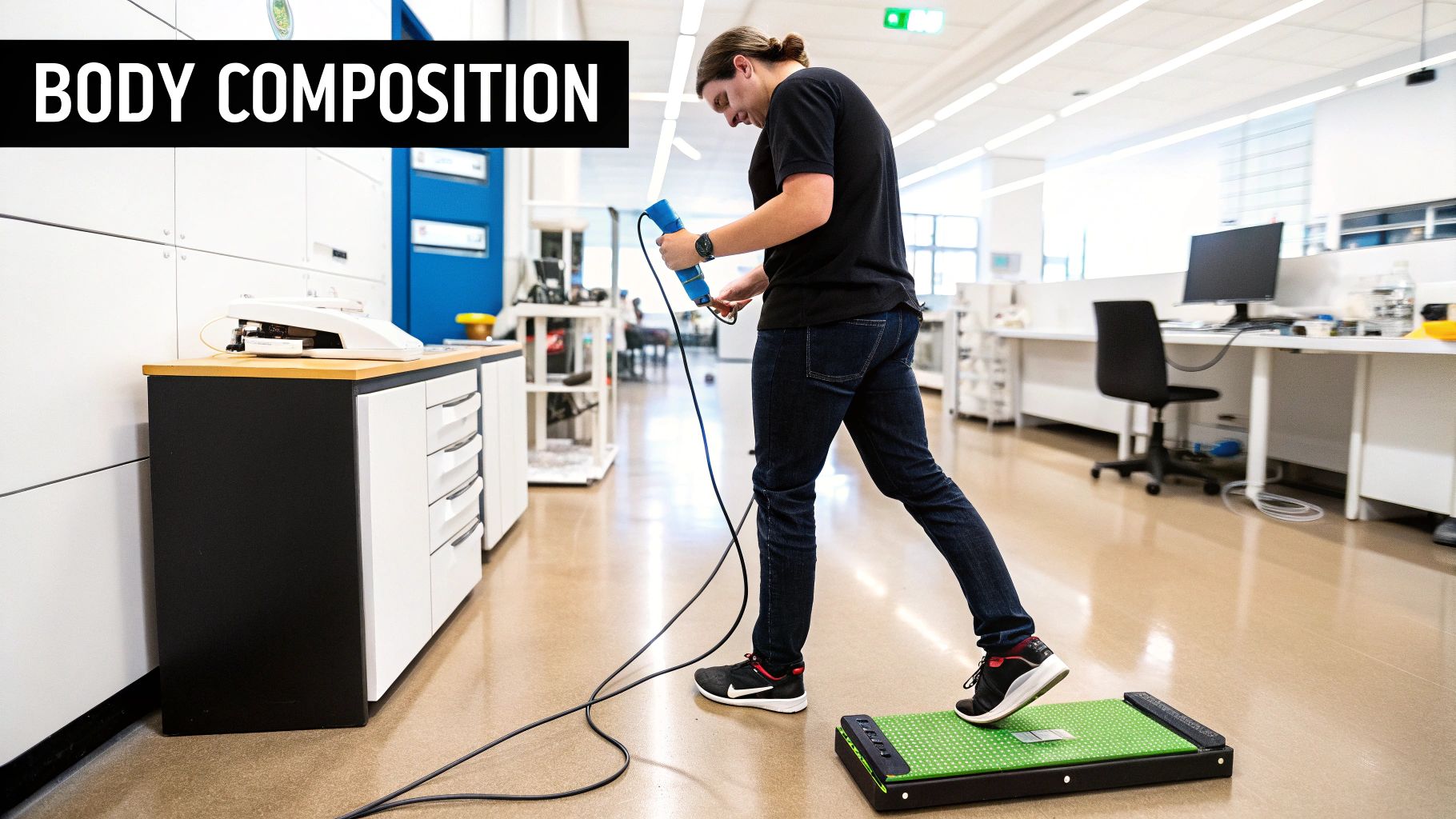
Think of it like this: the electrical current is a car, and your body is a road system.
Water is a fantastic conductor of electricity. Since your muscles, blood vessels, and organs are packed with water, they act like wide-open superhighways. The electrical current—our car—can zip through these tissues with very little resistance, moving quickly from point A to point B.
Body Fat: The Roadblock
On the other hand, fat tissue contains very little water. This makes it a poor conductor, or a great insulator. It essentially acts as a roadblock or a major traffic jam for the electrical signal. This resistance to the current is what we call impedance.
The BIA device measures how much the current is slowed down by these roadblocks. A high level of impedance means the signal encountered a lot of resistance, which points to a higher amount of body fat. Conversely, low impedance suggests the current flowed freely through water-rich lean tissue, indicating more muscle mass.
Key Concept: A BIA test doesn't see fat. It measures electrical resistance (impedance). The device then uses this data, along with personal info like your height, weight, and age, in sophisticated equations to calculate your body composition metrics.
Key Metrics Measured by a Bioimpedance Analysis Test
A BIA test's real power comes from the detailed breakdown of what makes up your weight. This gives you a far more complete picture of your health, fitness progress, and potential risks.
The table below breaks down the essential body composition data you get from a BIA test and why each metric is important for your health and fitness goals.
| Metric Measured | What It Tells You | Why It Matters for Health |
|---|---|---|
| Body Fat Percentage | The proportion of your total weight that is composed of fat tissue. | A key indicator of metabolic health; high levels are linked to an increased risk of chronic diseases. |
| Skeletal Muscle Mass | The total weight of the muscles attached to your skeleton. | Crucial for strength, mobility, and metabolic rate. More muscle burns more calories, even at rest. |
| Total Body Water | The total amount of fluid in the body (both inside and outside of cells). | Essential for proper hydration, cellular function, and nutrient transport. |
| Visceral Fat Level | An estimate of the fat stored deep within your abdominal cavity, around your organs. | This "hidden" fat is a major risk factor for conditions like heart disease and type 2 diabetes. |
| Basal Metabolic Rate (BMR) | The minimum number of calories your body needs to function at complete rest. | Heavily influenced by your muscle mass, BMR helps you set accurate calorie targets for weight management. |
Ultimately, this detailed information allows you to track meaningful changes with precision. You can finally confirm that your hard work is leading to fat loss, not just a loss of water or precious muscle. It transforms your health journey from a guessing game into a data-driven strategy.
How BIA Actually Sees Inside Your Body
So, how does a bioimpedance test turn a simple, harmless electrical signal into a detailed report about your body composition? It’s not magic, but it is clever science. It all comes down to two key principles: resistance and reactance.
Think of the electrical current as a tiny messenger traveling through your body. Resistance is how much your body's water content pushes back against that messenger. Tissues that are packed with water, like your muscles, create very little resistance, so the current flows through them easily.
Reactance, on the other hand, is a different kind of hurdle. This happens when the current bumps into a cell membrane. Every one of your cells acts like a tiny battery, momentarily holding on to the electrical charge before letting it go. Healthy, strong cell membranes put up a good fight, creating more reactance. This tells us a lot about the integrity of your cells.
The combination of resistance and reactance gives us a value called impedance—the total opposition the current encounters. By measuring these two components with incredible precision, a BIA device starts to build a detailed picture of what’s happening inside you.
This chart helps visualize how it all fits together.
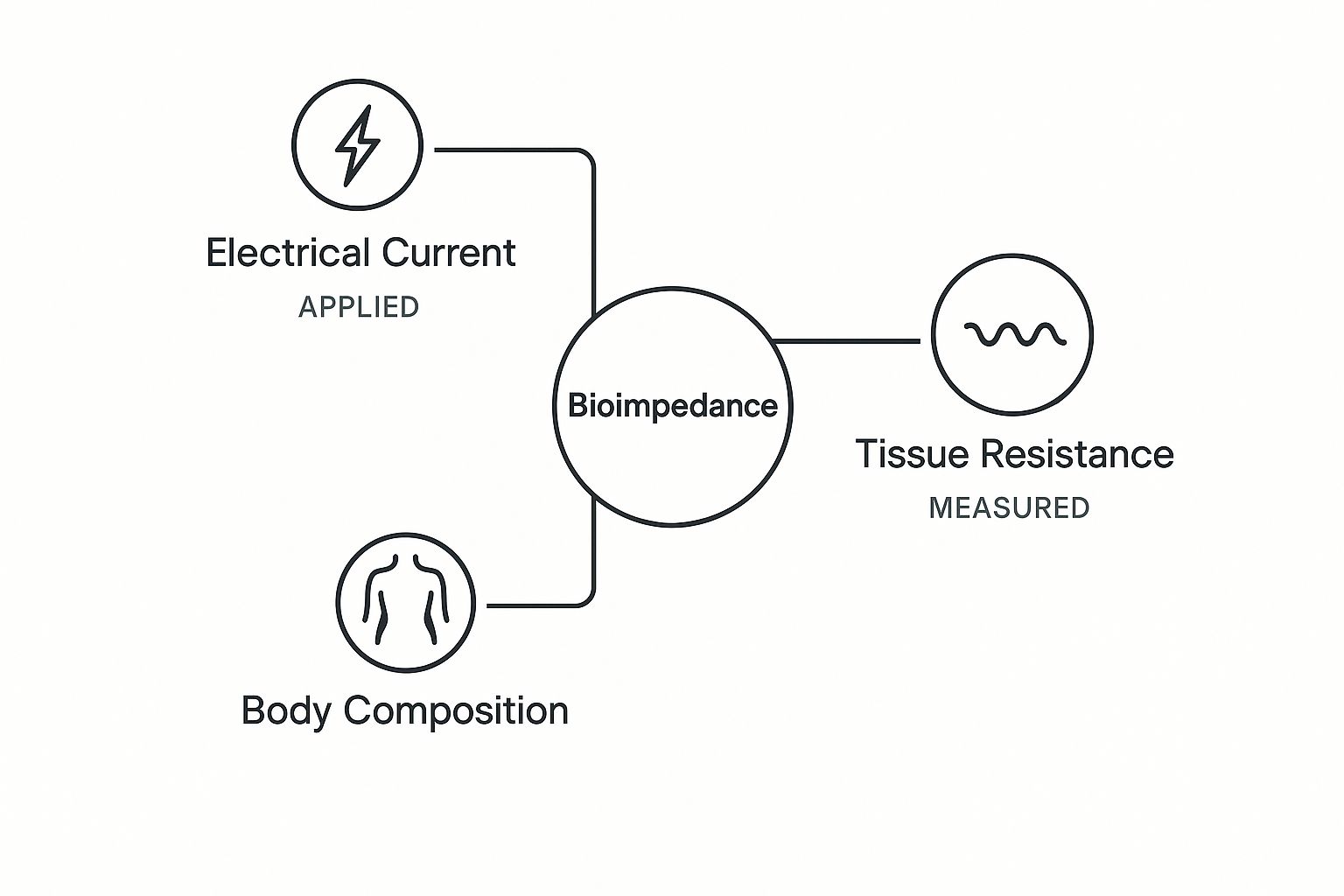
As you can see, impedance isn't just one simple number. It's a rich combination of how your tissues resist and react, which is the key to unlocking your body composition data.
Single-Frequency vs. Multi-Frequency BIA: What’s the Difference?
Not all BIA devices are created equal. The biggest difference between them is the number of electrical frequencies they use, which directly affects how deep and accurate the results are. It’s like the difference between a simple flashlight and a medical-grade MRI.
A single-frequency BIA device uses just one low-frequency current. Because the current is low-powered, it mostly just skims the surface, traveling through the water outside of your cells. While it can give you a decent ballpark estimate of your body composition, the view it provides is pretty limited.
A single-frequency test is a basic snapshot. It's fine for general wellness tracking but doesn't have the granular detail needed for clinical diagnoses or optimizing athletic performance.
This is where a multi-frequency BIA device changes the game. It uses a range of currents, from low to high frequencies. The low frequencies measure the water outside your cells, just like the simpler devices. But the high-frequency currents are strong enough to pass straight through your cell membranes.
This powerful capability allows the device to separately measure:
- Extracellular Water (ECW): The water found outside your cells.
- Intracellular Water (ICW): The water held inside your cells.
Getting both of these measurements is a huge deal. The ratio between ECW and ICW can reveal critical information about cellular health, inflammation, and fluid imbalances—data that is absolutely vital in both medical and high-performance sports settings.
Why More Frequencies Give You a Clearer Picture
The ability to tell the difference between water inside and outside your cells is what separates a basic estimation tool from a sophisticated diagnostic instrument. It's why both clinical and fitness professionals are increasingly choosing this more advanced technology.
The numbers back this up. The multi-frequency BIA segment held a 52.1% market share in 2023, showing a clear demand for greater precision. What’s more, 63.2% of the market is focused on segmental BIA—devices that measure each arm, leg, and the trunk separately. This highlights a growing need for detailed, regional data. If you're interested, you can explore more about these market trends and what they mean for the future of health tech.
Ultimately, these devices do more than just measure raw impedance. They feed that electrical data—along with your height, weight, age, and sex—into complex, scientifically-backed equations. This is how they translate simple physics into the meaningful numbers you see on your report, like fat-free mass and total body water. It’s a powerful blend of physiology and technology that gives you a clear window into your health.
How to Prepare for Your BIA Test to Ensure Accuracy
Getting an accurate bioimpedance analysis isn't just about using a high-quality machine. The real secret? Your physical state at the moment you step on the device. Think of your body as the environment for a sensitive scientific experiment; if the conditions aren't stable and controlled, the results won't be reliable.
The reason for this is simple: BIA technology is incredibly sensitive to your body's hydration. The test works by sending a tiny, safe electrical current through your body and measuring the opposition it encounters. Since muscle is rich in water and a great conductor, while fat is low in water and a poor conductor, your hydration level directly impacts the reading.
For instance, if you're dehydrated after a tough workout, the current faces more resistance. The machine misinterprets this as you having more body fat than you actually do. Following a strict, repeatable pre-test routine is the single most important thing you can do to avoid these misleading fluctuations and get a true picture of your body composition.
Your Pre-Test Checklist for Accurate Results
To get data you can truly count on, consistency is everything. The goal is to make the conditions for each test as identical as possible. This consistency transforms your BIA results from a random snapshot into a powerful progress-tracking tool.
For a deeper dive into the specifics, our complete guide on how to prepare for your BIA test to ensure accuracy provides even more detail.
Before every single test, follow these steps:
- No Strenuous Exercise: Avoid any intense physical activity for a minimum of 12-24 hours beforehand. A hard workout causes you to lose fluid through sweat and can shift water distribution in your body, throwing off the results.
- Fast Before the Test: Don't eat or drink anything for at least 3-4 hours before your measurement. Food and liquids in your digestive system can interfere with the electrical signal's path.
- Skip the Caffeine and Alcohol: Stay away from alcohol for at least 24 hours and caffeine for at least 12 hours before your test. Both are diuretics, which means they make you lose water. This can lead to a state of dehydration that artificially inflates your body fat reading.
- Hydrate Normally: While you need to fast immediately before the test, make sure you maintain your normal, healthy water intake in the days leading up to it. Don't try to "water-load" or deliberately dehydrate—just be normal.
Other Important Factors to Control
Beyond what you eat, drink, and do, a few other variables can influence your BIA reading. Getting these right is just as crucial for achieving that test-to-test consistency.
Key Takeaway: The whole point of preparing for a BIA test isn't to get a "good" number, but to establish a stable baseline. By standardizing your routine, you ensure that the changes you see over time are real, not just noise from a bad measurement.
- Stand Still: Before you step on the device, stand up straight and remain still for about 5 minutes. This simple step helps your body water settle and distribute evenly.
- Test at the Same Time: Your body’s hydration has a natural daily rhythm. Testing at the same time every session—like first thing in the morning after using the bathroom—is a great way to eliminate this variable.
- No Lotions or Ointments: Avoid applying any creams or lotions to your hands and feet before the test. They can create a barrier on your skin and interfere with the electrodes' ability to get a clean reading.
- Medical Considerations: The test is not suitable for anyone with an implanted electronic medical device, such as a pacemaker. It is also not recommended during pregnancy.
By checking off these boxes every time, you can have confidence that the data you're collecting is as accurate and actionable as possible.
Decoding Your Bioimpedance Analysis Results
https://www.youtube.com/embed/vTcUS3qCLSU
Getting your first Bioimpedance Analysis report can feel a bit overwhelming. You’re handed a page full of numbers, charts, and terms that look like they belong in a science textbook. It's easy to feel lost in the data.
But think of that report less like a final grade and more like a detailed, personalized roadmap. It gives you an honest look under the hood at your body’s inner workings. Once you learn to speak its language, you can turn those numbers into your most powerful tool for getting healthier and stronger.
The Core Metrics: Beyond Just Your Weight
A BIA report blows a standard bathroom scale out of the water. While different devices from brands like InBody or SECA might present the data a bit differently, they all hinge on a few core metrics that paint the big picture of your body composition.
Let's break down the essentials you'll almost always see.
Body Fat Percentage (BFP): This is the single most important number for most people. It tells you exactly what proportion of your total weight is actual fat tissue. It’s a much more accurate indicator of your health status than BMI, which can't tell the difference between a pound of muscle and a pound of fat.
Skeletal Muscle Mass (SMM): This is the good stuff—the weight of the muscles attached to your skeleton. These are the muscles you can actually grow and strengthen through your workouts. SMM is your body's metabolic engine; the more you have, the more calories you burn, even when you're just sitting on the couch.
Total Body Water (TBW): This number represents every drop of fluid in your body, both inside your cells (intracellular) and outside (extracellular). Being properly hydrated is non-negotiable for everything from delivering nutrients to your muscles to regulating your body temperature.
These three metrics give you the foundational snapshot of what you're made of. Watching them change over time is how you'll know for sure if your nutrition and workout plan is actually working.
Digging Deeper: The Health Risks You Can't See
A quality BIA test doesn't just stop at fat and muscle. It shines a light on specific health markers that are completely invisible from the outside. Two of the most critical are your visceral fat and metabolic rate.
Key Insight: It's not just about how much body fat you have, but where you store it. A BIA test is one of the only accessible ways to see this "hidden" and potentially dangerous fat.
Visceral Fat Level is arguably the most critical number on your entire report. This isn’t the fat you can pinch on your stomach (that's subcutaneous fat). This is the dangerous stuff, packed deep inside your abdomen and wrapped around your vital organs like the liver, pancreas, and intestines. High levels are directly linked to serious problems like heart disease, type 2 diabetes, and chronic inflammation. This number is your early warning system.
Your Basal Metabolic Rate (BMR) tells you how many calories your body needs just to stay alive—to keep your heart beating, lungs breathing, and brain functioning while at rest. Your skeletal muscle mass is the biggest factor here. The higher your BMR, the more efficient your body is at burning energy, giving you a huge advantage in managing your weight.
Putting It All Together with Segmental Analysis
Many of the best BIA devices also give you a Segmental Lean Analysis. This is an incredibly cool feature that breaks down your muscle mass by individual body part: right arm, left arm, torso, right leg, and left leg.
Why does this matter? It’s perfect for spotting imbalances. Your report might reveal that your right leg is much stronger than your left, or that your upper body is lagging way behind your legs. Armed with this knowledge, you can tweak your workouts with specific exercises to bring up weak points, leading to better overall strength and a lower risk of injury.
To help you get started, here's a quick guide to understanding the key outputs from your BIA report. This table breaks down what the numbers mean and what you can do about them.
Interpreting Common BIA Metrics and Healthy Ranges
A reference guide to understanding the key outputs of your BIA report, including typical healthy ranges and what they signify for your wellness journey.
| BIA Metric | What It Measures | General Healthy Range (Example) | Actionable Insight |
|---|---|---|---|
| Body Fat % | The percentage of your body that is fat tissue. | Men: 10-20% Women: 18-28% | Combine smart nutrition with consistent exercise to bring this number into the healthy zone. |
| Skeletal Muscle Mass | The total weight of your skeletal muscles. | Varies greatly. Look for upward trends over time. | Prioritize resistance training and eat enough protein to maintain or, ideally, increase this number. |
| Visceral Fat Level | The "hidden" fat surrounding your internal organs. | A score below 10 is generally considered healthy. | Cut back on processed foods and sugar; make regular cardio exercise a non-negotiable habit. |
| BMR | Your baseline daily calorie needs at rest. | Based on your muscle mass and body size. | Use this as your starting point to calculate calorie targets for fat loss, maintenance, or muscle gain. |
Ultimately, your BIA report isn't a final judgment; it's a starting point. It provides the objective, unemotional data you need to set smarter goals, see what's really working, and make the day-to-day decisions that will build a healthier, stronger you.
Real-World Applications in Fitness and Medicine
So, what does a bioimpedance analysis test actually do for people? Beyond the printout of numbers and charts, BIA is a genuinely practical tool that’s making a real difference in both medicine and fitness. It gives professionals objective data to fine-tune their strategies, prove that their programs are working, and ultimately improve the health of their patients and clients. This technology has grown from a niche assessment into a cornerstone of many professional practices.
In a clinical setting, BIA acts as a non-invasive window into a patient’s body, revealing critical information that a simple scale could never provide. This detailed insight helps doctors manage complex health conditions with far more precision.
This isn't just a niche tool anymore. The global market for bioimpedance devices is expected to jump from around USD 694.1 million in 2025 to roughly USD 1,369.7 million by 2035. This incredible growth is happening because demanding fields like nephrology and oncology are relying on it more and more. You can dig deeper into what's driving this expansion in this detailed market analysis from futuremarketinsights.com.
Clinical Uses for Managing Chronic Conditions
In a hospital or clinic, a bioimpedance analysis test is all about tracking subtle but vital changes inside the body. This data is priceless for managing chronic diseases where things like fluid balance and nutritional status are make-or-break factors.
Take kidney specialists (nephrologists), for example. One of their biggest challenges is figuring out a dialysis patient's ideal "dry weight"—their true weight without any excess fluid buildup. A BIA test helps them zero in on this target by accurately measuring body water levels, which leads to safer and more effective dialysis treatments.
In oncology, the battle is often to preserve muscle mass during grueling cancer treatments. A condition called cachexia, or severe muscle wasting, can tank a patient's strength and their ability to tolerate therapy. BIA gives oncologists and dietitians a powerful way to fight back by:
- Tracking Skeletal Muscle Mass: Catching the early signs of muscle loss means they can intervene quickly with nutritional support and physical therapy.
- Assessing Cellular Health: Watching for shifts in reactance and phase angle can signal changes in cellular integrity and overall nourishment.
- Monitoring Fluid Status: It helps manage side effects like lymphedema, a common and uncomfortable swelling caused by some cancer treatments.
Key Application: For both dialysis and cancer patients, BIA shifts the entire focus. It's no longer just about maintaining weight; it's about preserving essential lean tissue and managing fluid. This approach is directly tied to better health outcomes and a higher quality of life.
Powering Performance in Fitness and Athletics
In the fitness world, the bathroom scale can be incredibly misleading. A client might be training hard and eating right, only to see the number on the scale refuse to budge. This is often because they're losing fat while gaining dense, healthy muscle—a huge win that the scale completely ignores.
This is exactly where a BIA test becomes a personal trainer's best friend. It elevates the conversation beyond simple weight to what really matters: body composition. You can learn more by checking out our guide to different body composition assessment methods.
Top-tier trainers and nutritionists use BIA scans to:
- Prove a Program Works: Is a client's workout routine actually building muscle and burning fat? A segmental analysis can even show if specific body parts are responding like they should.
- Keep Clients Motivated: Nothing fuels motivation like seeing tangible proof of muscle gain or a drop in dangerous visceral fat, especially when the scale isn't cooperating.
- Personalize Nutrition Plans: By knowing a client’s Basal Metabolic Rate (BMR) and how much muscle they have, a nutritionist can craft a highly targeted and effective meal plan.
- Spot and Correct Imbalances: A segmental lean analysis can highlight when one arm or leg is stronger than the other, allowing trainers to program corrective exercises to prevent injury and build functional strength.
At the end of the day, whether it’s in a high-stakes clinical setting or a goal-driven gym, the bioimpedance analysis test delivers the hard data needed to make smart, effective decisions. It turns health management from a guessing game into a data-driven strategy for success.
BIA Accuracy and Common Misconceptions
To get the most out of any tool, you have to know its strengths and its limitations. A bioimpedance analysis test is a fantastic instrument for tracking changes in body composition, but it’s vital to have a realistic grasp of its accuracy and what the numbers really mean.

One of the first questions people ask is how BIA stacks up against a DEXA (Dual-Energy X-ray Absorptiometry) scan. In clinical circles, DEXA is often called the 'gold standard' for measuring body composition because it's incredibly precise. While a top-tier, multi-frequency BIA device can deliver results that line up very closely with DEXA, it's important to remember they aren't the same thing.
Think of BIA as a highly sophisticated estimation tool. Its results come from electrical measurements, and like any sensitive reading, they can be nudged by a few real-world factors.
Factors That Influence BIA Accuracy
The key to getting reliable BIA results is consistency. Just like a delicate science experiment needs a controlled environment, a BIA test requires stable conditions to give you data you can trust.
Here are the biggest things that can affect accuracy:
- Hydration Status: This is, without a doubt, the most critical factor. If you're dehydrated, the electrical current faces more resistance, which can make your body fat reading look artificially high. On the flip side, being over-hydrated can skew the numbers the other way.
- Meal and Drink Timing: Having a recent meal or a large drink in your system can interfere with the electrical signal and temporarily throw off your results. This is exactly why it's so important to fast before a test.
- Recent Exercise: A tough workout session can shift fluids around your body and leave you a bit dehydrated. Both of these effects will impact the accuracy of the reading.
- Device Quality: Not all BIA machines are created equal. Medical-grade, multi-frequency devices that use segmental analysis are in a completely different league of precision compared to your average at-home smart scale.
We dive much deeper into these variables in our guide to bioelectrical impedance analysis accuracy.
Debunking a Common Myth
One of the biggest mistakes people make is treating a single BIA reading as the absolute truth. Yes, one test gives you a valuable baseline, but the real power of BIA is revealed when you track your progress over time.
A single BIA test is a snapshot. A series of tests taken under consistent conditions is a motion picture, revealing the direction your health is heading.
Obsessing over one specific number is a recipe for frustration. Your body composition naturally has minor fluctuations day-to-day. What you should really focus on is the trend. Is your skeletal muscle mass creeping up over several months? Is your visceral fat level consistently going down?
This long-term perspective is what truly matters. It helps you make smart, informed decisions about your training and nutrition. It changes the bioimpedance analysis test from a simple measurement into a personal guidance system for your entire health journey.
Answering Your Questions About BIA Testing
If you're thinking about adding bioimpedance analysis to your routine, you probably have a few questions. It's a powerful tool, but it helps to know the ins and outs. Let's tackle some of the most common ones so you can get the most out of your tests.
How Often Should I Get Tested?
When it comes to tracking your progress, consistency beats frequency every time. For most people trying to lose fat or build muscle, getting a bioimpedance analysis test every 4 to 8 weeks hits the sweet spot.
This gives your body enough time to make real, measurable changes, but it's still frequent enough to keep you on track and adjust your plan if needed. The most important rule? Test under the exact same conditions every single time. That means the same time of day, similar hydration levels, and following all the pre-test steps. This is how you get data you can actually trust and compare.
Is the BIA Test Safe for Everyone?
For almost everyone, yes. The tiny electrical current used in a BIA test is so low that you won't even feel it, and it's perfectly safe. However, because it involves an electrical signal, there are a couple of important exceptions.
You should not use a BIA device if you have:
- An implanted electronic medical device, like a pacemaker or defibrillator.
- Any other electronic life-support systems.
Also, as a standard precaution, it's typically advised that you avoid the test during pregnancy. If you have any doubts or concerns, it's always best to chat with your doctor first.
How Does BIA Stack Up Against a DEXA Scan?
This is a great question, and one we get all the time. DEXA (Dual-Energy X-ray Absorptiometry) scans are often called the "gold standard" in body composition analysis because they are incredibly precise. But that precision comes at a cost—DEXA scans are expensive, you have to go to a special clinic, and they expose you to a small amount of radiation.
Key Comparison: Think of it this way: a DEXA scan is like a highly detailed, professional photograph you might get once or twice a year. A BIA test is like a reliable progress video, capturing the trends and changes over time that truly guide your journey.
A quality, multi-frequency BIA test is an excellent, practical alternative. It delivers fantastic accuracy for tracking your progress and is far more accessible and affordable. For the real-world purpose of monitoring your health and fitness regularly, BIA is an incredibly effective tool.
Ready to move beyond the scale and get a true picture of your body composition? Cartwright Fitness offers professional-grade bioimpedance analysis equipment to help you and your clients achieve data-driven results. Explore our validated BIA testing solutions and see what a difference accurate tracking can make.