

For any professional in health, fitness, or clinical practice, the best monitoring devices are rarely the ones you see advertised on TV. They aren't consumer gadgets; they are validated, high-precision tools designed to meet specific goals. Finding the right solution means looking past the flashy features and focusing on one thing above all: proven accuracy.
Choosing the Right Health Monitoring Devices for Your Practice
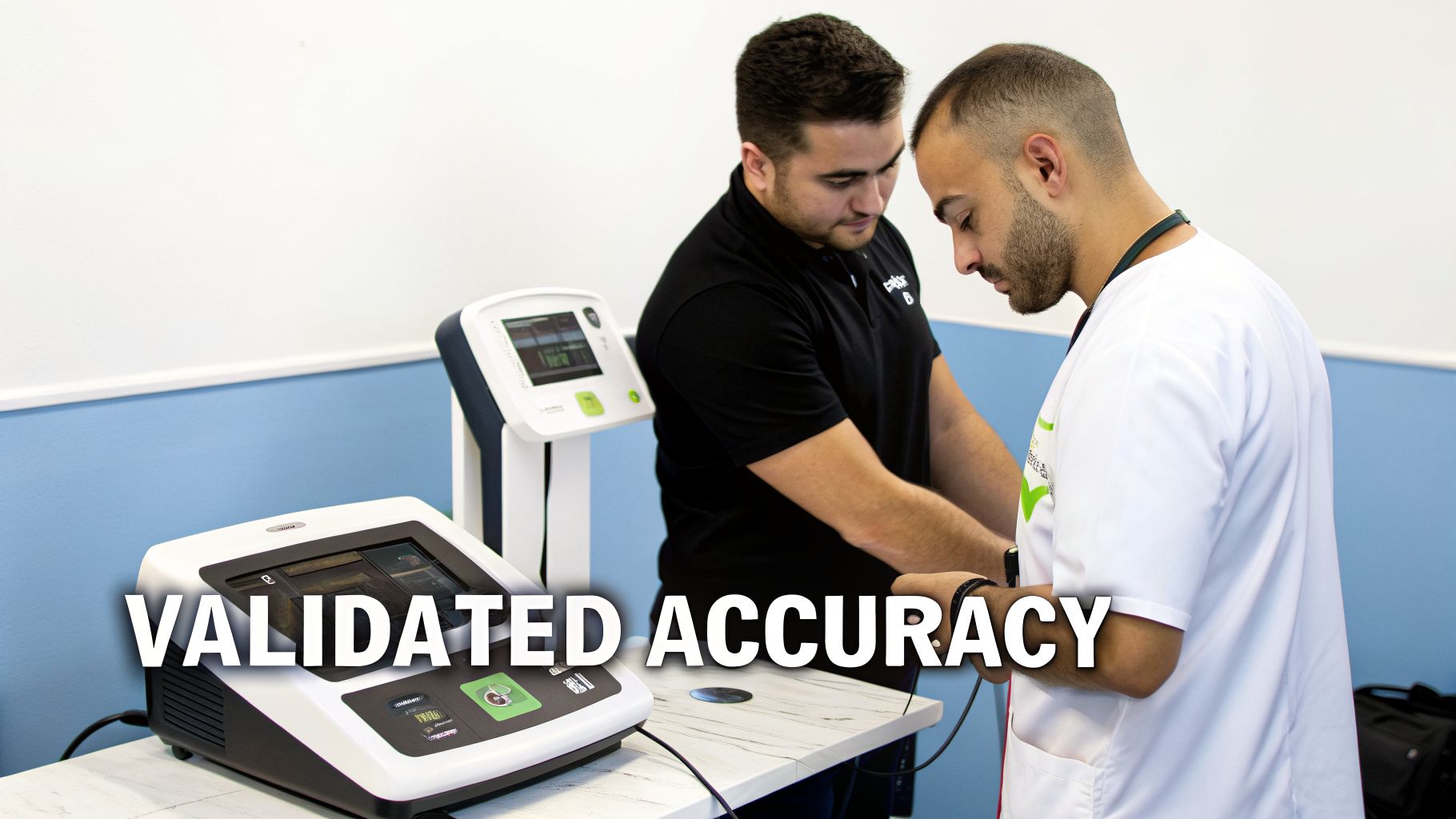
When you search for the “best health monitoring devices,” you’re immediately flooded with smartwatches and fitness trackers. But for a physiotherapist, sports scientist, or clinical researcher, the word "best" means something entirely different. The focus shifts from simply counting steps to capturing data you can confidently stake your professional reputation on.
Think about it like a master chef choosing their knives. A pastry chef needs a delicate, offset spatula, while a butcher relies on a heavy-duty cleaver. They are both cutting tools, but you'd never swap them. In the same way, the equipment a physiotherapist uses for a patient’s respiratory recovery is worlds apart from what a performance coach needs to measure an athlete's body composition.
The Critical Role of Validated Accuracy
For any professional, the most important factor is validated accuracy. This isn't just a marketing term. It means the device has been scientifically tested against a "gold standard" to prove its measurements are both precise and repeatable, time after time.
A consumer wearable might give you a ballpark estimate, but a validated device from a trusted brand like Cosmed or Seca provides hard evidence. That distinction is everything, because your professional decisions—from building rehab programs to designing elite training regimens—are only as good as the data they're built on. Using inaccurate information can lead to ineffective plans or, worse, compromise a client's safety and progress.
For a professional, a health monitoring device isn't just a gadget; it's a scientific instrument. Its value is measured not by a long list of features, but by the confidence you can place in its data.
A Market Driven by Need
The demand for genuinely reliable health monitoring is growing fast. The global digital health monitoring market is projected to climb from $7.75 billion in 2025 to $9.4 billion in 2026. A major reason for this growth is the rising prevalence of chronic conditions, which now affect over 1.9 billion adults worldwide and demand precise, ongoing tracking.
This guide is designed to help you cut through the noise. We’ll walk through the key categories of professional fitness testing equipment and help you match the right tools to your specific needs. By focusing on validated solutions, you can make an informed investment that elevates your practice and delivers better outcomes for your clients.
Understanding Key Types of Health Monitoring Equipment
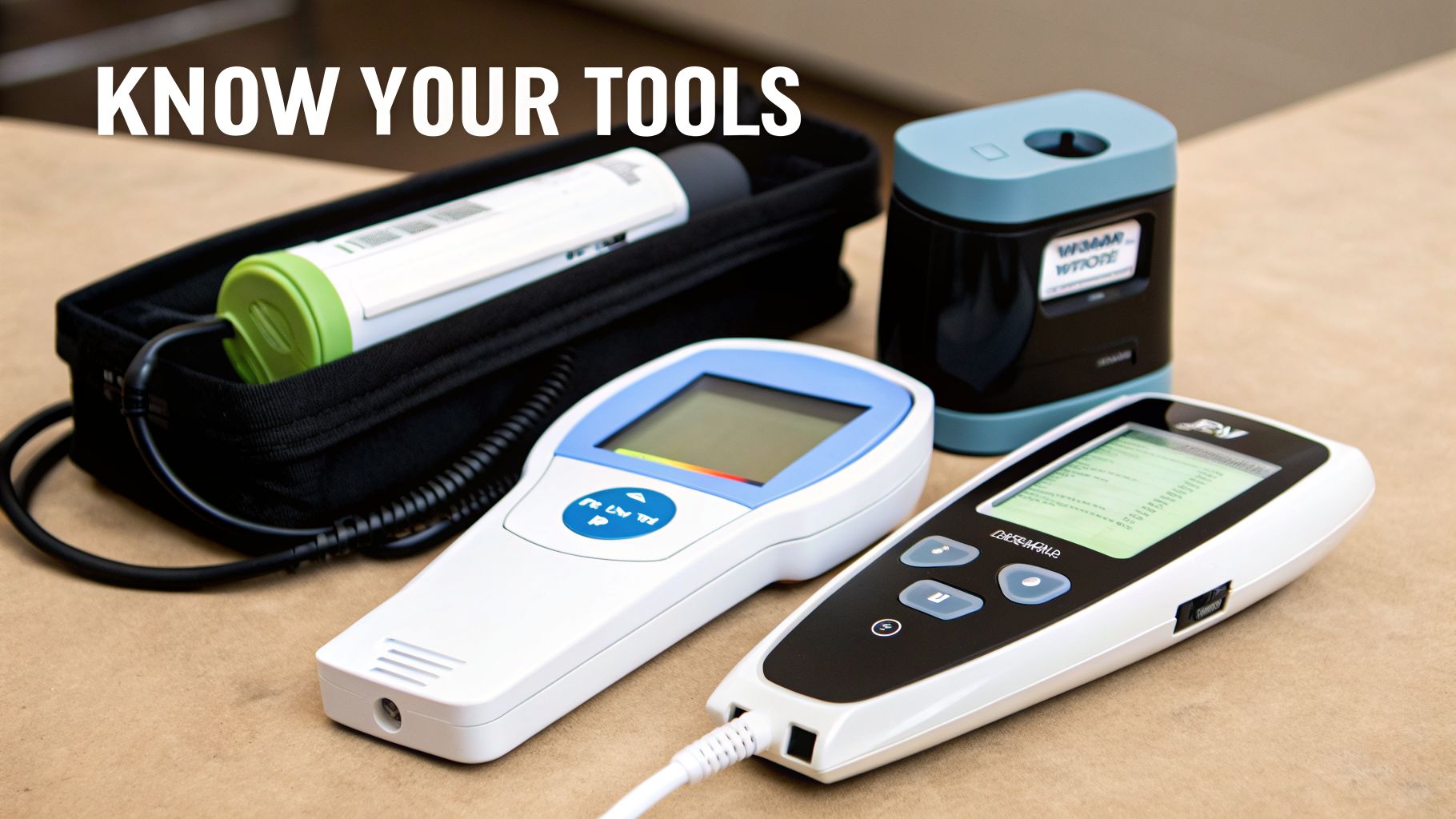
If you're going to invest in professional health monitoring equipment, you need to know what you're looking at. The market is flooded with devices, and to find the right tools for your practice, you have to understand what each category actually does and the kind of data it provides.
Think of it like stepping into a high-performance garage. You’ve got a whole suite of specialized tools, each designed for a specific job. You wouldn't use a wrench to measure engine output. In the same way, understanding a person’s metabolic "engine" or mapping their physical structure requires purpose-built equipment. This is where we go far beyond what any consumer gadget can tell us.
Metabolic Analyzers: The Human Engine Diagnostic
Imagine you’re a mechanic tuning a Formula 1 engine. You wouldn’t just guess based on the sound; you’d plug it into a diagnostic computer to see precisely how it burns fuel, how efficient it is, and where its power peaks. A metabolic analyzer is exactly that, but for the human body.
These devices, often called metabolic carts, measure gas exchange—the amount of oxygen (O2) a person consumes versus the carbon dioxide (CO2) they exhale. From this, we can pull incredibly valuable data about a person's metabolism.
- Resting Metabolic Rate (RMR): This tells you exactly how many calories a person burns at rest. It’s the foundational number you need to build any meaningful weight management or nutrition plan.
- VO2 Max: Widely seen as the gold standard for aerobic fitness, this is the maximum volume of oxygen someone can use during all-out exercise. For athletes, it’s a non-negotiable performance metric.
- Fuel Utilization: By analyzing the ratio of O2 to CO2, these systems can tell you if the body is burning fats or carbohydrates for fuel at different intensities. This is crucial for endurance training and nutrition timing.
For sports scientists, clinical dietitians, and high-performance coaches, metabolic analyzers from brands like Cosmed aren't just useful—they're indispensable. They provide the objective data needed to stop guessing and start strategizing.
Body Composition Analyzers: The Architect's Blueprint
Knowing a building’s total weight tells you almost nothing of value. An architect needs the blueprints to see the breakdown: how much is structural steel, how much is concrete, and so on. A standard bathroom scale is no different; it gives you a single, often misleading number for total body weight.
A body composition analyzer is like the body's blueprint, showing you what that weight is truly made of. It separates fat mass from lean mass (which includes muscle, bone, and water), giving you a far more honest picture of a person's health. We dive deep into choosing the right device in our complete guide to body composition analysis tools.
A change in weight on a standard scale doesn't tell the full story. A client could be losing fat and gaining muscle, yet the scale might not budge. Body composition analysis uncovers this crucial progress.
Professional-grade systems, like the BodyMetrix ultrasound technology, deliver precise measurements that track the real impact of a training or nutrition plan. For personal trainers, nutritionists, and physios, this is how you demonstrate true progress and make intelligent adjustments to your client's programming.
Submaximal Fitness Testing: The Safe Performance Check
Let's be realistic: not every client can or should be pushed through a punishing maximal fitness test. For the general population, older adults, or anyone in rehabilitation, we need a safer way to estimate their aerobic capacity. This is where submaximal fitness testing tools shine.
The Chester Step Test is a perfect example. It’s a simple, progressive stepping protocol performed at a controlled cadence while monitoring heart rate. Because there's a linear relationship between heart rate and exercise intensity, we can use the results to accurately predict a person's VO2 max without ever pushing them to their limit. It's the equivalent of checking a car's engine by driving it at a steady 60 mph instead of redlining it on a racetrack.
Of course, when building out your toolkit, don't forget the fundamentals. Reliable automatic digital blood pressure monitors are essential for getting baseline health data in almost any professional setting. These foundational devices work alongside more specialized equipment to give you a complete and holistic view of your client's health.
Why Validated Accuracy Is Non-Negotiable for Professionals
We're all swimming in health data these days. Smartwatches and fitness trackers have put metrics at our fingertips, making it easy to see daily steps or a resting heart rate. But for any serious professional—a physio, sports scientist, or clinical researcher—most of that consumer-grade data is just noise. The real signal comes from one place: validated accuracy.
What does “validation” actually mean when we’re talking about equipment? Think of it this way: if you were building a house, you wouldn't use a cheap, stretchy tape measure. You’d insist on one that’s been calibrated against a known standard, so you know every centimetre is a true centimetre.
It’s the same principle. A validated device has been put through its paces in a scientific setting, compared directly against a "gold standard" method to prove its measurements are spot-on, consistent, and repeatable. It’s the critical difference between a wild guess and a verifiable fact.
The Risk of Inaccurate Data
In a professional setting, basing your decisions on unvalidated data isn't just sloppy—it's a liability. Picture a personal trainer building a client's entire nutrition plan around the calorie burn estimates from a popular fitness watch. If that watch is off by 20-30%, which is common for consumer wearables, the whole plan is built on a lie.
The client won't get the results they're working for, leading to frustration and a breakdown of trust. In a clinic, the stakes are even higher. A faulty reading could completely misrepresent a patient's recovery, delaying crucial interventions or, in the worst-case scenario, causing actual harm.
Using unvalidated equipment is like navigating a ship with a faulty compass. You might be moving, but you have no reliable way of knowing if you're heading in the right direction. True professional practice demands a precise, trustworthy navigational tool.
The demand for better health management tools is causing the wearable medical device market to explode. Projections show it growing at a staggering 25% CAGR between 2026 and 2031. This growth is driven by the need to manage chronic conditions like diabetes, which now affects 537 million adults worldwide. With adoption for sports and fitness applications alone surging by 40% since 2020, knowing the difference between a consumer gadget and a professional tool has never been more important.
Why Professionals Trust Validated Equipment
This commitment to data integrity is exactly why you'll find validated equipment in any top-tier clinic, research lab, or elite sports facility. They aren’t choosing devices like Cosmed metabolic carts or Seca medical-grade scales for their fancy features; they’re choosing them because you can bet your career on the numbers they produce.
When a university researcher publishes a study using a Cosmed K5, the scientific community accepts the results because the device is a trusted constant. When a physiotherapist tracks a patient's lung function with a validated spirometer, they can make clinical decisions with confidence. To get a better sense of what this involves, you can explore a more detailed explanation of the medical device validation process and see why it’s so vital.
Ultimately, this dedication to accuracy is what builds your professional credibility. It shows clients, patients, and peers that your practice is grounded in scientific rigor, not guesswork.
For any professional, the choice is clear. A device’s true value isn't measured by how many things it tracks, but by how truthful its data is. Choosing validated equipment is a direct investment in reliability, better outcomes, and your own professional reputation.
Matching the Right Device to Your Professional Goals
Knowing the tech behind health monitoring devices is one thing, but knowing precisely which tool to grab for the job—that’s what separates the pros. The most advanced piece of equipment is useless if it doesn't solve a real-world problem. A device that delivers game-changing insights for a sports scientist might be nothing more than an expensive paperweight to a physical therapist.
Let's get practical. The real value comes from connecting a specific professional challenge to the right technological solution. It’s all about making the equipment work for you, not the other way around.
The first question you should always ask is simple: are you collecting data for professional, high-stakes decisions, or for general personal interest? This one question changes everything.
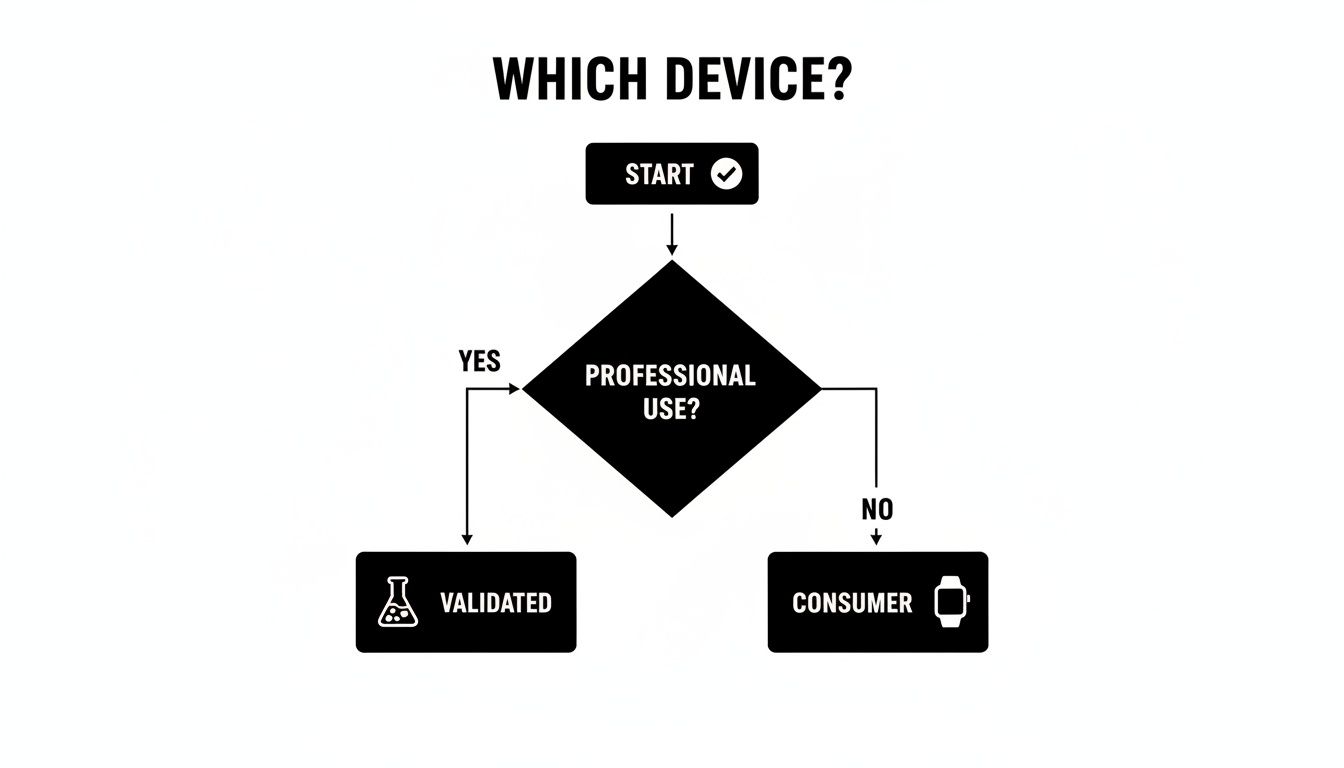
As you can see, the path for any professional immediately veers toward scientifically validated devices. For personal curiosity, a consumer gadget will do. Getting this first step right is the most critical part of the entire selection process.
To illustrate how this works, we've put together a table matching common professional roles with their primary goals and the type of equipment that helps them get there.
Professional Use Case vs Recommended Device Match
| Professional Role | Primary Goal | Recommended Device Type | Cartwright Fitness Solution Example |
|---|---|---|---|
| Physiotherapist | Objectively track a patient's recovery and ensure safe rehabilitation progress. | Respiratory & Metabolic Analysers | Cosmed Fitmate MED |
| Sports Scientist | Measure precise physiological changes and collect publishable, high-integrity data. | Gold-Standard Metabolic Systems | Cosmed K5 |
| Performance Coach | Optimize an athlete's body composition and fitness with minimal training disruption. | Body Composition & Step-Test Tools | BodyMetrix Ultrasound & Chester Step Test Kit |
| Personal Trainer | Demonstrate client progress and set accurate, individualized fitness goals. | Metabolic Analysers & Body Composition Tools | Cosmed Fitmate & BodyMetrix Ultrasound |
This table gives you a quick snapshot, but let's dig into what this looks like day-to-day for a few of these professionals.
For the Physiotherapist in a Rehab Clinic
Imagine a physio guiding a patient back from a serious respiratory illness. "Feeling better" isn't a measurable outcome. They need to quantify the patient's return to functional capacity with cold, hard numbers.
This is where a portable metabolic analyser, like the Cosmed Fitmate MED, becomes the cornerstone of the rehab program. It provides clinical-grade data on key respiratory functions.
- Pinpoint Recovery Milestones: Regular, low-intensity assessments allow the physio to track tangible improvements in lung function and oxygen uptake over weeks or months.
- Establish Safe Exercise Zones: The data is crucial for setting safe intensity thresholds, pushing the patient enough to progress without risking a setback.
- Prove Program Effectiveness: Objective data is powerful proof that the rehabilitation plan is working, which is a huge motivator for the patient and essential for clinical reports.
For the physiotherapist, the device isn't just a measurement tool; it's a compass for charting a safe and effective recovery.
For the Sports Performance Coach
Now, picture a performance coach fine-tuning an elite athlete for competition. The mission here is completely different: it’s about maximizing power, shredding body fat while building muscle, and pushing aerobic limits.
This coach needs a multifaceted approach. A simple scale is worthless when an athlete is simultaneously gaining muscle and losing fat. A tool like the BodyMetrix Ultrasound gives them the required accuracy, showing exact changes in fat thickness at specific sites.
At the same time, the coach needs to track aerobic fitness without running the athlete into the ground with constant max-effort tests. The Chester Step Test offers a validated, sub-maximal way to estimate VO2 max. It’s a reliable and repeatable assessment that confirms the training program is hitting the mark. The right equipment empowers the coach to make the small adjustments that lead to big wins.
For the University Researcher
Finally, consider a sports scientist at a university studying athlete metabolism. For them, the standards are even more demanding. The ultimate goal is to collect data that can survive the rigorous process of peer review.
For a researcher, data is the currency of their profession. If that data is not exportable, clean, and collected with a validated device, it holds no value in the scientific community.
Here, validation and data integrity are everything. The researcher will select a device renowned for its gold-standard accuracy, such as a Cosmed K5 metabolic system. But precision is just the start.
The data must be easily exportable in a raw format (like a .csv file) for analysis in sophisticated statistical software. The device's entire methodology must be bulletproof and defensible. The choice here is driven not by client motivation, but by the uncompromising demands of the scientific method.
The demand for these professional-grade tools is undeniable. North America currently commands the digital health monitoring devices landscape with a 38% market share. This market, valued at $1.53 billion in the U.S. in 2025, is expected to explode to $8.97 billion by 2035, fuelled by widespread adoption in both clinical and performance settings. You can explore these trends in the full digital health market report.
Integrating New Devices into Your Workflow
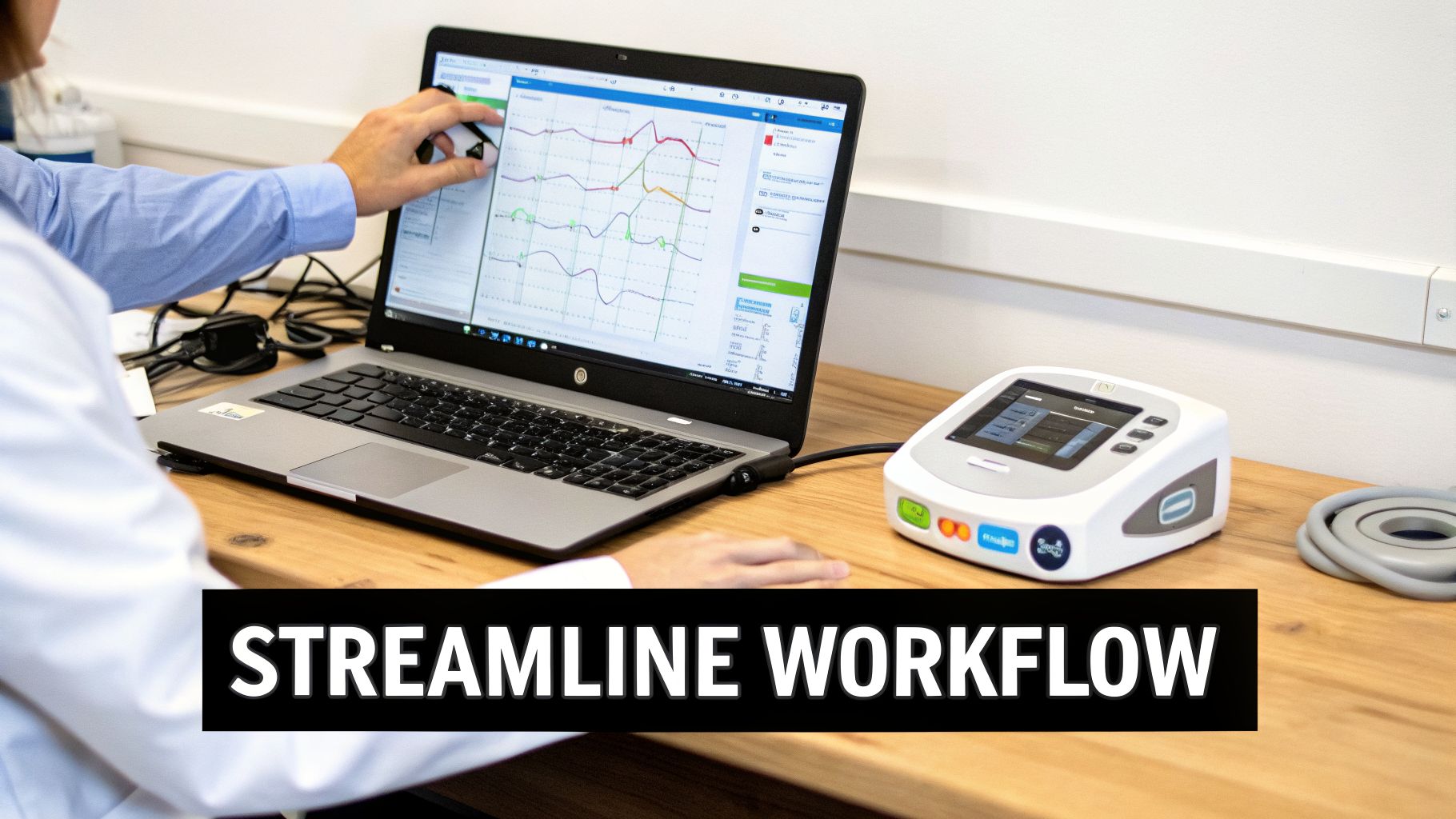
Getting a high-precision health monitoring device in the door is exciting, but it’s only step one. The real payoff doesn't come on the day of purchase, but over months and years of consistent use. How you bring a new tool into your day-to-day operations is what separates a game-changing investment from an expensive dust collector.
This is a hurdle many professionals stumble over. You’ve got this powerful new device, but what do you do with the flood of data it creates? How does a BodyMetrix ultrasound scan or a Cosmed metabolic test find its way into a client’s long-term progress report? The secret is having a clear, efficient data management process right from the start.
From Data Points to Progress Reports
Think of it this way: your new device is like a high-end camera taking incredibly detailed snapshots of a client's health. A single snapshot is interesting, but its true power is revealed when you arrange those shots into an album that tells a compelling story of their journey.
Your goal is to move beyond isolated test results and build a longitudinal view of your client’s progress. This is precisely what professional-grade software, like the kind paired with the BodyMetrix system, is built for. It gives you the ability to:
- Create Detailed Client Profiles: Every assessment gets stored under one client file, building a complete history session after session.
- Track Specific Metrics: You can easily see and show the changes in body fat percentage, muscle mass, or VO2 max over time.
- Generate Professional Reports: Compile the data into clean, visual reports to share with clients, proving the tangible results of their effort.
An organized system ensures that data isn't just collected—it’s actively used to guide your decisions, fine-tune programming, and demonstrate your value. When looking at new devices, understanding how to approach electronic medical records integration is also a critical piece of the puzzle for fitting new health data into your practice's existing ecosystem.
The Importance of Ongoing Support and Training
Let’s be honest—sophisticated equipment comes with a learning curve. You can’t just unbox a clinical-grade metabolic cart and expect to be an expert by lunchtime. This is exactly why the relationship you have with your supplier is every bit as important as the hardware itself.
Purchasing professional equipment should be the start of a relationship, not the end of a transaction. Access to product experts and tailored training transforms a piece of hardware into a fully integrated solution.
When you work with a dedicated provider like Cartwright Fitness, you’re never going it alone. You get a direct line to in-house specialists who can answer your questions, walk you through issues, and provide the specific training you need. This support makes sure you and your team feel confident and competent enough to use the equipment to its full potential.
A well-defined process for testing and data entry does more than just keep you organized. It gives you back your most precious asset: time. Instead of wrestling with software or fumbling through assessments, you can execute your protocols efficiently and professionally.
That efficiency translates directly into more face-to-face time with your clients—analyzing their results, explaining what the numbers mean, and building the strong relationships that are the true foundation of your practice. It elevates your entire operation, making it more credible, effective, and focused on the people you serve.
Wrapping It Up: Choosing the Right Tools for Your Practice
Choosing the right health monitoring device is a major decision. It’s not just an investment in a piece of hardware; it’s an investment in your credibility and the results you deliver for your clients. We've covered a lot of ground, from different types of equipment to how to match them to your specific work.
At the end of the day, it all comes down to one core principle: always prioritize validated accuracy over a long list of shiny but unproven features. Good data is the bedrock of any serious health, fitness, or clinical practice. The right tools allow you to stop guessing and start delivering precise, data-driven outcomes that build trust and get results.
What's the Next Step?
We get it—sifting through metabolic analysers, body composition scales, and fitness testing kits can feel overwhelming. Each tool has its own strengths, and the best one for a high-performance sports lab might be totally different from what a clinical dietitian needs. Finding that perfect fit is what makes all the difference.
If you want to talk through your specific situation, the in-house experts at Cartwright Fitness are here to help. They can offer personalized advice to cut through the noise and help you land on a device that truly fits your workflow and professional standards.
Investing in the right equipment is about more than the technology. You're also choosing a partner for your professional journey. The support, training, and expertise that come with your purchase are just as valuable as the device itself.
Ultimately, the goal is to find tools that give you accurate data and fit smoothly into your day-to-day work. This frees you up to do what you do best: helping your clients and patients reach their goals. Making a smart choice today lays the foundation for a more impactful and successful practice for years to come.
Your Top Questions About Health Monitoring Devices, Answered
When you're investing in professional-grade health monitoring equipment, you're bound to have a few questions. We get it. Here are some of the most common queries we hear from fitness professionals, clinicians, and researchers, along with our straight-to-the-point answers.
How Do I Keep My Devices Accurate Over the Long Haul?
This is a fantastic question, and the answer is all about routine care and calibration. Think of your precision equipment like a finely tuned sports car—it needs regular servicing to perform at its best.
Day-to-day, this means simple things: cleaning the device exactly as the manufacturer recommends and storing it somewhere safe, away from dust and potential bumps. But the real key to long-term reliability is periodic calibration.
Over time, sensors can drift slightly. Calibration is the process of resetting your device against a known, perfect standard to correct this. We strongly advise following the manufacturer's schedule for this. At Cartwright Fitness, our team can either walk you through the process or handle the servicing for you to ensure your data stays trustworthy year after year.
What’s the Real Difference Between a Submaximal and Maximal Fitness Test?
Knowing when to use each type of test is crucial for getting the right data safely. The main difference is simple: how hard you're asking your client to work.
A maximal fitness test, like a classic VO2 max test, is an all-out effort. The goal is to push an individual to their absolute physical breaking point. It's the gold standard for measuring aerobic capacity, but it's incredibly intense and really only appropriate for elite athletes or clinical subjects under strict supervision.
A submaximal fitness test, on the other hand, is a much more practical and safer option for most people.
The Chester Step Test is a perfect example. It estimates aerobic fitness by seeing how the heart rate responds to a steady, moderate stepping pace. You get valuable data without ever pushing the client to exhaustion.
This approach is ideal for gathering reliable fitness metrics from a wide range of people, from those just starting their fitness journey to participants in a corporate wellness program.
Can I Get Data from Different Devices to Play Nicely on One Platform?
Ah, the data integration puzzle. While getting different tools to feed into one central dashboard is the dream, it can quickly become a headache. Many devices simply aren't built to communicate with one another, and manually piecing together spreadsheets is a recipe for errors and wasted time.
The most straightforward path is to invest in systems that come with their own dedicated software designed for exactly this purpose. For instance, the BodyMetrix system has its own platform that effortlessly logs and visualizes body composition changes over time. Likewise, Cosmed devices are backed by powerful software for managing metabolic data.
When you're building out your equipment suite, talking to a specialist can save you a world of frustration. We can help you pick devices that work together, creating a smooth workflow so you can spend less time wrangling data and more time using it to get results for your clients.
At Cartwright Fitness, our experts are here to help you choose, integrate, and maintain the right health monitoring tools for your work. Explore our validated equipment and software solutions and let's build your perfect professional toolkit.


