

If you're looking for the best body composition analyzer, it's easy to get bogged down in the technology and fancy features. Before diving into comparisons, though, let's take a step back and understand why these devices are so much more valuable than your bathroom scale. It’s all about shifting focus from a single, often misleading, number to what your body is actually made of.
Why Body Composition Is a Smarter Health Metric
For decades, we’ve been conditioned to see the number on the scale as the ultimate measure of health. That's a fundamentally flawed approach. A traditional scale can't tell the difference between a pound of fat and a pound of muscle, which means it tells you almost nothing about your real health, fitness progress, or long-term disease risk.
Body composition analysis, on the other hand, gives you a much clearer picture by breaking your weight down into its core components. This is what tells the true story of your physical well-being, moving beyond a simple number to deliver insights you can actually use.
Key Metrics That Matter More Than Weight
Instead of fixating on total pounds, a body composition analyzer measures the specific metrics that genuinely correlate with health outcomes. These are the numbers that really define progress.
- Body Fat Percentage: This shows you how much of your body is made up of fat tissue. Keeping this in a healthy range is one of the best things you can do to lower your risk of cardiovascular disease and metabolic syndrome.
- Skeletal Muscle Mass: Muscle is your metabolic engine—it burns calories even when you're resting. Tracking muscle mass is essential for knowing if your workouts are building strength and boosting your metabolism.
- Visceral Fat: This is the dangerous, hidden fat stored around your vital organs. High levels are directly linked to serious health problems, making it a critical number to watch.
- Total Body Water: Proper hydration impacts everything from your energy levels to brain function. Your total body water should make up 45-65% of your total weight.
When you understand these metrics, you can set much smarter goals. For example, you might lose five pounds on the scale, but a body composition scan could reveal that two of those pounds were precious muscle—a sure sign that your training or nutrition needs a tweak.
The real goal isn't just weight loss; it's body recomposition. You want to decrease fat while preserving or even building muscle. A standard scale can never show you if you're succeeding at that.
The Practical Application in Fitness and Health
With accurate body composition data, you're empowered to make truly informed decisions. It provides the concrete feedback you need to see if your diet and exercise routines are actually working. This is especially true when considering things like the role of personal nutrition coaching, where professionals rely heavily on this data to guide their clients.
This level of detailed insight is precisely what makes a body composition analyzer such an essential tool. It changes your entire approach from guessing to knowing, making sure the effort you put in leads to real, measurable improvements in your health.
Understanding the Tech Behind the Numbers
Before you can pick the right body composition analyzer, you need to get a handle on the science that makes them tick. They aren't all built the same, and the technology inside directly dictates how accurate they are, what they can tell you, and where you'll find them. Think of it as looking under the hood—it’s the first step to making a smart investment.
This image breaks down what we’re actually made of. Advanced analyzers don’t just see weight; they see the individual components—fat, muscle, bone, and water. Different technologies are better at measuring certain parts, so knowing what you want to track is key.
The demand for this kind of detailed insight is exploding. The global market for body composition analyzers hit USD 702.46 million in 2024 and is expected to rocket to USD 1,739.27 million by 2032. This isn't just a niche trend; it shows how critical these tools have become for everything from personal training to serious athletic conditioning. You can dig into the numbers and market drivers in this detailed report.
Bioelectrical Impedance Analysis (BIA)
Chances are, if you've ever stepped on a smart scale, you've used Bioelectrical Impedance Analysis (BIA). It's the most common technology out there, found in everything from home scales to professional-grade handhelds. It works by sending a tiny, completely safe electrical current through your body.
The science is pretty straightforward. The current zips through water-heavy tissues like muscle with ease but slows down when it hits fat, which has very little water. That resistance, or impedance, is measured. The device then plugs that number into an algorithm along with your height, weight, and gender to estimate your body composition.
What to Know About BIA:
- Super Convenient: BIA is quick, non-invasive, and easily accessible, making it the perfect tool for tracking your progress at home.
- Broad Data: Most modern BIA devices provide estimates for body fat percentage, muscle mass, total body water, and even visceral fat.
- Consistency is Crucial: Hydration levels, when you last ate, or if you just worked out can all sway the results. To get reliable data for tracking trends, you have to measure under the same conditions every time.
For anyone who wants to keep a regular eye on their body composition without scheduling a clinic visit, a good BIA device is easily the most practical way to go.
Dual-Energy X-ray Absorptiometry (DEXA)
If you're looking for the gold standard in accuracy, you'll find it with DEXA. A Dual-Energy X-ray Absorptiometry scan uses two low-dose X-ray beams to give you an incredibly precise breakdown of bone mineral, fat mass, and lean tissue.
This isn't just an estimate; it's a direct measurement. DEXA is so precise it can deliver a three-component model of your body, even mapping out exactly where you store fat and muscle—down to each arm, leg, and your torso.
A DEXA scan provides a level of detail that BIA simply can't touch. For elite athletes, researchers, or anyone needing medical-grade accuracy, it’s an indispensable tool.
That said, this level of precision comes at a price. DEXA scans are only done in clinical settings, they cost more than a BIA measurement, and they involve a tiny dose of radiation. This makes them great for periodic, highly accurate check-ins but not for frequent tracking. You can learn more about the different options in our guide to body composition assessment methods.
Air Displacement Plethysmography (Bod Pod)
Another lab-grade method that delivers fantastic accuracy is Air Displacement Plethysmography, famously known by the brand name Bod Pod. It’s that futuristic, egg-shaped pod you might have seen at a university or high-performance gym.
The Bod Pod works by measuring your body density. You simply sit inside the chamber for a few minutes while it measures the amount of air your body displaces. By combining that volume measurement with your scale weight, the system precisely calculates your body density, which it then uses to estimate your body fat and lean mass.
How the Bod Pod Stacks Up:
- Highly Accurate: The results are right up there with hydrostatic (underwater) weighing, but you don't have to get wet.
- Totally Non-Invasive: The process is fast, comfortable, and uses no radiation, so it's safe for anyone to use repeatedly.
- Limited Access: Like DEXA, you won't find a Bod Pod at your local gym. They're typically located in universities, elite training facilities, and research clinics.
The Bod Pod is a brilliant choice for those who want a true, high-accuracy snapshot of their body composition without any X-rays. Ultimately, picking the right analyzer is a balancing act—you have to weigh your need for accuracy against the cost and convenience that actually fit your goals.
Comparing the Top Body Composition Analyzers
Trying to find the right body composition analyzer can feel overwhelming. You’ve got everything from smart scales for your bathroom to clinical-grade machines that look like they belong in a science fiction movie. The truth is, the "best" device really comes down to what you need, what you're willing to spend, and how you plan to use the data.
Let's cut through the noise and look at these analyzers from a practical standpoint. We'll go beyond the marketing buzz and focus on what really matters: accuracy, consistency, the depth of the metrics, and whether it’s a good value for your goals. We'll break down how different technologies serve different people, from home users to professional trainers.
First, to give some context to the numbers you'll be seeing, here's a quick visual guide to healthy body composition ranges.
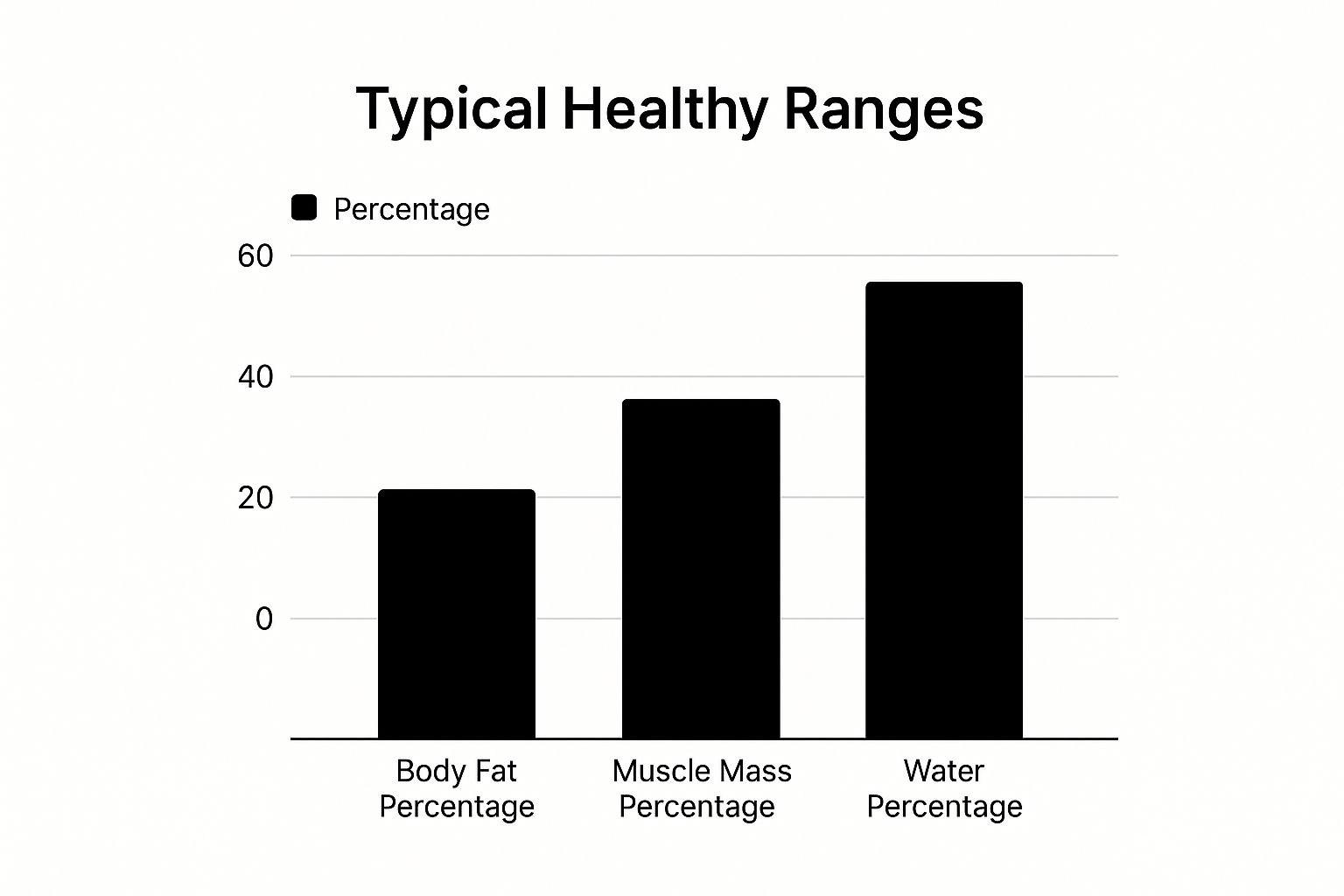
This chart helps you establish a baseline, so when you get your own detailed results, you'll have a better idea of where you stand.
High-End Consumer BIA Scales
If you're a home user who wants to track more than just your weight, a good Bioelectrical Impedance Analysis (BIA) scale is the perfect place to start. These aren't your old-school bathroom scales; they've evolved to offer a whole suite of metrics that paint a much clearer picture of your overall health.
Top-tier models from well-known brands use multi-frequency BIA technology. This just means they send a few different low-level electrical currents through your body to get a more accurate reading. It allows the scale to do a better job distinguishing between things like water and fat, leading to more reliable numbers for skeletal muscle mass, visceral fat, and body water. Their main appeal? Pure convenience. You can get a daily snapshot of your progress without ever leaving the house.
Here’s the key, though: the real power of these scales is in tracking trends over time. A single measurement might not be as precise as a clinical scan, but when you weigh yourself under the same conditions every day—like first thing in the morning—you'll see your progress unfold. You can definitively answer questions like, "Am I actually gaining muscle?" or "Is my visceral fat going down?" That’s where these devices shine.
The Bottom Line: A home BIA scale is all about consistent, frequent feedback. Don't get hung up on one day's numbers. Instead, focus on the big picture—the story your data tells over weeks and months.
Professional-Grade BIA Analyzers
Take a step up from home scales and you’ll find professional-grade BIA devices. These are the workhorses you see in gyms, wellness clinics, and with personal trainers. They often include hand electrodes along with the footplates, which allows for a much more detailed, segmental analysis of the body.
This segmental capability is a game-changer. Instead of just giving you a single whole-body estimate, these machines measure each arm, each leg, and your torso separately. This gives you incredibly granular data on things like muscle imbalances. For an athlete or someone in physical therapy, discovering that one leg is significantly weaker than the other is an invaluable piece of information.
Built for higher accuracy and repeatability, these machines are trusted tools for professionals tracking their clients' progress. They generate detailed reports—either printed or digital—that break down complex metrics like Basal Metabolic Rate (BMR), intracellular vs. extracellular water, and even phase angle, which is a key marker of cellular health. This is the kind of data that helps a fitness pro build and refine truly personalized plans. Many trainers now use a portable body composition analyzer to offer this level of service with the flexibility to work anywhere.
Clinical-Grade Options: DEXA and The Bod Pod
When it comes to pinpoint accuracy, nothing beats the clinical "gold standards": DEXA scans and the Bod Pod. You won't be buying these for your home gym; they're services you find at specialized medical or research facilities.
DEXA (Dual-Energy X-ray Absorptiometry) is the undisputed champion. It directly measures your bone density, fat mass, and lean tissue with unmatched precision. It literally maps out where the fat and muscle are on your body, making it the top choice for elite athletes, scientific researchers, and anyone needing medical-grade data.
The Bod Pod, which uses Air Displacement Plethysmography, is an excellent, non-invasive alternative. You sit inside an egg-shaped chamber while it calculates your body density to determine your body fat percentage. It’s incredibly accurate and a great option for people who prefer to avoid the very low dose of radiation from a DEXA scan.
The trade-off for this level of precision is, of course, cost and convenience. A single scan can be pricey, and you have to book an appointment at a clinic or lab. Because of this, DEXA and Bod Pod scans are best used as periodic benchmarks—maybe once or twice a year—to confirm that the trends you're seeing on your BIA device are on the right track.
Top Body Composition Analyzers Feature Comparison
To make sense of all these options, it helps to see them side-by-side. The table below breaks down the key differences between the types of analyzers we've discussed, highlighting their technology, what they measure, and who they're best for.
| Model | Technology | Key Metrics | Accuracy Level | Price Range | Best For |
|---|---|---|---|---|---|
| High-End BIA Scale | Multi-Frequency BIA | Body Fat %, Muscle Mass, Visceral Fat, Body Water, BMI | Good for trends | $100 – $300 | Home users tracking long-term progress and overall wellness. |
| Professional BIA Analyzer | Segmental Multi-Frequency BIA | Segmental Lean/Fat Analysis, Phase Angle, ECW/TBW Ratio | High | $2,000 – $15,000 | Gyms, trainers, and wellness clinics needing detailed, repeatable client data. |
| DEXA Scan | Dual-Energy X-ray Absorptiometry | Bone Density, Regional Fat/Lean Mass | Gold Standard | $100 – $250 per scan | Elite athletes, researchers, and individuals needing medical-grade precision. |
| Bod Pod | Air Displacement Plethysmography | Body Fat %, Fat-Free Mass, Body Density | Excellent | $50 – $150 per scan | Individuals seeking high accuracy without X-ray exposure; great for all body types. |
This comparison shows that there isn't a single "best" analyzer, but rather a best fit for a specific need. From daily check-ins at home to gold-standard clinical assessments, each technology serves a distinct purpose.
How to Choose the Right Analyzer for Your Goals
Picking the right body composition analyzer isn't about finding the one "best" machine—it's about matching the right tool to your specific goals, budget, and lifestyle. The data a casual user needs to stay motivated is worlds away from what an elite athlete requires to dial in their performance. The key is to be honest about what you're trying to achieve and what information will actually help you get there.

This is a decision more and more people are making. The market for these devices in North America alone was valued at USD 255.80 million in 2025 and is on track to hit over USD 719.51 million by 2033. This boom is driven by a greater focus on health and the growing understanding that measuring fat, muscle, and water is essential for assessing risks for issues like metabolic syndrome. You can learn more about the factors behind this market expansion.
To help you cut through the noise, let's break it down by looking at three common types of users and what they really need.
The Casual Home User
This is someone who wants to track their general health and wellness. They've realized the number on the scale doesn't tell the whole story and are ready to monitor meaningful trends in their body fat and muscle over time. For them, it’s all about motivation and accountability, not clinical-grade precision.
- What they're after: A clear picture of long-term changes in body fat and muscle, confirming their diet and exercise habits are actually working.
- What data matters: Just the core metrics will do. They need reliable numbers for total body fat, skeletal muscle mass, and maybe visceral fat to keep an eye on underlying health risks.
- Budget: Usually under $300.
A high-quality BIA smart scale is the perfect match here. Its real power is in convenience and consistency. While no single reading will be as accurate as a DEXA scan, taking measurements daily or weekly under the same conditions reveals invaluable trends. It’s the ideal tool to stay engaged and see the slow-and-steady rewards of a healthier lifestyle.
The Data-Driven Fitness Enthusiast
This person is serious about their fitness. They’re likely counting macros, following a structured training program, and want granular data to fine-tune their results. They understand that metrics are more than just numbers—they're a roadmap for making smart adjustments to nutrition and workouts.
This user isn't just tracking progress; they're actively managing it. They need an analyzer that provides actionable insights to break through plateaus and perfect their approach.
- What they're after: A deep dive into how their training is affecting their body, including identifying muscle imbalances or tracking changes in cellular health.
- What data matters: They need more than just whole-body numbers. Segmental lean analysis (which measures each arm and leg separately), Basal Metabolic Rate (BMR), and body water balance (the ECW/TBW ratio) are all critical metrics.
- Budget: They're willing to invest, either through professional services or by purchasing a high-end device.
For this enthusiast, a professional-grade, multi-frequency BIA analyzer is the way to go. These are the units you often find in high-end gyms and wellness clinics. For example, the segmental analysis can reveal that your right leg is lagging behind your left in muscle growth, giving you concrete data to adjust your lifting program. For those with the budget, owning a portable professional unit offers the ultimate convenience for frequent, detailed tracking.
The Athlete in Training
For a competitive athlete, body composition is performance. Whether you're a cyclist chasing an optimal power-to-weight ratio or a bodybuilder prepping for a show, every last ounce of muscle and fat counts. For them, accuracy isn't a bonus; it's everything.
- What they're after: Achieving peak physical condition with the help of precise, medical-grade body composition data. These numbers have to be solid enough to base critical training and nutrition decisions on.
- What data matters: Only the gold standard will do. They need exact measurements of regional fat and lean mass, and often bone mineral density to ensure their skeleton is holding up under intense training loads.
- Budget: The focus is on results, not cost. They will regularly invest in clinical-grade assessments to get the most reliable data possible.
In this arena, the DEXA scan is the undisputed champion. It provides the most precise, direct measurement of fat, muscle, and bone available today. An athlete might use a BIA device for weekly check-ins, but they’ll rely on a quarterly DEXA scan as their source of truth—the final word that validates their progress and helps them make definitive adjustments before a competition.
Getting Consistent and Accurate Readings
Having a top-of-the-line body composition analyzer is a great start, but what’s the point if you can’t trust the numbers? Inconsistent readings are more than just frustrating—they can completely derail your motivation and make it impossible to know if you're making real progress.
The secret to reliable data isn't just in the machine itself; it's in how you use it. So much of your daily routine can throw off a reading, especially with devices using Bioelectrical Impedance Analysis (BIA). Things like your hydration level, what you just ate, or if you just finished a workout can dramatically change how your body’s tissues conduct electricity, giving you a number that doesn't reflect reality. The single best thing you can do is create a solid, repeatable testing routine.
Creating a Standardized Testing Protocol
To get data you can truly rely on, consistency is everything. The goal here is to control as many variables as you can every single time you step on that scale. This simple habit is what transforms a fancy gadget into a serious tool for tracking your health.
Here’s a simple checklist to lock in your routine:
Measure at the Same Time: Your body's hydration levels change all day long. The best and most stable time to measure is first thing in the morning, right after you've used the bathroom and before you've had anything to eat or drink.
Be Mindful of Hydration: This is a big one. Dehydration can seriously mess up your readings. Fat tissue holds far less water than muscle, so if you're dehydrated, the electrical current from a BIA device meets more resistance, which can make your body fat percentage look artificially high.
Control Food and Drink: Try to avoid eating or drinking for at least 2-3 hours before you take a measurement. A full stomach or bladder doesn't just add to your total weight; it can interfere with the BIA reading itself.
Don't Measure Post-Workout: Exercise temporarily shifts fluids around your body and impacts your hydration, which will absolutely skew your results. Always measure before your workout, never after.
A single reading is just a snapshot. Real insight comes from watching the trend over weeks and months, and that's only possible if every measurement is taken under the same conditions.
Understanding the 'Why' Behind the Protocol
Following these steps ensures that when you see a change, it’s a genuine shift in your body composition, not just daily "biological noise." For example, if you eat a salty meal the night before a weigh-in, your body will hold onto extra water, which can temporarily alter your BIA results.
When you create a repeatable process, you start building a dataset you can trust. You’ll be able to confidently see if your fat mass is actually dropping or if that hard work in the gym is paying off with more skeletal muscle. For a more detailed look at what impacts these numbers, check out our guide on bioelectrical impedance analysis accuracy. This consistency is what turns confusing data points into a powerful motivator on your health journey.
So, What's the Final Verdict?
When it comes down to it, the "best" body composition analyzer isn't a one-size-fits-all answer. The right choice really hinges on your goals, your budget, and what you plan to do with the information once you have it. Think of it less like finding a single winner and more like matching the right tool to the right person.
Our Top Picks for Different Needs
Best All-Around Performer: If you're looking for that sweet spot between affordability, ease of use, and solid data, a high-quality, multi-frequency BIA smart scale is hard to beat. It’s the perfect home companion for consistently tracking long-term trends in body fat and muscle mass.
The Gold Standard for Athletes: For competitive athletes where every detail matters, nothing beats a DEXA scan. It’s the undisputed champion for accuracy, giving you a precise breakdown of segmental lean mass and bone density—the kind of granular data needed to truly fine-tune for peak performance.
Best Entry-Level Choice: Just getting started and want a simple way to track more than just your weight? A basic BIA scale is an excellent first step. It won't break the bank, introduces you to the core metrics, and helps you build the crucial habit of tracking your progress.
It's no surprise that more people are investing in these tools. The global market was valued at USD 856.36 million in 2024 and is only expected to grow. If you're curious about the industry trends, you can dive deeper with this market intelligence report.
Frequently Asked Questions
When you're diving into body composition analysis, a few practical questions always seem to pop up. Whether you're thinking about buying your first device or just want to get more consistent readings, good answers are crucial for making a smart choice and trusting the data you collect.
How Do Home Analyzers Stack Up Against a DEXA Scan?
This is the big one, and the answer really comes down to what you're trying to accomplish. A DEXA scan is the gold standard in a clinical setting; it's incredibly precise because it directly measures your bone density, fat mass, and lean tissue. Let's be clear: no home device is going to match that level of pinpoint accuracy.
But that's not really the point of a home analyzer. The best body composition scales, which usually rely on BIA technology, shine when it comes to tracking trends over time. A single measurement might be off by a few points, but if you take readings consistently every week under the same conditions, you get a powerful look at the direction you're heading.
Think of it this way: the DEXA scan is like your detailed annual financial audit, while your home scale is the daily check of your bank balance. Both are useful, just for different things.
Is It Safe to Use an Analyzer if I Have a Pacemaker?
Safety always, always comes first. Most body composition analyzers use a technology called Bioelectrical Impedance Analysis (BIA), which sends a tiny, completely safe electrical signal through your body. For almost everyone, it’s unnoticeable and totally harmless.
However, if you have an implanted medical device like a pacemaker or a defibrillator, using a BIA device is generally not recommended. The electrical current, as small as it is, carries a risk of interfering with your implant's function. Before you even consider using one, have a conversation with your doctor and carefully read the manufacturer's safety guidelines.
How Often Should I Be Measuring My Body Composition?
It's tempting to hop on the scale every day, but that's a quick way to get frustrated. Your body's hydration and digestion can cause wild swings day-to-day, which can mask your real progress and mess with your head. A more measured approach is far more effective.
For reliable data that shows real change, aim for a consistent weekly or bi-weekly measurement. Try to do it on the same day of the week, at the same time—first thing in the morning before you eat or drink anything is perfect. This routine minimizes the variables, giving you a much clearer picture of your actual progress instead of just biological noise.
For professionals who need validated, high-precision equipment to deliver top-tier results for their clients, check out the curated selection at Cartwright Fitness. You'll find the tools you need to provide accurate assessments and help clients achieve meaningful progress. Find out more at https://www.cartwrightfitness.co.uk.