

The fastest way to misunderstand the 800 meter race is to treat it like a short 1500m. At elite level, the event rewards a pacing pattern that looks wrong to most recreational runners: go out hard, then try not to disintegrate. David Rudisha's world record of 1:40.91, built on a 49.28 first lap and 51.63 second lap, remains the clearest proof that the race is won through controlled aggression, not comfort, according to World Athletics on the 800 metres.
That's why the 800m still confounds athletes, coaches, and even experienced physiologists. It sits in an awkward but fascinating space between sprinting and endurance. The runner needs enough raw speed to establish position early, enough aerobic support to keep moving when the legs flood with fatigue, and enough tactical intelligence to survive contact, surges, and panic.
For coaches and sports scientists, theory must become useful at this stage. General advice like “build endurance” or “work on speed” isn't enough. The event responds best when pacing, testing, and training are tied together. If you can measure what the athlete can sustain, rather than what they hope to sustain, you coach the race far more precisely.
Table of Contents
- The 800m Paradox The Longest Sprint
- Understanding the 800m Energy Systems
- Mastering Pacing and Race Day Tactics
- Structuring an Annual Training Plan
- Sample 800m Workouts for Every Level
- Using Performance Data to Guide Coaching
- Synthesizing Data with the Art of Coaching
The 800m Paradox The Longest Sprint
The 800m is the most miscoached event on the track because athletes are asked to produce near-sprint speed under metabolic conditions that punish even small pacing errors.
Coaches call it the longest sprint for a reason. The first 300m demands intent, but the wrong kind of intent ruins the race. I see the same mistake repeatedly. Athletes attack the opening bend by overstriding to prove they are “committed,” then spend the next 100m trying to settle by backing off too sharply. That single error raises energy cost, disrupts rhythm, and leaves them boxed or braking behind slower runners.
The better cue is specific. Build speed through the first 60 to 80 meters, secure position with cadence rather than a longer stride, then carry pressure without forcing the pace. In practice, that means coaching athletes to feel fast while keeping ground contact controlled and posture quiet. If the head lifts, the hands cross the midline, or the foot lands too far in front at 200m, the race is already becoming expensive.
Why this race resists simple coaching
The event rejects tidy categories. A pure sprinter usually cannot tolerate the acidosis and aerobic strain of the second lap. A pure distance runner often cannot hit race velocity early enough to claim useful position before the field closes.
That is why broad middle-distance plans miss the target. Good 800m coaching answers three questions with evidence, not guesswork:
- Can the athlete reach race position without wasting anaerobic capacity?
- Can they transition from acceleration to race rhythm without a visible brake point?
- Can they preserve mechanics after lactate rises and stride length starts to fall?
Those questions can be tested. Portable metabolic systems such as Cosmed units help quantify how quickly an athlete reaches high oxygen demand in severe-intensity work. BodyMetrix skinfold and body-composition data help coaches judge whether a change in mass is likely to improve relative power or instead reduce durability. Field testing matters too. Split decay across repeat 300s, blood lactate after race-pace reps, and velocity at anaerobic threshold all shape pacing decisions better than intuition alone.
The race demands one commitment followed by one negotiation.
Rudisha remains a useful model because his aggression had structure. The opening lap established position and pace authority. The second lap showed what elite control looks like under fatigue. He did not avoid slowdown. He limited it while maintaining posture, front-side mechanics, and tactical clarity.
That distinction matters in coaching. The goal is rarely to “hold the same pace.” The goal is to choose an opening speed the athlete can defend once the race becomes what physiologists would classify as sugar-hungry exercise explained, where glycolytic demand is high and technical errors multiply.
For practitioners, the working model is simple. Coach the first 300m as a positioning problem, the middle 200m as a rhythm-under-pressure problem, and the final 300m as a mechanics-under-acidosis problem. That framework gives testing a purpose and turns physiology into race decisions athletes can execute.
Understanding the 800m Energy Systems
The 800m is decided by how well an athlete sustains sprint mechanics while energy supply shifts under pressure. Coaches who treat it as a pure sprint usually overcook the first half of the race. Coaches who treat it as a short endurance event often produce athletes who are fit enough to suffer but not fast enough to compete for position.
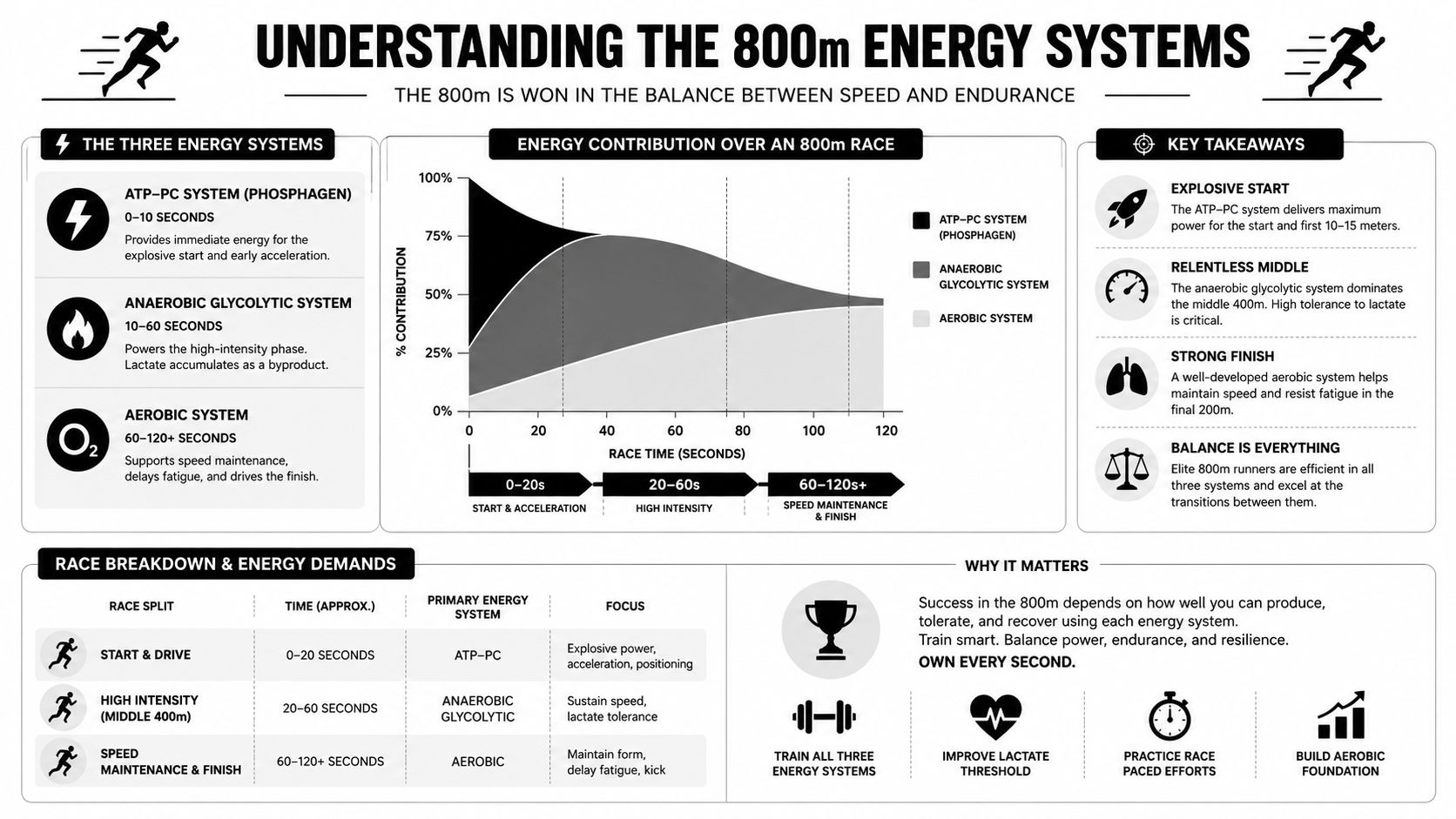
For a two-minute elite performance, the event is commonly estimated at about 62% aerobic and 38% anaerobic contribution, as outlined by the NFHS high school and elite 800m physiology discussion. Athletes still experience the race as overwhelmingly anaerobic because the glycolytic load is high, lactate rises quickly, and mechanical breakdown is obvious. The aerobic system is doing a large share of the work anyway. It just does not feel dramatic in the same way.
That distinction changes training design.
An 800m runner needs immediate phosphagen power for the break and early acceleration, glycolytic capacity to tolerate sustained high speed, and enough aerobic development to preserve velocity once acidosis starts to interfere with stride mechanics. In practice, I want testing to confirm which of those capacities is limiting performance rather than guessing from race video alone. Cosmed gas analysis can show whether an athlete has the aerobic support to recover between hard efforts and stay economical near race pace. BodyMetrix data can help judge whether added mass is supporting force production or increasing the oxygen cost of running.
Why the race feels chaotic
The first 10 to 15 seconds are deceptive. Speed rises before ventilation and oxygen uptake fully respond, so the athlete feels fast and in control while anaerobic demand is already climbing. Then the race settles into the uncomfortable part of the event. Velocity stays high, aerobic contribution rises, and the athlete still has to pay for the opening speed.
That is why the third 200m exposes poor preparation so reliably. Athletes who lack aerobic support lose posture and rhythm there. Athletes who lack speed reserve can stay tidy but cannot respond to a squeeze. The symptom looks similar from the stands. The fix is different.
Use a simple athlete-facing model:
- Win the first acceleration without overspending.
- Hold rhythm at a high metabolic cost.
- Protect mechanics when acidosis peaks.
A useful companion read on why hard running becomes metabolically punishing is sugar-hungry exercise explained. It helps athletes understand why high-lactate work feels so different from steady endurance training.
Practical rule: If an athlete describes the 800m only as speed or only as endurance, the training plan is probably too blunt.
Turning physiology into split targets
One practical starting point is the familiar 400m-based estimate noted earlier in the NFHS discussion. Add roughly 10% per lap to the athlete's open 400m best, then check whether training and testing support that prediction. It is a screening tool, not a prescription.
The prescription comes from the full profile. If an athlete can run fast fresh but cannot repeat quality 300s without sharp split decay, glycolytic tolerance and aerobic support both need attention. If blood lactate after race-pace work is high but running mechanics stay stable, the athlete may be fit enough metabolically and still need more speed reserve. If a Cosmed assessment shows a modest ceiling but good economy, I will usually protect some top-end work while raising aerobic power. If BodyMetrix shows body mass dropping during a heavy block, I want to know whether relative power improved or whether we just traded resilience for a lighter number.
Coaching gets sharper when those pieces are connected. An athlete with a strong 400m profile but weak threshold markers needs different work than an athlete with average speed and excellent aerobic support. That is why understanding anaerobic threshold in practical terms matters for the 800m. It helps coaches set sessions that target the primary limiter, not just produce fatigue.
Two athletes can run the same 800m time through very different physiology. Good coaching identifies which engine is carrying the performance, which one is failing late, and how to train the gap.
Mastering Pacing and Race Day Tactics
The 800m is often decided before the bell, but not because the first lap should be frantic. It's because the runner who controls position early gets to spend the rest of the race running their line instead of reacting to everyone else's.

The best evidence-backed pacing model for elite racing is the positive split. Elite 800m races predominantly use a first lap that is 2 to 5 seconds faster than the second. Speed-type runners also produce the fastest early 200m splits, helping them secure forward positions, while pacing control from 400m to 600m shows the strongest relationship with overall personal bests, with r > 0.8, according to TrackStar USA's 800m pacing analysis.
Why positive splits keep winning
A positive split works because the event punishes delayed commitment. If you try to run the opening lap too conservatively, you often create three problems at once: poor position, extra lateral movement, and a forced surge later when fatigue is already rising.
That doesn't mean “blast the first lap.” It means opening assertively enough to establish control. The difference matters.
Use this race logic with athletes:
- The first 200m is for placement. You're trying to avoid traffic and establish a clean stride pattern.
- The second 200m is for settling. Smart runners stop forcing and start carrying pace at this stage.
- The third 200m decides the race. Athletes who panic here usually overstride or surge unnecessarily.
- The final 200m rewards whoever stayed most economical under pressure.
Position first then rhythm
In crowded races, being boxed in is rarely a matter of bad luck alone. It usually starts with indecision. The athlete who drifts instead of committing often gets trapped on the rail or stranded wide.
That's why I coach the break line as a skill, not a detail. Runners need to know whether they're fighting for the front, tucking just off the lead, or deliberately staying clear of congestion. Passive positioning is expensive.
If your athlete reaches 300m feeling surprised by where they are, the tactical error happened earlier.
A few race-day rules work consistently:
- Commit to the first move: Don't wait for the field to sort itself out.
- Protect stride length: Short choppy steps through traffic cost rhythm.
- Don't chase every surge: Many mid-race moves are emotional, not efficient.
- Launch the finish from posture: A strong kick starts with mechanics, not desperation.
What doesn't work is coaching “even effort” without context. In practice, the athlete must absorb the early speed of the race, then control the middle without fighting it. That's very different from splitting each segment identically.
Structuring an Annual Training Plan
Most 800m athletes get into trouble when the whole year starts to look like race season. Too much specific work, too early, leaves them stale. Too much general work, too late, leaves them unprepared for the pace and violence of actual racing.
A good annual plan gives each phase one dominant job. The athlete can still touch other qualities, but one quality should lead.
Base phase building the engine
The base phase is where you build work capacity, aerobic support, and movement resilience. The mistake here is making everything slow. Base training for 800m runners should improve aerobic function without stripping away coordination and elasticity.
This is also the right phase for broad strength development, technical drills, and honest assessment of mechanics. If the athlete can't hold posture under moderate fatigue in training, they won't hold it at race pace.
Useful priorities in this phase include:
- Aerobic development: Controlled runs, threshold-oriented work, and repeat efforts that teach rhythm.
- General strength: Lifting, medicine ball work, and trunk stability that supports running shape.
- Mechanical economy: Drills, strides, and submaximal speed exposure.
Build phase raising race specificity
The build phase introduces more event-specific stress. Sessions should start to resemble the metabolic and mechanical demands of the race, but not every workout should feel like an 800m test.
Many coaches overcook lactate sessions at this point. One demanding speed-endurance workout can be productive. A week full of them usually ruins quality and teaches the athlete to train tired rather than race well.
A better approach is to layer specificity:
- Add race-pace repetitions with enough recovery to protect mechanics.
- Keep one aerobic support session so the athlete doesn't become one-dimensional.
- Maintain short speed work so top-end coordination stays alive.
If you're using objective testing across the season, this is the point where VO2 max measurement in applied settings becomes useful for confirming whether the aerobic side is keeping pace with the specific work.
Peak phase sharpening without flattening
Peaking for the 800m isn't about doing less of everything. It's about removing what creates unnecessary fatigue while preserving speed, confidence, and race rhythm.
The final phase should leave the athlete feeling dangerous, not dull. Sessions become shorter, sharper, and more specific to race execution. Recovery matters more, but so does preserving exposure to pace.
The athlete should arrive at the line feeling underworked for one day, not overworked for six weeks.
What doesn't belong here is last-minute panic volume. Coaches sometimes chase fitness late because the athlete looks flat in training. In the 800m, flatness is often a recovery issue, not a sign that more work is needed.
Sample 800m Workouts for Every Level
The best 800m sessions are specific to the athlete in front of you. A novice needs rhythm and restraint. A collegiate runner often needs better tolerance to race pace. An elite athlete usually needs precision, not novelty.
That's why the same session can be excellent for one runner and destructive for another. The question isn't whether a workout looks hard. The question is what adaptation it's supposed to produce.
How to choose the right session
Use three filters before assigning any workout:
- Current limiter: Is the athlete lacking speed reserve, aerobic support, or race-specific tolerance?
- Training age: Can they execute pace and recovery correctly, or will the session become guesswork?
- Recent load: Hard workouts only work if the athlete arrives able to run them properly.
A coach should also adjust by response, not ego. If the athlete's mechanics collapse halfway through the key set, the session has usually gone past productive stress.
Good 800m workouts create information as well as fitness. You should learn something from how the athlete completes them.
Sample Weekly 800m Training for Different Levels
| Ability Level | Key Workout 1 (e.g., Speed Endurance) | Key Workout 2 (e.g., VO2 Max) | Supporting Session (e.g., Tempo/Strength) |
|---|---|---|---|
| High school novice aiming around sub-2:20 | 6 x 200m at controlled fast pace with full attention to form and recovery | 4 x 400m at sustainable rhythm, teaching pace judgment rather than racing every rep | Short tempo run, drills, and basic strength work |
| Competitive collegiate athlete aiming around sub-1:55 | 5 to 6 x 300m at race-relevant pace with enough recovery to hold mechanics | 4 to 5 x 600m at demanding but controlled effort | Threshold session plus gym strength and strides |
| Elite or professional aiming around sub-1:46 | Split runs such as 500m plus 300m, or 300m plus 300m plus 200m, with precise recoveries | Longer aerobic power intervals that support the ability to recover between surges | Short speed session with fast relaxed 120m to 150m repetitions and high-quality lifting |
For the novice athlete, the biggest gain usually comes from removing wasted effort. They need to learn pacing, posture, and relaxation under discomfort. Sessions should be challenging, but they shouldn't mimic elite suffering. Too much intensity too early teaches fear of the event.
For the collegiate runner, speed endurance often becomes the hinge point. They may have enough raw fitness to run well in controlled time trials but not enough tolerance to hold pace through the third 200m in a real race. Work at 300m and 600m distances becomes valuable at this stage, provided recoveries are long enough to protect quality.
For the elite athlete, specificity becomes narrow. The coach is often solving small problems: drifting in the second 200m, overstriding at the bell, or failing to change gears off a tactical slowdown. Their sessions need clean intent. The point isn't to impress observers. The point is to sharpen the exact quality that wins races.
A few practical modifications work across levels:
- Shorten the rep when mechanics are the priority.
- Extend the recovery when quality matters more than density.
- Use split runs when the athlete needs race-specific discomfort without one long breakdown rep.
- Insert strides after aerobic sessions if leg speed is fading during heavy weeks.
What doesn't work is copying championship training without championship prerequisites. An athlete who hasn't earned volume, speed, or technical control won't benefit from elite-style complexity.
Using Performance Data to Guide Coaching
Good 800m coaching gets sharper when each test answers a coaching question. The event sits in an awkward physiological middle ground, so broad labels like "speed-based" or "aerobic" are rarely enough. I want to know why the athlete ties up at 500m, why race pace looks controlled in training but collapses under pressure, and whether the limiter is aerobic support, glycolytic cost, mechanics, or simple pacing error.

That is the practical value of applied sports science in the 800m. Testing should reduce guesswork, not add paperwork.
A Cosmed metabolic analyser helps separate two problems that often look identical from the stands. One athlete fades because oxygen uptake kinetics and aerobic support are weak relative to race demand. Another fades because they can reach the pace but pay too much anaerobic cost to hold form through the final 200m. Those athletes should not receive the same session prescription, even if they both "die late."
A BodyMetrix ultrasound adds useful context if you use it with restraint. It can track body composition and site-specific tissue changes across a training block, which helps when you are managing power-to-mass ratio, recovery quality, and readiness during high-load phases. Used well, it informs decisions about load, fuelling, and strength support. Used poorly, it distracts the athlete from performance.
A useful testing framework for the 800 meter race usually includes four parts:
- Metabolic profiling: Identifies VO2 response, substrate use trends, and the aerobic contribution supporting race pace.
- Lactate validation: Checks whether threshold estimates and special endurance paces match the athlete's field response.
- Body composition tracking: Adds context for force production, fatigue resistance, and seasonal weight shifts.
- Track-to-lab comparison: Verifies whether laboratory markers hold up in real sessions, with real recoveries and real pacing stress.
A reliable blood lactate test kit for field use helps compare lab values with session response on the track. That matters because 800m coaching breaks down when training zones look tidy on paper but drift under race-specific fatigue.
For a sub-elite runner, I keep the model simple first. Test threshold, check lactate accumulation against target pace, and compare that with split quality across repeat efforts. If the athlete cannot clear or tolerate the metabolic cost of planned race pace, the answer is not motivational language. The answer is to adjust the demand, then rebuild.
For elite runners, the margin is smaller and the questions are narrower. I am often looking at repeatability of race pace after controlled recovery, the oxygen cost of pace changes, and whether mechanics degrade before the chemistry does. Small shifts in economy or lactate response can justify a meaningful change in session design, especially during competition blocks.
The trade-off is straightforward. More testing gives more precision, but only if the coach knows what decision the test will change. If a measure does not alter pacing targets, workout density, recovery prescription, or race modeling, it is noise.
Data should narrow the coaching decision, not replace it.
Synthesizing Data with the Art of Coaching
The best 800m programmes don't choose between instinct and measurement. They combine them. The stopwatch tells you what happened. Physiological testing helps explain why it happened. Coaching judgment decides what to do next.
Why data matters most in messy environments
Indoor racing is a good example because it exposes how imperfect race settings can be. Academic studies cited in a 2025 Journal of Sports Sciences discussion reported that unpaced athletes fade 4.2 seconds more on indoor tracks because of variables such as air quality and CO2 buildup affecting ventilation, and that pre-race physiological testing with Cosmed K5 analysers can help address that gap, according to this indoor 800m analysis reference.
That matters because coaches often blame the athlete for what the environment helped create. Tight turns, variable air, and tactical congestion distort pacing decisions. If you don't measure anything, you're left guessing whether the athlete lacked fitness, judgment, or a clean physiological platform.
The art of coaching still matters most on race day. You still need to read posture, confidence, composure, and competitive instinct. But data gives that art sharper edges. It helps you separate a training problem from a pacing problem, and a pacing problem from a context problem.
The future of 800m coaching isn't more complexity for its own sake. It's better precision. When validated tools support clear coaching decisions, athletes stop training on hope and start training on evidence.
Cartwright Fitness supports coaches, physiologists, clinics, and performance facilities that want that kind of precision in everyday practice. If you need validated tools for metabolic testing, body composition assessment, step testing, and field-based performance evaluation, explore the specialist range and expert support available at Cartwright Fitness.